Greenhouse Goes Up in Redwood

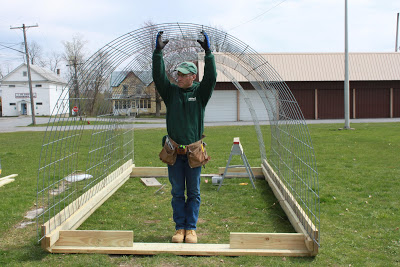
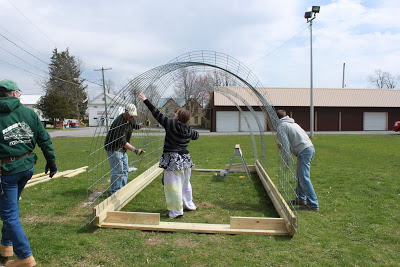
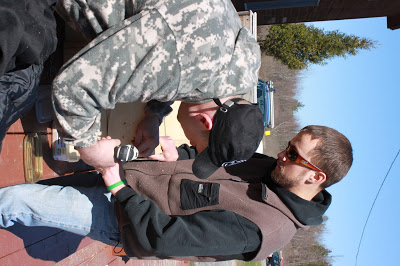
Redwood Neighborhood Association Vice President Jim Stine holds the metal greenhouse arch in place.
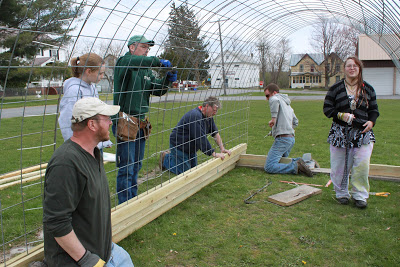
Members of the Redwood Neighborhood Association met last Saturday at the Redwood Volunteer Fire Department to construct a community greenhouse for the public.

With funds secured from the local not-for-profit Hearts for Youth, the neighborhood group's plan was to build a structure to house seedlings and plants for the community. Local residents interested in participating can sign up to help tend the plants, with all excess produce going to the local food pantry.


At the commissioners' meeting at the fire hall April 10, I presented the idea of the greenhouse being put on that property. The group voted unanimously in favor of providing the host site for the greenhouse.

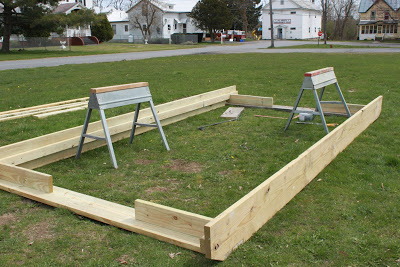
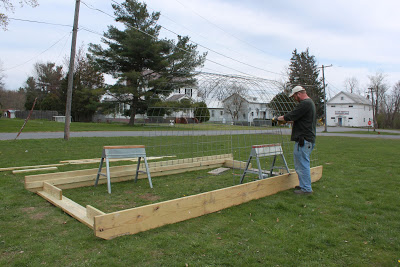
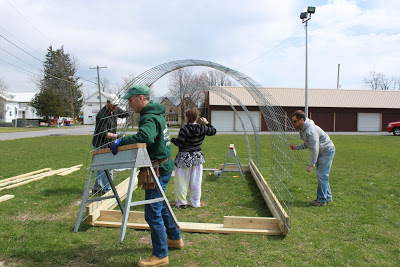
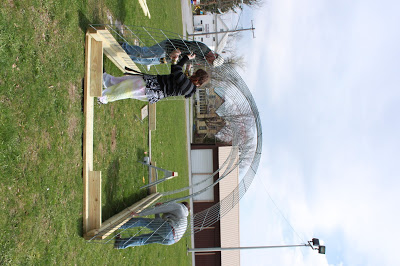
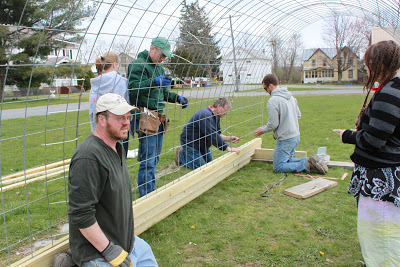
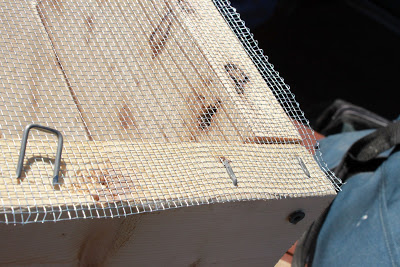
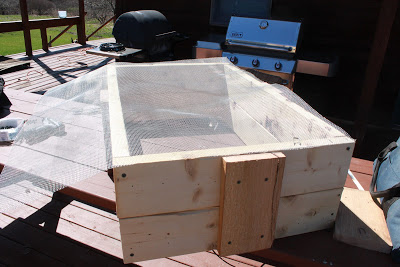
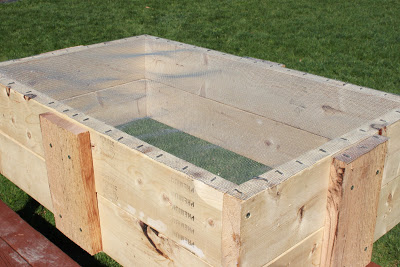
Here are some shots of the construction (thanks to Rick Lopez for the design, Jim Stine for donating some of the materials, and the Better Farm crew for lending a hand!):


All that's left to do are the doors and the greenhouse plastic. Want to get involved, as a volunteer or gardener? Shoot us an e-mail or call (315) 482-2536. And stay tuned for an upcoming announcement on our planting day!
Comment

Nicole Caldwell

Nicole Caldwell is a self-taught environmentalist, green-living savant and sustainability educator with more than a decade of professional writing experience. She is also the co-founder of Better Farm and president of betterArts. Nicole’s work has been featured in Mother Earth News, Reader’s Digest, Time Out New York, and many other publications. Her first book, Better: The Everyday Art of Sustainable Living, is due out this July through New Society Publishers.

The Worms Have Arrived!

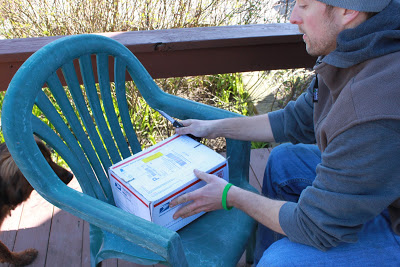
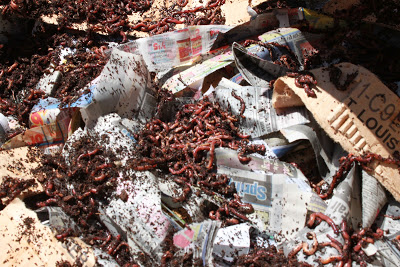
Ten thousand worms arrived this morning via Priority Mail from Uncle Jim's Worm Farm and The Worm Ladies of Charlestown. Their function? To do all the dirtiest work in Better Farm's new compost initiative, which takes food waste from local grocers and turns it into fertile potting soil.

Our on-site composter extraordinaire, Matt Smith, was like a little kid on Christmas morning. Here he is, about to open the first box of worms:

Worm Advisory!
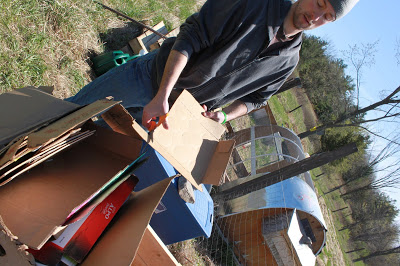
We went out to the bins Matt and Nick built two weeks ago to get them ready for their new residents. First step? To shred cardboard and newspaper so the worms have a nice, cozy bedding setup (thanks to Redwood's own Knorr's Grocery and Felder's Service Station for giving us their scrap cardboard and newspaper):


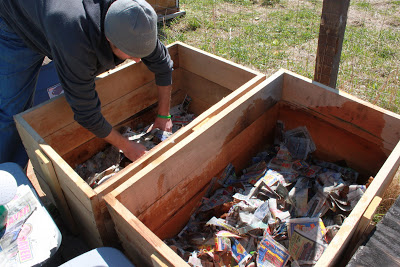
Then Matt watered the bedding so it was damp, like a wrung-out rag:

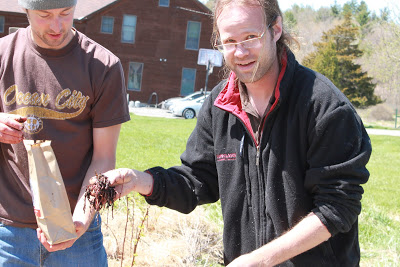
Onto the bedding went the worms (we could have used gloves for this, but what fun would that be?):
Former artist-in-residence Brian Purwin gets his hands dirty.


We sprinkled in a little dirt:

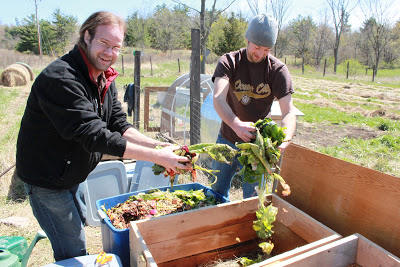
Then it was time to give the worms the biggest buffet of their lives. Here's some of the food waste Matt's been collecting:

Here are Brian and Matt feeding the worms:


We filled the bins about halfway up so as to not overwhelm the tired, hungry, thirsty worms who've spent the last three or four days in transit:

This puts us about six weeks away from having our first batch of fresh potting soil and worm-casing fertilizer. Stay tuned for results!

Thanks to the following businesses for partnering with Better Farm on this project and allowing us to stop in each week to load up on food for our worms. Their willingness to participate is keeping tons of food waste out of landfills:
Alexandria Bay Big M Supermarket
The Mustard Seed in Watertown
Great American Food Stores in Watertown 
North Star Restaurant in Alexandria Bay
Comment

Nicole Caldwell

Nicole Caldwell is a self-taught environmentalist, green-living savant and sustainability educator with more than a decade of professional writing experience. She is also the co-founder of Better Farm and president of betterArts. Nicole’s work has been featured in Mother Earth News, Reader’s Digest, Time Out New York, and many other publications. Her first book, Better: The Everyday Art of Sustainable Living, is due out this July through New Society Publishers.

Clayton Food Co-op Seeks Vendors, Members, Local Goods

Image from the Cooperative Development Institute.
The brand-new Clayton Food Co-op, opening May 15 at 226 James St., is seeking participation from area farmers, bakers, and members.

A cooperative is a business owned and managed by its members. As locally owned businesses, co-ops are committed to the people they serve and the communities in which they live. To join the Clayton Food Co-op, there is a one-time capital share payment of $150. Annual renewable membership is $35. Member-owners have the benefit of special ordering food items from our supplier's vast catalog at a 10-15% discount.  Many items are local, many are certified organic. The catalog item list may be accessed on the group's Member-Owner Only Page.
As a member-owner you belong to an organization that strives to sustain the environment, the economy and our community. The Clayton Food Co-op actively supports local agriculture, food producers and general products.

Member-owners have a voice in what is sold, as well as in the overall organization of the co-op. Member-owners get the most buying power for their money and the money stays in the community, contributing to its strength.

The co-op is seeking vendors with local, natural, fresh produce, baked goods, food, meat, dairy, honey, soaps, personal care items, and more. Click here to learn more or sign up for the vendors' open house Tuesday, May 1. We hope to see you there!

Those interested in selling their homegrown or homemade goods through the co-op are encouraged to e-mail claytonfood@gmail.com or call (315) 775-8087. To sign up for the group's newsletter, click here.
Comment

Nicole Caldwell

Nicole Caldwell is a self-taught environmentalist, green-living savant and sustainability educator with more than a decade of professional writing experience. She is also the co-founder of Better Farm and president of betterArts. Nicole’s work has been featured in Mother Earth News, Reader’s Digest, Time Out New York, and many other publications. Her first book, Better: The Everyday Art of Sustainable Living, is due out this July through New Society Publishers.

DIY Kayak Rack

To build a storage rack for Better Farm's fleet of four kayaks and two canoes, we upcycled previously discarded items we found on the property: leftover 4x4s from building the garden fence, scrap 2x4s, and miscellaneous decking screws found in the tool shed.

The design plan was simple. We decided to stand four 4x4s up with four cross-beams. Four shorter pieces of wood were used to connect the whole structure together.

Materials:
Four 4x4 posts, at least 6 feet long
Four 2x4 boards, cut to 11 feet
Four 2x4 boards, cut to 3 feet
Decking Screws (3 inches)
Drill
Tape measure
Pencil
A friend to help stand the structure up 

Instructions:
1. Measure up 8 inches from the bottoms of your 4x4s and draw a line. Lay one 2x4 across two of your 4x4s (flush against the line), making sure there are 3.5 feet between the 4x4s. Repeat on second set of 4x4s. This will be your bottom shelf for your boats.

2. Measure up 2.5' from top of 2x4 and draw another line on your 4x4s. Screw another 2x4 to your 4x4s, flush against the line. The structure should look like a tic tac toe board:

3. With the help of a friend, stand the two structures up facing each other (2x4s on the outside of the 4x4s). Connect the two structures with your your shorter, 3' 2x4s. Screw the shorter boards to the insides of the 4x4s:

4. Fill the rack!


Got a great DIY project you'd like to share? Send it to us at info@betterfarm.org.
2 Comments

Nicole Caldwell

Nicole Caldwell is a self-taught environmentalist, green-living savant and sustainability educator with more than a decade of professional writing experience. She is also the co-founder of Better Farm and president of betterArts. Nicole’s work has been featured in Mother Earth News, Reader’s Digest, Time Out New York, and many other publications. Her first book, Better: The Everyday Art of Sustainable Living, is due out this July through New Society Publishers.

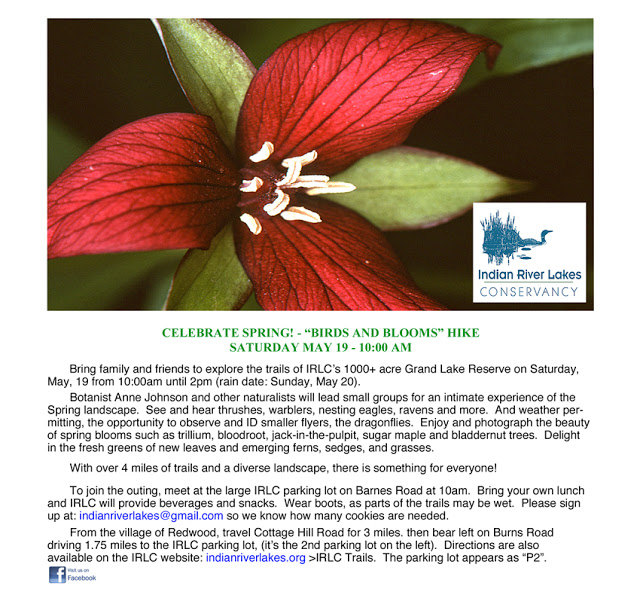
'Birds and Bloom' Hike Set May 19

Comment

Nicole Caldwell

Nicole Caldwell is a self-taught environmentalist, green-living savant and sustainability educator with more than a decade of professional writing experience. She is also the co-founder of Better Farm and president of betterArts. Nicole’s work has been featured in Mother Earth News, Reader’s Digest, Time Out New York, and many other publications. Her first book, Better: The Everyday Art of Sustainable Living, is due out this July through New Society Publishers.

DIY Guide to Screen and Storm Doors

1 Comment

Nicole Caldwell

Nicole Caldwell is a self-taught environmentalist, green-living savant and sustainability educator with more than a decade of professional writing experience. She is also the co-founder of Better Farm and president of betterArts. Nicole’s work has been featured in Mother Earth News, Reader’s Digest, Time Out New York, and many other publications. Her first book, Better: The Everyday Art of Sustainable Living, is due out this July through New Society Publishers.

Nature Center Clean-Up Set May 5

Comment

Nicole Caldwell

Nicole Caldwell is a self-taught environmentalist, green-living savant and sustainability educator with more than a decade of professional writing experience. She is also the co-founder of Better Farm and president of betterArts. Nicole’s work has been featured in Mother Earth News, Reader’s Digest, Time Out New York, and many other publications. Her first book, Better: The Everyday Art of Sustainable Living, is due out this July through New Society Publishers.

First Annual Artists' Studio Tour Slated May 26 & 27

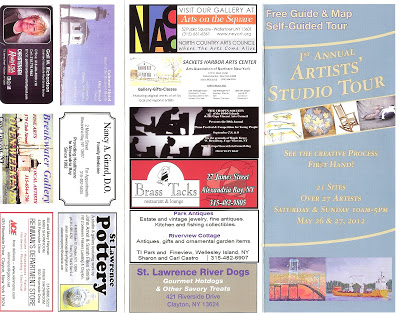
Map of the First Annual Artists' Studio Tour
betterArts' gallery space and studio will be featured during the First Annual Artists' Studio Tour, scheduled from 10 a.m.-5 p.m. Saturday and Sunday, May 26 and 27.

Functioning much like a wine tour, a free brochure includes an easy-to-follow map and brief description of more than 27 artists and 21 studios along the tour. The self-guided studio tour will allow the public to see  the creative process in action at artist studios in Alexandria Bay, Redwood, Wellesley Island, Town of Orleans, Clayton, and Cape Vincent.

Here's the brochure (to find out where you can get yours, e-mail Robert Hedden at heddenrpsr@yahoo.com): 

In conjunction with that studio tour, betterArts will host an Open House and Fundraiser from 10 a.m.-8 p.m. Saturday, May 26.

All money raised at this event will directly fund betterArts' summer workshop series and aid creative outreach efforts in the North Country.

The Open House will feature live music and performances, interactive art projects, information on our artist residency program and upcoming workshops, arts and crafts stations, a gallery exhibit of work by local and visiting artists (which will be part of the First Annual Artists' Studio Tour), raffles, and barbecue. A cash bar will also be available. Entrance is free and open to the public. All ages are welcome.

Visitors can also tour the full grounds of Better Farm, step inside green buildings and learn about construction methods, check out the organic gardens, and meet Better Farm's staff.

Overnight accommodations, including tent camping, is available. You can make a reservation by clicking here.

For more information or to volunteer, e-mail info@betterarts.org. For more information about Better Farm and betterArts, visit www.betterfarm.org and www.betterarts.org.
Comment

Nicole Caldwell

Nicole Caldwell is a self-taught environmentalist, green-living savant and sustainability educator with more than a decade of professional writing experience. She is also the co-founder of Better Farm and president of betterArts. Nicole’s work has been featured in Mother Earth News, Reader’s Digest, Time Out New York, and many other publications. Her first book, Better: The Everyday Art of Sustainable Living, is due out this July through New Society Publishers.

Occupy Watertown Training Session This Thursday

 Posted by Occupy Watertown
"The 99% Spring", a free education and training course designed to educate people about the Occupy Movement in the North Country, is set from 4:30-8 p.m. this Thursday, April at the Flower Memorial Library in Watertown.

People living in the North Country are invited to join in solidarity to share, learn, and take action to keep this movement growing, diversified, and leaderless.

This is a FREE education and training campaign on how individuals can use non-violent, direct action and coordinated community campaigns to create a new movement that addresses specific needs, resources, and well-thought out intentions; to develop a peoples-driven economy and voice of reason.

99% SPRING TRAINING GOALS
  • To form a local community of people committed to non-violent direct action to forge a more just economy.
  • To use storytelling as a means to find commonalities and connections as a method of creating solidarity.
  • To analyze the past in order to understand how we got here.
  • To create a vision for a new, more just economy.
  • To prepare personally and as a community for nonviolent direct action.
This is the first stage of the largest-developing North Country peoples movement for economic justice, sustainable development, and social equality.

Watch the YouTube video by clicking here.

To learn more visit www.the99spring.com. Sign up for Thursday's education seminar by clicking here.
A participant guide is available here.
The Flower Memorial Library is located at 229 Washington St. in Watertown, N.Y.
Comment

Nicole Caldwell

Nicole Caldwell is a self-taught environmentalist, green-living savant and sustainability educator with more than a decade of professional writing experience. She is also the co-founder of Better Farm and president of betterArts. Nicole’s work has been featured in Mother Earth News, Reader’s Digest, Time Out New York, and many other publications. Her first book, Better: The Everyday Art of Sustainable Living, is due out this July through New Society Publishers.

Earth Day Events Set for April 21 in the North Country

This year, you can help out on Earth Day with a neighborhood clean-up, upcycling project, commitment to eat more local, sustainable food, by signing a few petitions or volunteering for some outreach advocacy projects, or simply by stopping in at an Earth Day festival to learn more about the  environmental issues affecting you now. Whatever you choose to do, the North Country is rich with environmental events scheduled April 21.

Here are three activities that are sure to have you busy all day:
  • Redwood Clean-Up     Better Farm, in conjunction with the Redwood Neighborhood Association, will be hosting an annual Earth Day cleanup in downtown Redwood in an effort to help beautify the neighborhood. Interested parties are to meet at the pavilion downtown (behind Felder's) at 10 a.m. and wear appropriate footwear (and gloves if desired). Bags will be provided. Groups will disperse among side streets and trails (adults will also cover either side of Route 37). A picnic lunch will follow in the pavilion. Email us for more information or to register.
  • Earth Day Event in Watertown     The Mustard Seed Natural Market will host its Sixth Annual Earth Day Event on Arsenal Street in Watertown from 10 a.m.-5 p.m. Event highlights include a kids' craft table sponsored by Better Farm featuring environmentally friendly craft projects utilizing upcycled household items; and a "how-to" composting display sponsored by Better Farm. There will also be plenty of free samples from Liberte Yogurt, Field Roast Sausage, Tofurkey, Shirataki Noodles, Mu Mu Muesli, and more. Click here to learn more.
  • Third Annual Green Fest Expo     The Green Fest is set from 12-2 p.m. at Cerow Park Arena in Clayton and features vendors and exhibitors who relate to the five zones of local sustainability: eating, shopping, powering, moving, and acting locally. There will also be residential and commercial energy workshops, a health and wellness fair, volunteer fair, kids' bike rodeo, and more! Click here for additional information.
Comment

Nicole Caldwell

Nicole Caldwell is a self-taught environmentalist, green-living savant and sustainability educator with more than a decade of professional writing experience. She is also the co-founder of Better Farm and president of betterArts. Nicole’s work has been featured in Mother Earth News, Reader’s Digest, Time Out New York, and many other publications. Her first book, Better: The Everyday Art of Sustainable Living, is due out this July through New Society Publishers.

Why Organic?

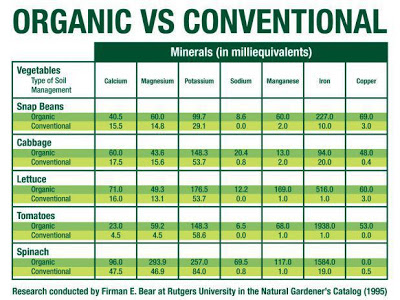
The nutritional advantages of going organic.
When you're selecting produce for you and your family to eat, how often do you pick out generic fruits and veggies in order to save a little money?

What’s the difference between the shiny red apple in your right hand, and the identical organic red apple in your left? Is the organic apple healthier? With all the hooplah over organic foods—sales in the United States jumped from $23 billion in 2002 to $40 billion in 2006—and their increased availability, it’s worth knowing what makes them different from your average Granny Smith apple or Sunkist orange before you put them in your shopping cart.


Organic butter at a GreenWise store in Palm Beach Gardens, FL. Organic food is criticized for its cost, but it contains no pesticides, and farmers must follow environmental standards to become certified.
SOURCE: AP/Luis M. Alvarez

If you're growing your own produce, expect to pay a little more for organic—but also expect a great return. With a packet of of seeds costing roughly $3.50, consider that your yield will be pounds and pounds of produce that would normally cost you roughly $3.50/pound in the supermarket. Even though the price-per-seed-packet is more than you'd pay for generic, consider the nutritional and environmental advantages of going organic (and keep in mind the money and resources you're saving by starting from seed).

From the Center for American Progress:

What does “organic” mean?
Organic refers to how farmers grow and process food. Organic farming methods differ from conventional farming in several ways:
  • Conventional farming uses chemical fertilizers to promote plant growth, while organic farming employs manure and compost to fertilize the soil.
  • Conventional farming sprays pesticides to get rid of pests, while organic farmers turn to insects and birds, mating disruption, or traps.
  • Conventional farming uses chemical herbicides to manage weeds, while organic farming rotates crops, hand weeds, or mulches.
  • When raising animals, conventional farmers give animals antibiotics, growth hormones, and medications to spur growth and prevent disease. Organic farmers feed their animals organic feed and allow them to roam. They also will make sure the animals have a balanced diet and clean housing.
The U.S. Department of Agriculture certifies organic products according to strict guidelines. Organic farmers must apply for certification, pass a test, and pay a fee. It’s important to note that this means not all organic foods become certified, even though all certified food is organic.

If you pick an item off the shelf and see the “USDA Organic” label, it means that at least 95 percent of the food’s ingredients were organically produced. The seal is voluntary, but many organic producers use it. Products that are 100 percent organic are labeled as such and given a small USDA seal. Some product labels may also state that the product was “made with organic ingredients,” which means the product contains at least 70 percent organic ingredients.

Is organic better?
Shoppers may choose organic foods for a variety of reasons. There are certainly environmental reasons to go organic. According to USDA guidelines, organic farming practices are designed to reduce pollution and conserve water and soil. They do not release synthetic pesticides, which can harm wildlife, and they also seek to preserve biodiversity and local ecosystems.

Many people choose organic foods to avoid any risks associated with the pesticides, herbicides, and other chemicals used in conventional farming. Parents may be concerned that exposure to these chemicals might harm the development of their children, and therefore they choose organic. Studies appear to support the fact that organic diets lower children’s exposure to pesticides.

As for organic food being healthy, some studies, including one at UC Davis, have demonstrated higher amounts of nutrients in some varieties of organic foods. Another study from Newcastle University in England showed organic milk contained 67 percent more vitamins and antioxidants, as well as more Omega-3s and Omega-6s (“healthy” fat) than conventional milk. Organic foods do not contain any additives or preservatives, and are not genetically modified. And when you buy organic, you’re also bypassing antibiotics and hormones given to animals in conventional methods, added to the fact that these animals are also treated in a more respectful and humane way under organic standards.

Controversy exists over whether all organic foods carry substantial benefits over their counterparts—organic onions, for example, might not be much different from their conventional cousins when it comes to health benefits—but in all cases, organic means the foods were grown on farms with USDA guidelines. 

Why it costs more
The biggest criticism of organic food is its cost. There are several reasons it’s more expensive. Organic farmers pay more for organic animal feed, and the farming is more labor intensive, since farmers avoid chemical fertilizers and pesticides. Because farmers don’t use herbicides, for instance, they rely more on hand weeding. And since they avoid chemical fertilizers, they use compost and animal manure, which is bulkier and more expensive to ship. This also means their crop yield is usually lower. Conventional farming also uses every acre of farmland to grow crops, while organic farmers rotate their crops to keep soil healthy.

All of these production costs mean organic farming tends to be more expensive than conventional farming, and this is reflected in how much you pay at the grocery store. However, when you take into account the true “cost” of food production from conventional farming, including replacement of eroded soils, cleaning up polluted water, health care for farmers who get sick, and environmental costs of pesticide production and disposal, organic farming might actually be cheaper in the end.

Probably the most “green” way to acquire your weekly provisions is through a local farmer’s market. The food travels a shorter distance, which means less carbon emissions and food that hasn’t been shipped hundreds of miles or processed to keep it preserved during transport. The food comes from small farms where the farmers are usually conscious of their impact on the earth and care about the food they’re producing. By purchasing food from them, you also support the local food economy and know where your food is coming from. According to the Center for Urban Education about Sustainable Agriculture, food in the United States travels an average of 1,500 miles to make it to your refrigerator. Why take an apple off the truck when you’re a step away from plucking it off the tree?

Comment

Nicole Caldwell

Nicole Caldwell is a self-taught environmentalist, green-living savant and sustainability educator with more than a decade of professional writing experience. She is also the co-founder of Better Farm and president of betterArts. Nicole’s work has been featured in Mother Earth News, Reader’s Digest, Time Out New York, and many other publications. Her first book, Better: The Everyday Art of Sustainable Living, is due out this July through New Society Publishers.

Building With Bottles

Bottle Jug House

We've been brainstorming design ideas for a new structure to sit alongside the Birdhouse and greenhouse next to Better Farm's main garden. The long list of possibilities has been narrowed down to two: an earthship made from reclaimed tires, or a small cottage made entirely out of glass bottles and mortar.
To build a basic wall out of glass bottles, you lay the items out like bricks and use mortar between the rows. For a structure, you'd need to frame out windows and ceilings.
Photo from Instructables.com

Here are some great photos we found on unusuallife.com of particularly excellent bottle construction:

Bottle-end shower
Instead of throwing those glass bottles away, many folks have wondered how to recycle and build with these ubiquitous items.
This photo show walls being constructed on a build in New Mexico by Mike Reynolds at one of his “earthships”.
Bottle Wall
Bottle Bricks
Apparently back in the 60’s Mr. Heineken came up with the idea of makeing the beer bottles and size and shape of bricks, while concerned about the about of litter and wastage beer bottles were causing. They never came to be, however.

Building with bottles has often been a choice of folk artists, early settlers and the poor in some countries, as they used whatever resources they had to build shelter. Agility Nut has a wonderful website featuring bottle houses around the world.
Airlie Gardens Bottle House
The Airlie Gardens Bottle House was created by a local artist, Virginia Wright-Frierson in 2004. It is officially named the “Minnie Evans Sculpture Garden Bottle House” after an artist/gatekeeper that worked at Airlie for many years. This bottle house is also referred to as the “chapel”. Frierson used bottles of all shapes and sizes as well as cement and chicken wire in its creation.
Riverside Chapel by Martin Sanchez
Beer Bottle Chapel created by Martin Sanchez of Riverside California
Ann’s Bottle House B&B in Arizona
Tom Kelly’s Rhyolite Bottle House
The Bottle Houses of Prince Edward Island

Stay tuned for our own plans!
1 Comment

Nicole Caldwell

Nicole Caldwell is a self-taught environmentalist, green-living savant and sustainability educator with more than a decade of professional writing experience. She is also the co-founder of Better Farm and president of betterArts. Nicole’s work has been featured in Mother Earth News, Reader’s Digest, Time Out New York, and many other publications. Her first book, Better: The Everyday Art of Sustainable Living, is due out this July through New Society Publishers.

Vermicompost Project: Update

We reported in February on an upcoming vermicompost project to be undertaken by Matt Smith at Better Farm this year.

The scope of that undertaking is to develop a low-cost vermicomposting system that is scalable for municipal and commercial use. By collaborating with local supermarkets and convenience stores to pick up their food waste on a weekly basis, Matt's goal is to utilize earthworms to break food wastes down into dirt fit for potting soil that can then be sold and distributed to the public for low-cost.

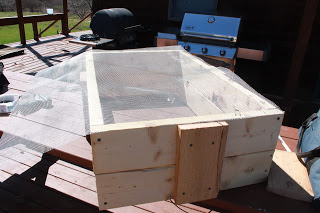
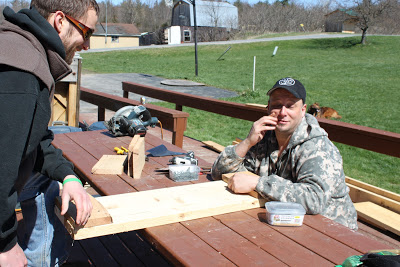
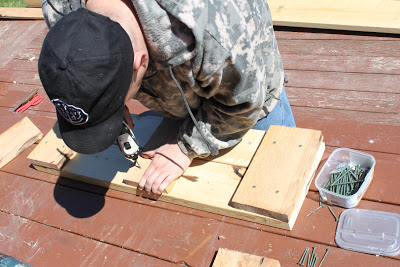
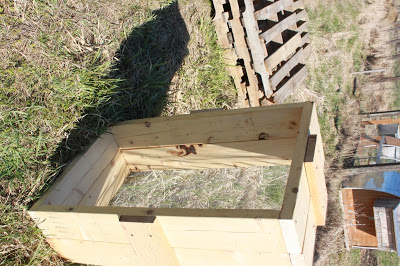
Matt got started last week with his research, and began building the compost bins. Here are photos of him and volunteer Nick Bellman putting the project together:


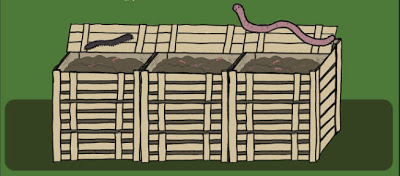
The boxes Nick and Matt built last week will function as the bottom shelf of a multi-tiered system. The finished product will look something like this:

The next step was securing businesses to donate their food waste to Better Farm. Matt made some calls and visits to places in Alexandria Bay and Watertown, N.Y. Here's our list of confirmed businesses so far:
We're expecting a few more to sign up this week. Stay tuned for more information!
Comment

Nicole Caldwell

Nicole Caldwell is a self-taught environmentalist, green-living savant and sustainability educator with more than a decade of professional writing experience. She is also the co-founder of Better Farm and president of betterArts. Nicole’s work has been featured in Mother Earth News, Reader’s Digest, Time Out New York, and many other publications. Her first book, Better: The Everyday Art of Sustainable Living, is due out this July through New Society Publishers.