
Call for Artists: 2011 Fine Art Show in Watertown
/
 |
| Brian Purwin plays violin. Photo/Erin Fulton |
 |
| Foggy River Band is from left: Brian Purwin, Nick Piccininni, Chad Darou, Liza Atkinson, Perry Cleaveland, and Jim Treat. Photo/Erin Fulton |
 |
| Raspberries growing like crazy in our raspberry patch. |
 |
| Baby Brussels sprouts |
 |
| Round two of lettuce |
 |
| Lima beans |
 |
| Our second batch of onions going strong |
 |
| Birdhouse gourds |
 |
| Soybeans |
 |
| Cabbage |
 |
| Leeks |
 |
| Celery |
<p>&amp;amp;amp;lt;p&amp;amp;amp;gt;&amp;amp;amp;amp;amp;amp;amp;lt;p&amp;amp;amp;amp;amp;amp;amp;gt;&amp;amp;amp;amp;amp;amp;amp;amp;amp;amp;lt;br&amp;amp;amp;amp;amp;amp;amp;amp;amp;amp;gt;A&amp;amp;amp;amp;amp;amp;amp;lt;/p&amp;amp;amp;amp;amp;amp;amp;gt;&amp;amp;amp;lt;/p&amp;amp;amp;gt;</p>
has launched a new
campaign to expand its programming
of free food, clothing, and educational workshops for the community by spearheading an effort to turn a third vacant lot in the Brooklyn neighborhood into a mini-farm growing organic produce and eggs.
"Bushwick City Farms is a network of open spaces run by neighborhood volunteers that provides free food, clothing and educational programs for the community," Masha, the group's founder, told us. "Centered in the heart of Bushwick, Brooklyn, the farm creates a unique opportunity to experience active models of responsible food production. In addition to the farming practices at the farm's main location, we build and help maintain vegetable gardens for local public schools, host school field trips and youth service groups, hold free beginner's English classes for speakers of other languages at a nearby location, and coordinate with local businesses to distribute bread and fresh produce donations."
The vacant lot at Stockton Street and Lewis Avenue has for 30 years harbored violence, illegal dumping, and other illicit behavior which climaxed last August with a homicide. Bushwick City Farms volunteers this April cleared the garbage, spread wood chips, and planted flowers. Their idea? To convert a negative space into a positive one that offers tangible benefits for the community. Sounds like the
if I've ever heard it.
"All help we receive is on a volunteer basis," Masha said. "All materials used are recovered from the garbage or paid for by individual donations. We collaborate with property-owners for the free availability fo their space and in turn everything that the farms provide is also free. We operate solely on a 'give what you can, take only what you need' basis.
The group's already managed to meet its $5,000 goal, but additional donations will help with programming, seeds, and the acquisition of future farm spaces. Learn more about the campaign and how you can help
.
For more information about Bushwick City Farm, visit their website at
http://bushwickcityfarm.wordpress.com
.
We were lucky enough to have staff member-at-large Tyler Howe stay full-time at Better Farm for the month of August. That meant no computer breakdowns for anyone in the house (or the hamlet of Redwood, for that matter), higher morale as we wound down the summer session of internships and artist residencies, and the ground-breaking for Better Farm's homemade, wood-burning pizza oven.
Tyler's a handy guy, but he's never built a pizza oven before; so there was a lot of research involved before he set the first spade into the ground. Any construction projects in the North Country have to take into account
, heavy winds, extreme temperature ranges, and six months (on average) of winter. Piece of cake!
To start, Tyler staked out the 6' x 6' spot on the lawn where the pizza oven would go and he (with the help of intern Soon Kai Poh) dug a couple of feet down into the ground:

Into the dug hole went drainage gravel to help combat the floodlike waters of early spring, and to secure the pizza oven's base. Then it was time to set nine 2x2 pavers down in a square:
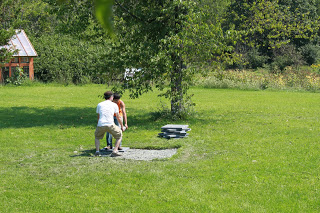

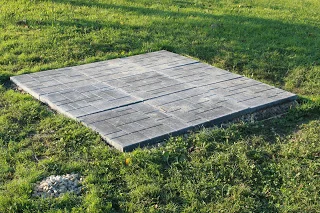
After letting them settle for a day or two, Tyler pushed some sand between the cracks and used a level to make sure the oven's bottom was sitting flat. Then it was time to build the base. This involved finding someone on Craigslist who was getting rid of a bunch of rock. This turned out to not be a problem; which makes me wonder just how different the 1970 Better Farm crew's stories might have been had they not decided to spend the better part of a week driving around in a pickup truck, collecting rocks for the addition on the house:

Putting in the library, 1970.
One trip to pick up the rocks was all it took (thanks to Jaci Collins, Eric Drasin, Soon Kai Poh, and Tyler for making that trip, and David Garlock for lending me the pickup to do the work with), and Tyler set to work piling them up into a horseshoe shape:

Han Solo and I inspect Tyler's work.

The Man.
Note the various levels of rock and sand:

To stabilize his creation, Tyler lined the inside with cinder blocks before laying down another set of pavers on top of the whole thing. The wood will be stored in the space between.
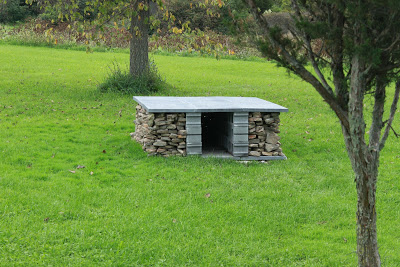
Left to do:
Lay a hearth stone on top of the pavers
Construct the dome with fire brick and mortar
Stay tuned for Part II of this project!
For more information about this project, please e-mail
.
In spite of moves throughout his term toward
and the implementation of the first
fuel-efficiency standards for heavy-duty trucks
, the president on Friday announced his decision to reverse positioning on tougher air-quality rules that some experts say would have reduced instances of premature deaths and heart attacks annually by 6,500.
The Washington Times reported Sunday that a "
." This came at the heels of the aforementioned loosening of air-quality regulations and protests last week in defiance of Obama's proposed
Keystone XL pipeline extension
:
Everyone's favorite mermaid made a Splash and got arrested in D.C. last week at an XL pipeline protest.
And of course, let's not forget the total lack of governance that contributed to one of
BP's pipes bursting under the Gulf
.
Obama's most recent turning-of-tail has to do with changing the "ozone standard", which basically breaks down the amount of parts-per-billion allowed to be released into the atmosphere by U.S. industry. Though Obama's administration previously claimed the ozone standard of 75 parts per billion (set by the
in 2008) was based on outdated science, the new standard of 70 parts per billion (which the EPA and NRDC estimate would result in 4,300 fewer premature deaths and 2,200 fewer heart attacks annually by 2020) has been nixed. Ignored. Forgotten about. In fact, Obama cited the tragic economic climate as proof that protecting the environment at the cost of American jobs was, quite simply, not worth it.
Which brings me to my rant.
In order for us to have the luxury to play games with politics (in fact, to have politics at all) and the division of power; to invent an idea of currency that is totally abstract and without any actual basis in the real world; to make wonderful inventions and to live in them as though they were as literal as the trees that grow and the wind that blows; in order to do any of these silly human things—to make civilizations and destroy them, to obsess over material gains, to build great skyscrapers and jetset and work a 9-5 job and lobby congress and to invest and gamble and win and lose...
We have to, fundamentally, be able to breathe and eat and have shelter. Before we can worry about job loss in America, or our footing in the international economy, we have to remember we're animals who have to be able to breathe and drink water and eat food. And that the more we poison those things, whether by dumping oil in the water or ignoring the toxins we emit into the air or ripping down trees for big agriculture so forests eventually turn into deserts, the closer we bring ourselves to the point of no return, literally speaking.
Yes, in a short-term way you can create big, fancy water treatment plants that will allow the richest among us to drink the best water money can buy. You can make gated communities with poisoned, treated sod and no bugs at all. You can make more and more car factories (even some within
inexplicably "green" structures
), you can farm salmon indoors, you can break apart entire mountains and make pretty bands of gold to show how in love you are. You can keep doing these things, but the One Great Truth about sustainability is that these things, done in these ways, simply can't go on forever. The system itself is unsustainable.
So the longer we choose industry over environment, jobs over air, corporate loopholes over water, well, the less sustainable we are. And the closer we come to that dreaded point of no return. Come on, Mr. President. You who would be our "Yes We Can" agent of change owe it to those who believed in you to put fundamental elements of survival over the monetary gains of private interests and some conceptual bottom line. We can't keep pushing the pesky issue of finite natural resources out of the way to keep big business happy. Doing so secures only one thing: that we're going to run out of the very things we need the most.
Just a little food for thought.
Want to get even more worked up? Recommended reading:
, by Derrick Jensen and Aric McBay.
 |
| A few hours' worth of compost from the Redwood Tavern in Redwood, N.Y. |
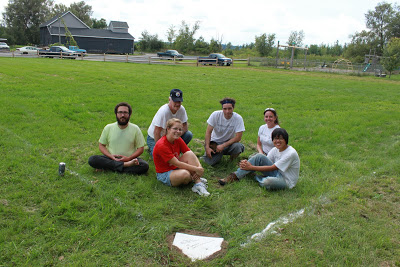 |
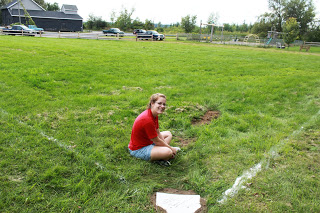
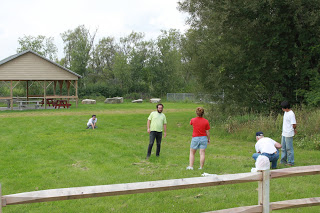
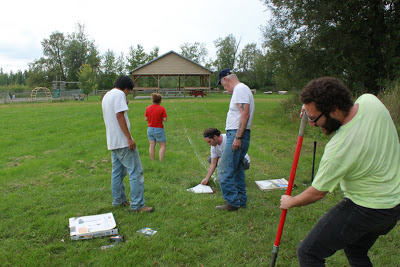
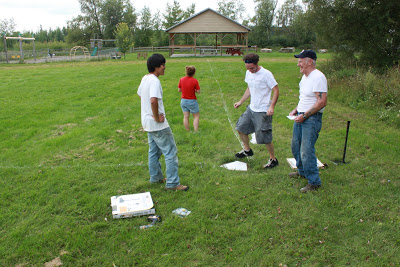
| Work crew: Thanks from left to right to Eric Drasin, Fran Farren, Erin Fulton, Tyler Howe, Nicole Caldwell, and Soon Kai Poh. |


, according to a recent announcement by New York State Agriculture Commissioner Darrel J. Aubertine.
Steve Miller, senior executive chef of Cornell University's Cornell Dining, recently outlined the new grant for me, which is designed to increase the number of B&Bs offering locally produced food and agricultural products in meals served to their guests, carrying shelf-stable local products such as jams, maple syrup and sauces, and to measure the economic impact of producers of sales made through this specialized marketing channel.
Funds, Miller said, will be used to organize regional opportunities for B&B owners to meet local producers and sample their products. "Part of the project will be to identify these two groups and make it easier for them to access each other's products and services," he said. The grant doesn't send funds directly to individual B&B operators or farmers, but rather works with producer organizations such as beef producers,
, maple producers, small-scale food processors, and B&B owners as a group.
On the other end, farmers who offer tours and other opportunities for tourists will be encouraged to work closely with B&B owners. Regional and statewide promotions will encourage consumers to partake in the foods offered by New York-based producers and B&Bs.
Producer organizations and B&B owners are encouraged to participate in the project, which starts this fall and runs two years.
Where do we sign?
For more information about this grant, e-mail Steve Miller at
or Jonathan Thomson at
 It all started simply enough back in the 1960s or early 1970s, when the crew from Better Farm crashed the Fourth of July Parade in Ridgewood, N.J., "Better" banners a-blazin' off the back of 10-wheeler. We picked things up from there in 2009, when Staciemae and I marched in the Redwood Field Days parade and tossed wildflowers to the crowd. "You ladies are lovely, but we don't know who you are!" cried the announcers when we passed that evening. That all changed last year when a bunch of us piled into the back of Butch's pickup truck, cranked a CCR album, and tossed bags of string beans to people, scoring third place in the parade. We knew we had to turn up the heat this year if we wanted to contend with the other parade floats; and in our planning we brainstormed everything from reviving the old bus on Better Farm's property to riding through town on bicycles dragging a sailboat. Plans got moved around a bit when I had to head to New Jersey for the weekend, but luckily Eric Drasin stepped up as leader with a killer crew (thank you Angelina, Soon Kai, and Tyler!). Here's what they came up with:
 |
| The precarious "doors as floor" setup on our sailboat trailer. |
 |
| Vegetable theme |


 |
| The crew (Soon Kai as photographer) |
 |
| Floats lining up in town |


Nestled deep in East Hampton, Long Island, is a gem of a farm whose sole purpose is to feed the hungry.
is a tax-exempt 501(c)(3) nonprofit organization that operates on about two acres of land at EECO Farm. Run by volunteers John Malafronte, Ira Bezoza, and Peter Garnham, it donates fresh, organic produce to local food pantries. Between May and November of 2009, the organization donated thousands of pounds of fresh vegetables to the East Hampton Food Pantry. The following year, The Food Pantry Farm more than doubled its output. The group now supplies vegetables every week to the East Hampton, Springs, and Sag Harbor food pantries.
Because all the food is given away, The Food Pantry Farm relies on donations to buy seeds, growing supplies, tools, and harvesting materials. All donations go 100-percent to support the Food Pantry Farm. For more information or to help out,
.
Get involved locally! Check with your local food pantry to see if you can drop off your extra homegrown produce for distribution.