Five Things You Can Do Right Now to Lessen Your Eco Footprint

Let's review the basic tenet of sustainability, which demands that one action be capable of going on indefinitely. Example:

Food Scraps — Chickens — Fresh Eggs and Fertilizer — Garden and Dinner Table — Food Scraps

In the above example, food scraps and free-range roaming is nourishing chickens, who provide fertilizer and food for the system supporting them. That fertilizer nourishes the plants growing in the garden, which feeds the people, who turn the food scraps back over to the birds. This system is sustainable; as long as there are an appropriate amount of chickens, food scraps, and gardens, all branches of the chain stay in business. Another example, using our aquaponics setup:

Fish in Tank — Fish Poop in Water Fertilizing Plants in Grow Bed — Plants Filter Water and Send Nutrients Back into Tank

But any system where there is more going out than coming in, or vice versa, ceases to be sustainable. Example:

Massive Drilling for Natural Resources > Heating, Fuel, etc. in Homes > No More Natural Resource

In the above example, oil or natural gas is a finite resource not being replenished at an equal rate of removal; similar to the depletion of rainforests and old-growth forests.  In sustainability, what you take needs to be replaced in order for you to take and give it all over again. So in your daily life, how much more are you taking out than putting in? Below are some quick, extremely simplistic things you can do right now that will limit what you're taking out. Next time, we'll talk about ways to put back in.

1.

Stop Using Tissue Pape

r

Paper napkins, paper towels, facial tissue, and yes, even toilet paper account for a huge amount of all trees cut down annually. As per the records of WWF, 10 percent of the 270,000 trees cut every day are used in the manufacturing of toilet

paper

. It doesn’t come as a surprise that an average American household uses more tissue

paper

than the rest anywhere in the world: The North American usage of tissue

paper

was estimated in 2005 to be 24 kg per capita which is six times higher than the global average of 3.9 kg consumption per capita. And while it's great to buy recycled tissue paper, there's still an awful lot of energy and fresh water (and, often, natural resources like fuel) going into the process of recycling. There's really no "green" way to use disposable products. Some people really go all the way with removing tissue paper entirely from their lives (

family cloth

, anyone?!), but I'm not quite there yet. How about easing into this transition with these three ideas:

  • Handkerchiefs Back in the day, Kleenex didn't exist. Everyone had handkerchiefs! Ladies and gents carried lovely, embroidered hankies, hankies of different silks and cottons, hankies of every color. King Richard II of England, who reigned from 1377 to 1399, is widely believed to have invented the cloth handkerchief, as surviving documents written by his courtiers describe his use of square pieces of cloth to wipe his nose. Certainly they were in existence by Shakespeare's time, and a handkerchief is an important plot device in his play Othello. The use of a cloth handkerchief is occasionally considered old-fashioned or unhygienic, or both, in some parts of the world, mainly due to the popularization of disposable paper handkerchiefs (talk about subversive marketing!) and the fact that they are stored in a pocket or a purse after being used. However, they are a potentially more environment-conscious choice, as cloth handkerchiefs are reusable. I don't know of a single person who has ever been made sicker by having a hanky on-hand. Try it out and see if you don't also agree they're much gentler on the face.

  • Rags Companies like Bounty have made mega fortunes off of convincing you that spills need to be picked up with soft, super-absorbent, disposable paper towels. But you know what works better than paper to pick up liquid? Fabric. Every single time. Those old, stained, ripped T-shirts, sweatshirts, towels, and sheets that you'd otherwise throw in the trash make perfect rags that you can use, wash, and reuse hundreds and hundreds of times. For cleaning windows and mirrors, crumpled-up newspaper works just as well. Ditto for absorbing oil run-off on bacon, fried green tomatoes, or deep-fried anything. Keep a pile of folded rags in a kitchen drawer, or hang a decent-looking one on a hook near the kitchen sink.

  • Cloth Napkins Whether you want to buy your cloth napkins at a store or make your own, this is such a no-brainer it's ridiculous everyone's not already made the switch. Why are cloth napkins reserved for fancy dinner parties only? You can toss your entire family's cloth napkins into the laundry pile after a meal, they take up minimum space, and it's so easy to make your own out of old clothing garments and fabric scraps, there's really no excuse not to.

2.

Stop Bagging your Purchases in Disposable Bags

I know this one gets kicked around a lot, and I know a lot of us now have more than our fair share of reusable, adorable totes with cutesie messages like "Save Our Mother"—but it still always amazes me how few people stand in line at the supermarket with reusable bags; or at the pharmacy, clothing store, or pet shop. Most commonly, people walk out of their homes without remembering to grab their totes. My suggestion: Keep three or four reusable bags in your car at all times. No car? No problem—put a hook near your front door and hang your bags there so you're always reminded to grab one (or several) on your way out.

3.

BYO Doggy Bag

Here's another big one. There's really no reason to send any food back into the kitchen at a restaurant, only for it to be tossed right in the trash. Whether you take the food home to be your leftovers, tossed to the chickens or dogs or pigs, or thrown into your compost bin, no food should ever go to waste! Up the ante by bringing your own to-go box so as to avoid the completely unnecessary, grotesquely outdated and unsustainable Styrofoam container.

4.

Get Your Feminine Hygiene Products Right

Ladies, listen up.

Landfills are over-taxed with feminine hygiene products.

In 2000, more than 55.9 million women (in the U.S. alone) were monthly users of disposable feminine hygiene products. The 41 year menstruation span (11-52 years) creates billions of pounds of disposable feminine hygiene products being "dumped" into the environment each year

.  Want to make a switch? Good. You've got lots of options. 

There's a whole category of disposable menstrual products made by companies like Seventh Generation and Natracare that are unbleached, made with less plastic, made with plant materials, etc. While they are still disposable, if you are not ready to try reusables then this is a good way to go. Eliminating these nasty ingredients from the manufacturing process (and keeping them away from your tender bits) can only be a positive. But please take 'biodegradable' claims with a grain of salt. If you're composting your biodegradeables in your yard, then these claims may apply (though how long it takes for a "biodegradable" product to actually break down can vary wildly). Please, please remember that in a modern landfill, nothing is breaking down. No air and water reaches any of those products, so they never get to fall apart and turn into dirt. 

If you want to take your feminine hygiene to the next level, there are a lot of

reusable options. You've got your reusable menstrual cups, like the

Diva Cup

made from silicone, and

The Keeper

made from natural rubber (they also make a silicone version for women allergic to latex). Then there are the reusable cloth pads that you wash and wear, like

Glad Rags

,

Lunapads

and

homemade varieties

 (or

make your own

).

Grist did a comparison of various types of pads

that might be helpful. There are also

sea sponge tampons

, made from, yes, sea sponges.

5.

Entertain in Style

It's tempting to have red Solo cups, plastic cutlery, and paper plates at your next backyard barbecue, New Year's Eve party, or kid's birthday party. But this creates an unseemly amount of waste that's just going to require a lot of energy to recycle (yes, you

should

be recycling all those plastic cups, forks, and knives) or—you guessed it—end up in a landfill somewhere far, far away.

My top recommendation here is to use real dishes, real forks and knives, and real glassware. For easy cleanup, put a few rubber tubs out and a pail with designations marked on them: plates, glasses, compost, etc. When they're full, just pour warm soapy water into the tubs for easy cleaning and empty your pail into your compost pile (or feed your chickens, they love love love table scraps!). We do this at all our gallery openings, and have never had an issue with an inconvenient clean-up. And I guarantee your guests will take notice should you serve them in glassware with cloth napkins—this is a simple way to class up any occasion.

If you are having a big guest list, please consider using biodegradable plates, cutlery, and napkins. And don't send them to a landfill (see reasons above)!. When your party's over, put your biodegradables into your compost pile or bury them.

Click here

for a cornucopia of biodegradable items for entertaining.

Comment

Nicole Caldwell

Nicole Caldwell is a self-taught environmentalist, green-living savant and sustainability educator with more than a decade of professional writing experience. She is also the co-founder of Better Farm and president of betterArts. Nicole’s work has been featured in Mother Earth News, Reader’s Digest, Time Out New York, and many other publications. Her first book, Better: The Everyday Art of Sustainable Living, is due out this July through New Society Publishers.

De-Skunking

Has your dog ever been skunked? Have you learned that the classic bath in tomato juice is but a mere myth? So have we.

Last night, our beloved dog Kobayashi Maru was skunkified. Horrified by the scent, we quarantined her onto the back porch while we planned our attack on the stench. In an act of desperation, we utilized a recipe from a local trapper; consisting of 2 parts hydrogen peroxide, 1 part baking soda, 1 part laundry detergent. Our bath was successful, but the event also sparked some interest in how to keep this from ever happening again. 

Through research, we have learned that one of the better skunk repellents is hot pepper. Just boil one chopped yellow onion, one chopped jalepeno pepper, and 1 teaspoon of cayenne pepper in two quarts of water for about 20 minutes. Let it cool, and spray this around your property every 3-5 days to keep skunks away from your home. This may also double as a pest repellent in your garden!

'Falling Leaves' Hike Oct. 13


Comment

Nicole Caldwell

Nicole Caldwell is a self-taught environmentalist, green-living savant and sustainability educator with more than a decade of professional writing experience. She is also the co-founder of Better Farm and president of betterArts. Nicole’s work has been featured in Mother Earth News, Reader’s Digest, Time Out New York, and many other publications. Her first book, Better: The Everyday Art of Sustainable Living, is due out this July through New Society Publishers.

Art, Food at Better Farm for Harvest Weekend

Better Farm is slated to participate in Jefferson County's first Harvest Tour Weekend from 10 a.m.-4 p.m. Saturday, Sept. 29, and 12-4 p.m. Sunday, Sept. 30, with fresh produce at our farmstand, handmade items, T-shirts, and a gallery exhibit featuring sculptural work by visiting betterArts resident Kevin Carr.


Those interested in learning more about agriculture in the North Country—and sampling some great, local food—will have the opportunity to visit dozens of farms and agribusinesses to tour facilities, meet the animals, sample the wine, buy fresh produce and homemade goods, and see exactly where their food comes from.
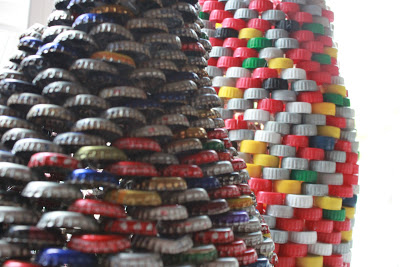
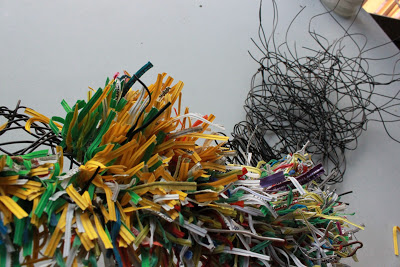
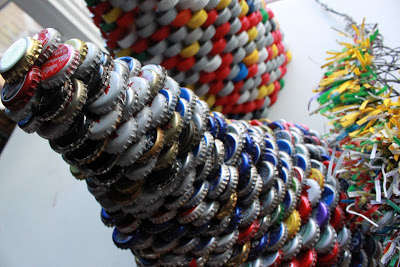
At Better Farm, our farm stand will be open, featuring fresh produce, handmade items, and T-shirts. Our gallery and studio space will also be open with art for sale. Kevin Carr, this month's artist-in-residence, will have his completed work on display throughout the weekend. We will additionally be offering tours to the general public of our gardens, outbuildings, and studio spaces. Here are a few photos of Kevin's work:

Kevin is a 22-year-old artist from Canandaigua, N.Y., who has been living in Redwood for the month of September as part of the betterArts residencyprogram. Carr earned a bachelor of fine arts from Alfred University's School of Art and Design. He has served as director of Alfred University's Robert C. Turner Student Gallery, and as a teaching assistant at his school's painting department. His work has appeared in several galleries and in print. 

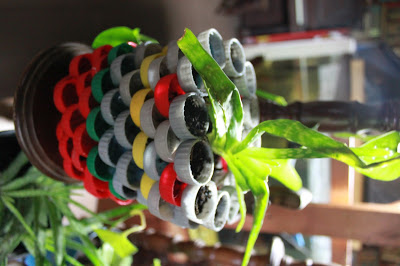
The work he has produced during his residency is centralized around concepts of sustainability and recycling; utilizing otherwise discarded objects such as bottle caps, plastic bags, and bread ties. "A lot of my work is about collections of objects that are often overlooked because they appear insignificant," Kevin said, "but when displayed in large masses they become significant and make people think about what the object really is, what it does, and why it is so small. For a while, I have wanted to create works involving recycled items, things that would normally be thrown away or tossed somewhere to sit forever. Imagine thousands of beer bottle caps, bread clips, plastic grocery bags, or discarded receipts shown or displayed together in a systematic way. This would draw the viewer's attention to how throwing away something small like a rubber band or a toilet paper tube can actually cause a large amount of waste when 15 million other people also just threw away one of these objects. I aim to bring my creative and systematic way of lying out and creating work to prove a point about waste with a project about recycling.The sculptures I create promote recycling and sustainability." 

 The fall season is a beautiful time to travel our country roads, look at the great colors of the season and purchase a vast variety of fresh produce.  Gather the kids, grab a cooler and hit the road! Your neighborhood farms will be ready to show you around, answer some questions and help you learn more about agriculture in the North Country.

For more information about the harvest tour and other agritourism opportunities in the North Country, visit www.agvisit.com. Better Farm is located at 31060 Cottage Hill Road in Redwood. Call (315) 482-2536 for more information. To learn more about betterArts, visit www.betterarts.net.

Comment

Nicole Caldwell

Nicole Caldwell is a self-taught environmentalist, green-living savant and sustainability educator with more than a decade of professional writing experience. She is also the co-founder of Better Farm and president of betterArts. Nicole’s work has been featured in Mother Earth News, Reader’s Digest, Time Out New York, and many other publications. Her first book, Better: The Everyday Art of Sustainable Living, is due out this July through New Society Publishers.

DIY Upcycled Planter Design

Elyna's vertical garden in Better Farm's library.
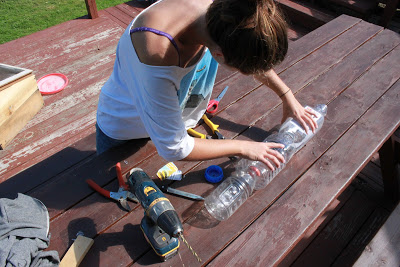
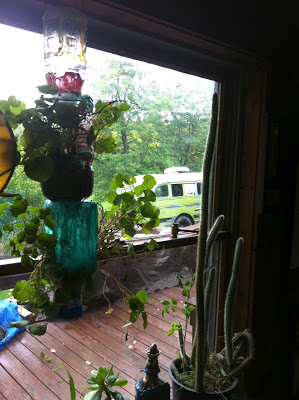
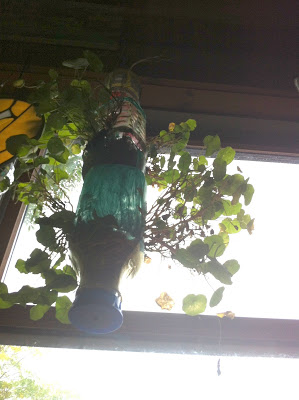
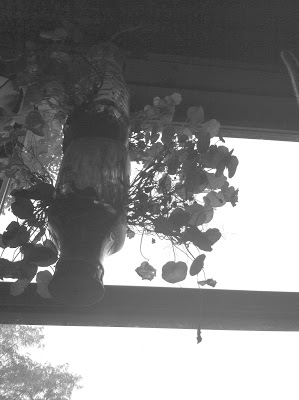
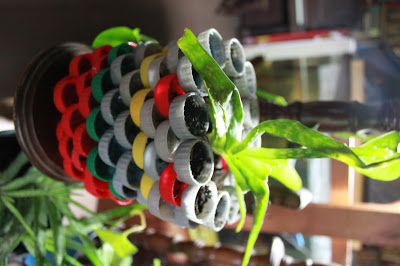
We wrote last week about a simple vertical gardening project utilizing discarded plastic bottles. Intern extraordinaire Elyna Grapstein came up with another system over the weekend that she applied in Better Farm's library. And to get into the mix of things, betterArts resident Kevin Carr upcycled some plastic bottle caps to make us a colorful planter for our overgrown aloe plants.


It was simple serendipity that in the midst of all this going on, summer Millsite Lake-dweller Tammy Leach Lueck stopped in at Better Farm to drop off some herbs she grew over the summer in her garden (she and her husband headed back to Florida Saturday and couldn't talk all the plants with them). Basil, nasturtium, oregano, rosemary, and parsley plants filled out our planters systems quite nicely.

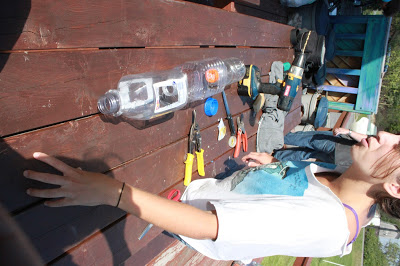
Here are some photos of Elyna putting the vertical garden together. For this design, you cut a hole in the bottom of a bottle, put the top of the next bottle through that hole, and screw the top on:


And the finished pieces:


For Kevin's design, he attached bottle caps with hot glue:


Got a great DIY idea? Share it with us at info@betterfarm.org.
Comment

Nicole Caldwell

Nicole Caldwell is a self-taught environmentalist, green-living savant and sustainability educator with more than a decade of professional writing experience. She is also the co-founder of Better Farm and president of betterArts. Nicole’s work has been featured in Mother Earth News, Reader’s Digest, Time Out New York, and many other publications. Her first book, Better: The Everyday Art of Sustainable Living, is due out this July through New Society Publishers.

Hobbit House: Planning

A few people have approached us lately to suggest a group hobbit-house construction project at

Better Farm

. Who are we to argue? These amazing little structures are right on our wavelength for their alternative properties, potential use of green materials, and unusual style.

We had an informal meeting yesterday to scope out the grounds at Better Farm to find an appropriate hillside into which our hobbit house could go.

Here are some possible locations we liked at Better Farm:

Utilizing the old barn foundation, we could construct our hobbit house and put dirt over the top.

A lovely hillside behind the Art Barn.

And here's our ideas list so far:

  • Get a work day together in the next week or two to pull useable scraps together and ready them for upcycling

  • Secure a source for lime mortar to be used on our walls

  • Get dimensions together for the structure, secure enough tires to build an earthship structure

  • Secure old barn wood for the interior ceiling

  • Utilize a strong roof appropriate for dirt and foliage cover

Want to volunteer on this or other projects at Better Farm? Contact us at

info@betterfarm.org

.

1 Comment

Nicole Caldwell

Nicole Caldwell is a self-taught environmentalist, green-living savant and sustainability educator with more than a decade of professional writing experience. She is also the co-founder of Better Farm and president of betterArts. Nicole’s work has been featured in Mother Earth News, Reader’s Digest, Time Out New York, and many other publications. Her first book, Better: The Everyday Art of Sustainable Living, is due out this July through New Society Publishers.

Ecologist Talk at JCC Tonight!

The Center for Community Studies at Jefferson Community College

in Watertown will host a free Civic Engagement Lecture with Respect to the Environment by Bob Deans from 6:30-8:30 p.m. in the Sturtz Theater.

Bob Deans was a correspondent for the Atlanta-Journal Constitution for 25 years and former president of the White House Correspondents Association before joining the

National Resources Defense Council

. He has authored, co-authored and contributed to a number of books including most recently

Reckless: the Political Assault on the American Environment

. Other titles include

The River Where America Began: A Journey Along the James

;

In Deep Water: The Anatomy of a Disaster, the Fate of the Gulf and How to End our Oil Addiction

.

This event is sponsored by Watertown Daily Times. Sturtz Theater is located at

1220 Coffeen St. in Watertown, N.Y.

Comment

Nicole Caldwell

Nicole Caldwell is a self-taught environmentalist, green-living savant and sustainability educator with more than a decade of professional writing experience. She is also the co-founder of Better Farm and president of betterArts. Nicole’s work has been featured in Mother Earth News, Reader’s Digest, Time Out New York, and many other publications. Her first book, Better: The Everyday Art of Sustainable Living, is due out this July through New Society Publishers.

Food Politics

Economics. Abortion. Foreign policy. Health insurance. Bailouts. Tax loopholes. Energy policy. Wealthy Americans. Poor Americans. The middle class. There's one topic you haven't heard about this election season, however, and it's one of the most literal issues you're likely to ever face—one that you actually deal with many times each and every day.

Your food.

A great number of commercial crops grown in the United States contain genetically modified organisms (GMOs). Those crops are sold to you in the produce section of the supermarket, and are used as ingredients in a number of processed foods you buy; from cereals to chips to canned goods.

Currently

commercialized GM crops in the U.S. include

:

  • Soy (94% of all grown in US is GM)

  • Cotton (90% of all grown in US is GM)

  • Canola (90% of all grown in US is GM)

  • Sugar beets (95% of all grown in US is GM)

  • Corn (88% of all grown in US is GM)

  • Hawaiian papaya (more than 50% of all grown in US is GM)

  • Zucchini and yellow squash (more than 24,000 acres). 

All but soy cross-pollinate, although pop corn and blue corn do not cross with the current GM corn varieties. And now, with the sugar beet growers going GM, there is the possibility of cross-pollination into other beet varieties and near relatives, such as chard.

There's a proposition on the voting block in California this November that, if passed, would make the state the first to require food labels

to include the following information

:

  • Require labeling on raw or processed food offered for sale to consumers if the food is made from plants or animals with genetic material changed in specified ways.

  • Prohibit labeling or advertising such food as "natural."

  • Exempt from this requirement foods that are "certified organic; unintentionally produced with genetically engineered material; made from animals fed or injected with genetically engineered material but not genetically engineered themselves; processed with or containing only small amounts of genetically engineered ingredients; administered for treatment of medical conditions; sold for immediate consumption such as in a restaurant; or alcoholic beverages."

Whether you live in California or not, the vote is relevant because, if passed, it will establish a trend likely to be considered in other states over the course of the next several years. It's relevant because it begs the question of whether consumers have the right to know whether ingredients in their food products have been genetically modified. And it's relevant because of the extensive research conducted lately that links

genetically modified food organisms to organ failure

, suggests

GMOs can contribute to obesity

, and shows genetically modified food can actually

cause cancer

.

I'm not sure of any reason why this

shouldn't

be a basic requirement on food labels, or what the argument would be against people knowing what's in their food, but—no surprise—

lots of companies that turn a profit off food chock-full of GMOs (and the associated pesticides) have come out in opposition to the proposal

(namely brands like Monsanto, which has already thrown more than $7 million into the ring, go figure).

Nationally, on the broader issue of labeling, in answer to the question of whether the Food and Drug Administration should require that “foods which have been genetically engineered or containing genetically engineered ingredients be labeled

to indicate that,” a whopping

91 percent of voters say yes

and 5 percent say no. This is as nonpartisan as an issue gets, and the polls haven’t changed much in the last couple of years.

So what are the politics of the issue, on a national level, and why hasn't GMO labeling already been established nationwide?

[To read particularly timely pieces on the current, frighteningly state of GMOs in our food supply chain, check out

this piece on apples

and

this on cancer

].

President Barack Obama

As a candidate,

Barack Obama promised to label genetically engineered food

. But so far, no labels. And, even more disturbingly perhaps, this: He

appointed Michael Taylor in August 2011 as senior advisor to the commissioner of the FDA

. This is the same man who was in charge of FDA policy when GMO's were allowed into the US food supply without undergoing a single test to determine their safety. He had been Monsanto's attorney before becoming policy chief at the FDA; and became Monsanto's vice president and chief lobbyist. This guy, appointed as America's food safety czar?!

Yes. Really.

Then, earlier this month,

Michelle Obama

developed a new shopping guide as part of her Let's Move campaign against obesity that offers Americans some personal tips on how best to shop for food while at the grocery store

. But missing from her guide is any warning (let alone any mention) about avoiding chemical poisons like the artificial sweetener chemical aspartame, genetically-modified organisms (GMOs), the meat preservative sodium nitrite, and many other common food toxins.

I guess it's kind of hard to lash out about something your top food safety guy is in bed with.

Okay, so what about the other guy?

Mitt Romney

Obama's not the only guy with ties to Monsanto—which, to remind you,

is a company sporting a checkered past

that involves scandals with PCBs, Agent Orange, bovine growth hormone, NutraSweet, IUD, genetically modified (GM) seed and herbicides, reaching back to the 1970s and ’80s...

...Which happens to be right around the time when Monsanto was the

largest consulting client

of Romney’s employer, Bain and Company, and when Romney helped move Monsanto from chemical colossus to genetic giant, trading one set of environmental controversies for another.

Awesome!

But is it relevant? Well, put it this way: "This history matters ...because of the litany of Monsanto corporate objectives that clash with planetary concerns. If Romney is elected, this bête noire of environmentalists will have a very old friend in a very high place." So says Wayne Barrett in an article he penned for the admittedly liberal-leaning

Nation

(read the full, very compelling article,

here

). The year Romney joined Bain (1977), Monsanto became one of Bain's first clients.

"John W. Hanley, the Monsanto CEO at the time, became so close to [then-30-year-old] Romney that he and Romney’s boss Bill Bain devised the idea of creating Bain Capital as a way of keeping Romney in the fold. Hanley even contributed $1 million to Romney’s first investment pool at Bain Capital... Bain and Romney whispered in Monsanto’s ear until 1985, when Hanley’s successor Richard Mahoney says he “fired” them and when Romney moved on to Bain Capital."

The history is

long and not terribly illustrious

. Fast-forward to this past March, when Romney named an

11-member Agricultural Advisory Committee

packed with Monsanto connections, including its principal Washington lobbyist Randy Russell, whose firm has represented Monsanto since its founding in the 1980s and has been paid

$2.4 million

in lobbying fees since 1998.

Fair to say Romney's not going to come out in favor of labeling GM food anytime soon.

Oof. On both sides of the coin.

Okay. Seems like whoever you vote for this November (and you should, of course, vote—if you hate the top-two picks, may I encourage you to

check out the other options

) may not be terribly helpful in the labeling of foods department—nor is he likely to

take the sort of environmental action necessary to actually turn the tides of climate change, which as far as I can tell stands to cause far more damage than homeland security, economic, or abortion policy issues combined

. Luckily, there

is

an immediate solution: Grow your own. Even then, you need to be careful! A lot of the seeds you buy today are riddled with GMO's. Here's a short list of seeds you can buy that have no GMOs in them. 

Zero. Zip. Zilch.

Note: For organic seed databases, see

OMRI

and

ATTRA

.

Comment

Nicole Caldwell

Nicole Caldwell is a self-taught environmentalist, green-living savant and sustainability educator with more than a decade of professional writing experience. She is also the co-founder of Better Farm and president of betterArts. Nicole’s work has been featured in Mother Earth News, Reader’s Digest, Time Out New York, and many other publications. Her first book, Better: The Everyday Art of Sustainable Living, is due out this July through New Society Publishers.

Vertical Garden Update

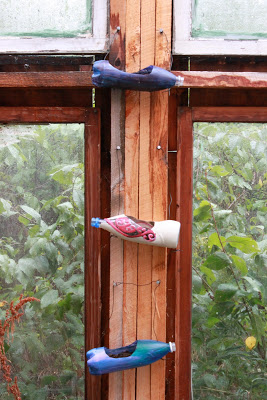
One of Better Farm's vertical garden setups is finally under way! Yesterday in the greenhouse, three beautifully painted plastic bottles were hung with just a few nails and some wire along a wall in the greenhouse. Not only is it exciting to have started a living, growing, space saving garden, but the bottles certainly brighten the greenhouse, as well.


The next step is to figure out the proper way to take care of these plants. One piece of advice we've been given is to mist the leafy green plants everyday instead of watering them like any outdoor plant. Leafy plants will get mites when grown indoors if natural growing conditions are not reproduced (like morning dew). Misting will keep the mites away, and more than that, it will also allow for fresh air flow.

There is also always an issue of getting your indoor plants the proper amount of sunlight. Vegetable plants generally need at least 6 hours of sunlight per day in order to produce vegetables at all. However, light can be increased in a number of ways. Mirrors or any kind of reflective surface, like mylar for example, can nearly double the amount of lumens reaching your plants.

Our next project is going to be a vertical herb garden in the kitchen—possibly also using plastic bottles. The only difference will be the goal of creating a vertical garden while also implementing a drip irrigation system. But don't worry, we'll keep you all updated on that too!

Turn Your Chicken Coop Into a Day Spa

Sage, oregano, mint, and other herbs keep chickens cozy and peaceful—and significantly less stinky.
Aromatherapy—for chickens?

Sure, it may sound strange, but fresh and dried herbs have spectacular health and well-being benefits for your backyard birds. Check out all the benefits your chickens can enjoy by you spending a few seconds to sprinkle herbs in their laying boxes:


Basil - antibacterial, mucus membrane health
Catnip - sedative, insecticide
Cilantro - antioxidant, fungicide, builds strong bones, high in Vitamin A for vision and Vitamin K for blood clotting
Dill - antioxidant, relaxant, respiratory health
Fennel -laying stimulant
Garlic - laying stimulant
Lavender - stress reliever, increases blood circulation, highly aromatic, insecticide
Lemon Balm - stress reliever, antibacterial, highly aromatic, rodent repellent
Marigold - laying stimulant
Marjoram - lay stimulant
Mint (all kinds) - insecticide and rodent repellent
Nasturtium - laying stimulant, antiseptic, antibiotic, insecticide, wormer
Oregano - combats coccidia, salmonella, infectious bronchitis, avian flu, blackhead and e-coli
Parsley - high in vitamins, aids in blood vessel development, laying stimulant
Peppermint - anti-parasitic, insecticide
Pineapple Sage - aids nervous system, highly aromatic
Rose Petals - highly aromatic, high in Vitamin C
Rosemary - pain relief, respiratory health, insecticide
Sage - antioxidant, anti-parasitic
Spearmint - antiseptic, insecticide, stimulates nerve, brain and blood functions
Tarragon - antioxidant
Thyme - respiratory health, antibacterial, antioxidant, anti-parasitic

[Source: grit.com]


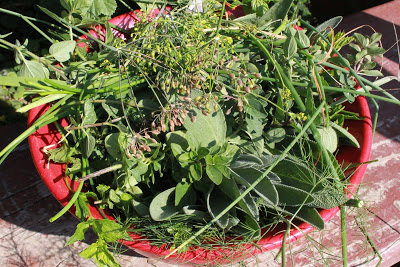
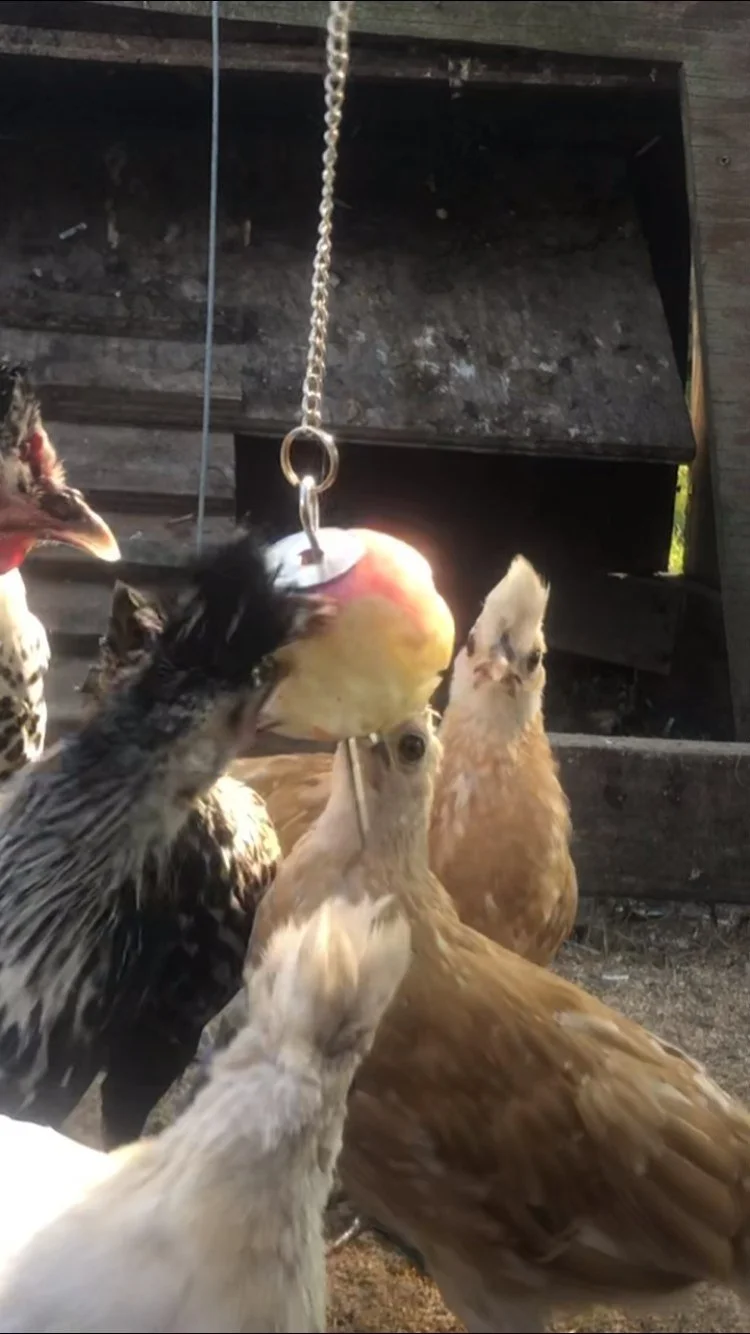
It took intern extraordinaire Elyna Grapstein and I about five minutes to harvest the following herbs from our beds out back and sprinkle them throughout three different chicken coops. In our mix were fresh organic basil, mint, sage, oregano, garlic chives, and various fragrant flowers.


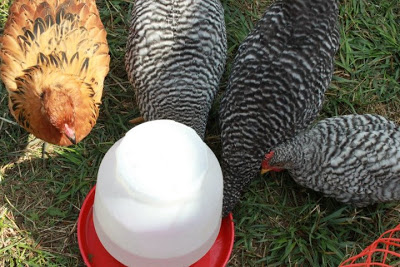
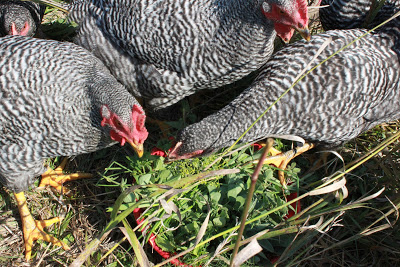
The chickens check out the fresh herbs. 


Click here for more information about the benefits of treating chickens to a little aromatherapy.
Comment

Nicole Caldwell

Nicole Caldwell is a self-taught environmentalist, green-living savant and sustainability educator with more than a decade of professional writing experience. She is also the co-founder of Better Farm and president of betterArts. Nicole’s work has been featured in Mother Earth News, Reader’s Digest, Time Out New York, and many other publications. Her first book, Better: The Everyday Art of Sustainable Living, is due out this July through New Society Publishers.

Better Science: Aquaponics and the Nitrogen Cycle

What is an appropriate nitrogen level for a freshwater fish tank? When checking the nitrogen level of our

aquaponics system yesterday, we wondered the same thing. Unaware if our nitrogen level results of 20 ppm indicated anything good or bad, we traveled back in time to those days of high school biology and chemistry and did some research on the nitrogen cycle.

The nitrogen cycle, like our aquaponics setup, starts with fish poop. The fish poop decays into ammonia, an incredibly toxic substance. Bacteria living in the water (nitrosomonas) then eat the ammonia creating a byproduct of

nitrites

- also a very toxic substance. Then another kind of bacteria (nitrobacter) consumes nitrites in the water, creating a byproduct of 

nitrates

. Now, this is where things get healthy.

Nitrates

are good. We want nitrates, especially when working with hydroponics, because nitrates are a fertilizer. Plants and algae thrive when the nitrate levels are high—which would explain why the herbs and lettuces we're growing over our fish tank are green and growing. Healthy plants in (or above!) a fish tank are an excellent indicator that the nitrogen cycle is acting as it should.

After the plants consume most of the nitrate, the freshly and naturally filtered water recycles back into the tank and the fish don't swim in clean and clear water. Not to mention we get freshly grown herbs and salad greens out of all of this, as well...thanks, science!

Harvest Tour Weekend Sept. 29 and 30


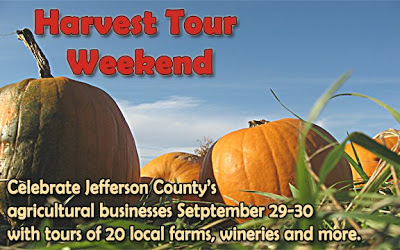
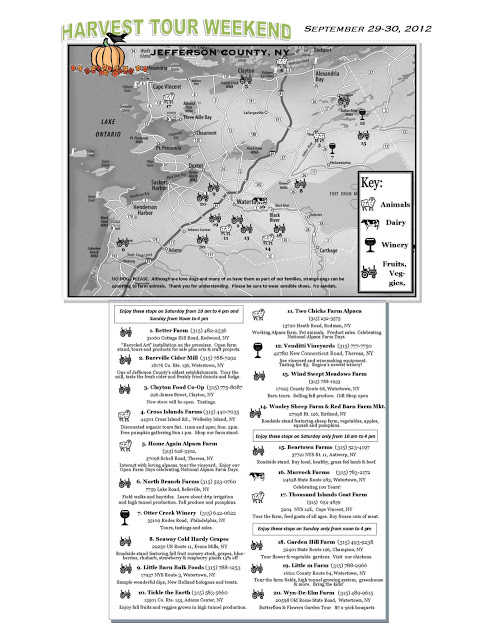
Jefferson County's first Harvest Tour Weekend is slated from 10 a.m.-4 p.m. Saturday, Sept. 29, and 12-4 p.m. Sunday, Sept. 30. Those interested in learning more about agriculture in the North Country—and sampling some great, local food—will have the opportunity to visit dozens of farms and agribusinesses to tour facilities, meet the animals, sample the wine, buy fresh produce and homemade goods, and see exactly where their food comes from.

At Better Farm, our farm stand will be open, featuring fresh produce, handmade items, and T-shirts. Our gallery and studio space will also be open with art for sale. Kevin Carr, this month's artist-in-residence, will have his completed work on display throughout the weekend. We will additionally be offering tours to the general public of our gardens, outbuildings, and studio spaces.

The fall season is a beautiful time to travel our country roads, look at the great colors of the season and purchase a vast variety of fresh produce.  Gather the kids, grab a cooler and hit the road! Your neighborhood farms will be ready to show you around, answer some questions and help you learn more about agriculture in the North Country. 

For more information about the harvest tour and other agritourism opportunities in the North Country, visit www.agvisit.com.
Comment

Nicole Caldwell

Nicole Caldwell is a self-taught environmentalist, green-living savant and sustainability educator with more than a decade of professional writing experience. She is also the co-founder of Better Farm and president of betterArts. Nicole’s work has been featured in Mother Earth News, Reader’s Digest, Time Out New York, and many other publications. Her first book, Better: The Everyday Art of Sustainable Living, is due out this July through New Society Publishers.

Growing Up

Vertical gardening seems to have gained plenty of popularity in the last couple of years since it was first formerly introduced in Japan, and with good reason. For those with limited space, growing upwards is an excellent space saver as the garden can be planted essentially anywhere with enough sunlight (both inside and outside).

Sometimes soil isn't even needed to plant anything; hydroponic technology allows for plants to grow along the walls of buildings without bringing harm to a building's infrastructure. The idea is to bring water to the plants before their roots grow in search of water and penetrate the walls of the structure they're growing on. A hydroponically or

aquaponically

based vertical garden may function the same way a fish tank's water is filtered and recirculates. Growing plants on the walls of a building also has insulation properties, not to mention it can also act as rain screening. Seems so simple, right?

There are also smaller scale, and non-hydroponic vertical gardens that can be planted. For example, there are plenty of blogs that talk about using old shoe organizers to grow herb gardens in, or even old rain boots might do the trick too.
Nowadays at Better Farm, we're working on installing a couple of vertical gardens of our own! We have been using a

handful of stacked and rescued tires to grow our potato plants in the garden outside, and we're working on having an accessible herb garden in the kitchen for this winter.