Mandala Garden Part III: Outline complete

We started work on a mandala garden back in October. Researching basic components of this permaculture design, we set about overlaying one of our own in Better Farm's main garden on the property.

Linear gardens have their origin in division and ownership of land (easier to mark and measure), and in use of mechanical soil cultivation (easier to drive a horse or a tractor down a straight row). Since neither one of these elements applies to a vast majority of home gardens, there is absolutely no need to make them straight! Any shape that respects the landform, works with the flow of water and with the way humans move make more sense.


A mandala garden is a raised garden bed using keyhole pattern. It is meant to be a domestic garden able to feed a family all year. It can also be scaled up in order to feed more people. It is usually a circle shape on a flat area. We talk about mandala as it presents a circle centered pattern drawing. Originaly this word refers to Hindu and Buddhist vocabulary. It is a figuration with mystical and ritual value representing, under the form of a varied aspects geometrical diagram, the cosmos and the different relationships that are established between the material and the spiritual.

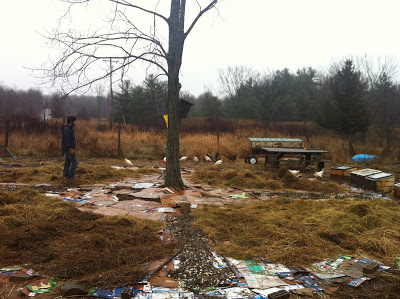
Since updating you the first week in December on the progress former intern Jackson Pittman made, he—along with our new intern Zoya Kaufmann—completed the circular garden's basic layout. Using cardboard as a weed barrier, direct compost and hay as mulching materials for planting next spring, and gravel and stones for barriers and walkways, our design is complete.
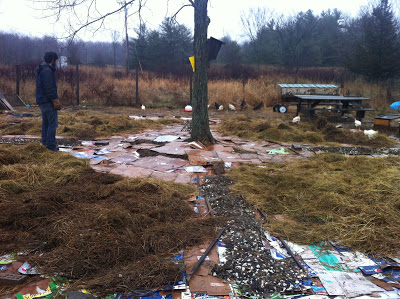

Nature will do the work this winter, as snowfall and our chickens do their part to break down the hay, decompose the compost, and add natural fertilizers to the layout. While that's going on, we'll be mapping out the garden for springtime and allocating certain segments to specific plants.

After the snow melts, we'll be able to get into that thick, rich soil and help to raise up nourishing plants that will sustain the people and animals at Better Farm as well as in the community.
Comment

Nicole Caldwell

Nicole Caldwell is a self-taught environmentalist, green-living savant and sustainability educator with more than a decade of professional writing experience. She is also the co-founder of Better Farm and president of betterArts. Nicole’s work has been featured in Mother Earth News, Reader’s Digest, Time Out New York, and many other publications. Her first book, Better: The Everyday Art of Sustainable Living, is due out this July through New Society Publishers.

Happy Holidays!

Illustration/Jackson Pittman
Comment

Nicole Caldwell

Nicole Caldwell is a self-taught environmentalist, green-living savant and sustainability educator with more than a decade of professional writing experience. She is also the co-founder of Better Farm and president of betterArts. Nicole’s work has been featured in Mother Earth News, Reader’s Digest, Time Out New York, and many other publications. Her first book, Better: The Everyday Art of Sustainable Living, is due out this July through New Society Publishers.

Reflections From Fall Intern Jackson Pittman

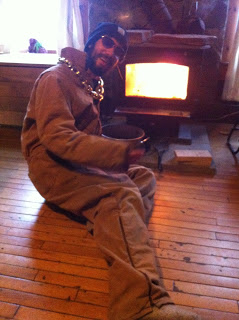
Intern Jackson Pittman relaxing fireside.
By Jackson Pittman

As I prepare to say my goodbyes to the farm after a two-and-a-half-month internship, I'm taking a minute to reflect on some of the things I've learned. As things stand now, I'm hoping to be back to continue work at the farm next summer.

Things I learned at Better Farm:
  • How to split wood
  • How to stack wood
  • How to use an old-school washing machine
  • How the bottom of a compost bucket smells
  • The subtleties of chicken squawks
  • How to identify standing-dead trees
  • How to design and build an earthship
  • How to design and build a garden
  • How aquaponics and hydroponics work
  • How mulching and permaculture work
  • The joys of owning dogs
  • How to use a wirewheel
  • How to use a sawzall
  • How to start a fire in and maintain a woodstove
  • How to fill a wood ring
  • The joys of working with chickens
  • How to clean and maintain chicken coops
  • The power of perseverance
  • How to drive a three-wheeler
  • How to make pasta sauce from scratch
  • How to make a compost/worm bin
  • How to remove porcupine quills from a dog
  • How to build stream systems and direct flows of water
  • How to care for chickens
  • How to balance art and science
  • How to dance
  • The benefits of chicken poop
  • The importance of safety during serious projects
  • How to garden during the winter
  • How to tend to broccoli plants
  • How to grow potatoes vertically
  • How to integrate creativity into technical projects
  • How to write a blog


Seriously though, my experience at Better Farm was wonderful.

The real beauty of this place lies within the love that the people here have for working together and they’re constantly refocusing on positive ways to change and grow. Here at Better Farm, we work to enrich our lives and it is that driving force that allows us to cooperate so fluidly and enjoy our labor and its fruits so much. I am proud to have been a part of this family and I know I will be back! The depth of the care here is tangible. See you all in 2013!
Comment

Nicole Caldwell

Nicole Caldwell is a self-taught environmentalist, green-living savant and sustainability educator with more than a decade of professional writing experience. She is also the co-founder of Better Farm and president of betterArts. Nicole’s work has been featured in Mother Earth News, Reader’s Digest, Time Out New York, and many other publications. Her first book, Better: The Everyday Art of Sustainable Living, is due out this July through New Society Publishers.

Debunking the Dishwasher Myth


By PAUL WHEATON
Originally published at permies.com

I had a painfully awkward week. In one week, five different people told me “the fact” that dishwashers use less water than washing dishes by hand. I wanted to say that I think I use less water than a dishwasher, but in all five cases I was immediately hushed and reminded that this is “a fact” therefore not open to any discussion.

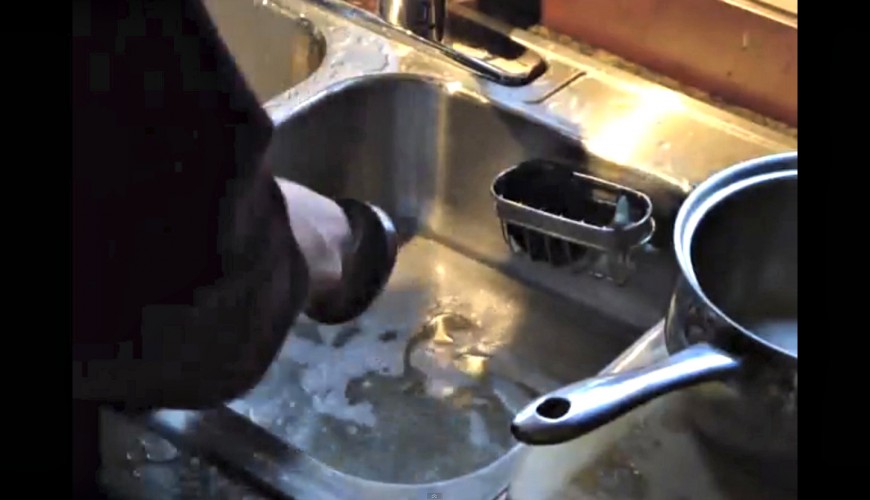
After the fifth time, something fun popped into my head... So I made this video. I just had to. I needed to express my position. I needed to prove my point! Proof dammit! So I set up my camera and proceeded to wash a load of dishes by hand. And when the dishes were clean, I used the dishwasher as a sort of drying rack. And PRESTO! I crushed a lame, so-called “fact”.

The common misconception, that washing dishes with a dishwasher (versus by hand) saves on water usage, is an excellent example, in my mind, of how some of the greenest people succumb to the greenwashing of Madison Avenue.

The doing-it-by-hand technique that beats the most eco dishwasher under any circumstances is pretty simple: use a dishpan and run just a tiny amount of water (quarter cup) to wash the first thing. Then use a tiny amount of water to rinse that one thing, with the rinse water running into the dishpan. As you are on to the fifth thing, you have a bit more soapy water in the bottom of the pan. So you can start washing bigger things.

By the time you are done washing and rinsing everything, there should be about two quarts of water used.
Eco dishwashers set to eco mode use about nine gallons of water and usually don’t get the dishes clean unless you clean them first. Granted, it is possible for a person to wash dishes by hand where they leave the water running and waste lots and lots of water. I am certainly not advocating that.
Hand washing vs. dishwasher: Which wins on water conservation?

There are some new dishwashers that will use only three gallons of water, but these are very expense and there are still some who say they don’t do a good job of cleaning.
I do agree with those who say washing by hand, or not, can also be just a matter of personal choice. Beyond the water usage issue, I prefer washing dishes by hand for many other reasons:
  1. I like to wash dishes by hand because when I am done, the dishes are all done. I am not burdening my future self to finish loading. Or to unload. Nor am I leaving a “to do” for somebody else.
  2. Each piece meets my cleanliness standards.
  3. It’s the way my grandad did it – and I’m always keen on doing things the way my grandad did.
Paul Wheaton is is the tyrannical ruler of two on-line communities. One is about permaculture  and one is about software engineering. There is even one for Missoula. Paul has written several permaculture articles starting with one on lawn care that he presented at the MUD Project 17 years ago, including articles on raising chickenscast iron and diatomaceous earth. Paul also regularly uploads permaculture videos and permaculture podcasts. In his spare time, Paul has plans for world domination and is currently shopping for a hollowed out volcano in the Missoula area, with good submarine access. See all of Paul’s contributions to Make it Missoula here.

Comment

Nicole Caldwell

Nicole Caldwell is a self-taught environmentalist, green-living savant and sustainability educator with more than a decade of professional writing experience. She is also the co-founder of Better Farm and president of betterArts. Nicole’s work has been featured in Mother Earth News, Reader’s Digest, Time Out New York, and many other publications. Her first book, Better: The Everyday Art of Sustainable Living, is due out this July through New Society Publishers.

Four-Season Farming

By Jackson Pittman

As we come closer to the

winter solstice

, it's not uncommon to find farms and gardens closing shop up for the cold, short days ahead. In fact, even our own farm has virtually stopped producing altogether aside from our sporadic batches of chicken eggs and an ever-producing aquaponic system. But, do things always have to be this way? Is it impossible for us in

Zone 4

to maintain production as the days get chillier? Do we have to cast away the thought of crop production just because the temperature drops a couple measly degrees because designing a full functioning growing area with a heater is beyond our price range? The answer to all of these is: of course not. In fact, we can make the most of these colder months in surprisingly simple ways, not by working against the colder shorter days, but using them to our advantage. As Eliot Coleman describes in

TheWinter-Harvest Manual: Farming the Back Side of the Calender

, harnessing frosty conditions for plant production can be done by using simple plastic structures and veggies that grow better under lower temperatures.

The technique Coleman describes in

The Winter-Harvest Manual

is one which uses simplistic, greenhouse-like structures to grow cold-hardy vegetables in abundance. These structures are neither heated nor extremely insulated. In fact, they are merely plastic covered hoop-houses, or high tunnels. The outer layer of plastic over the high tunnel should have an anti-drip coating so moisture condenses as opposed to forming drops, to allow more light in and reflect the heat coming from the soil at night. The hoop houses are aligned to the east-west axis, and, instead of being attached to a foundation, the hoops are attached to a pipe rail the length of the greenhouse so they can move easily in a straight line like a sled. This allows two adjacent sites for the greenhouse, one to cool heat-loving crops in the summer, and the other to heat cold-hardy plants in the winter. It also allows the off season site to be refreshed by half a year of exposure to fresh air and elements each seasonal cycle.

The real crucial part of Coleman’s winter-harvest technique lies in row covers. He prescribes “any lightweight translucent fabrics that allow air and water to pass through.” Although heavier fabrics create more heat, they block out around 35 percent more sunlight than lighter fabrics, and allowing air and water to pass through is much more substantial when it comes to cultivating healthy and tasty vegetables. The plants don’t need the extra heat of a heavier cover anyway because the combination of the plastic covered hoop house and the row covers creates a twice-tempered climate, which creates extra humidity to fight the frost and breaks the wind, both substantial parts of keeping the plants healthy. 

Another reason why it’s better have a lighter cover which ventilates more efficiently is because since the cold months have less sunlight the plants need the most they can get. To cold-hardy plants, a couple degrees below freezing isn’t as detrimental as factors like wind-chill and poor ventilation. Another beauty of these covers is that they are easy to manage—they sit on flat-topped wire wickets 12 inches above the soil, and they are also inexpensive and large pieces are easy to remove and replace for harvesting and accessing the plants. The fabric should be clothespinned to the wickets at the ends of each row to prevent the fabric from sagging; frost damage can occur when the fabric droops down to the plants below but if properly maintain no damage will occur.

The final ingredient for successful winter harvesting lies within the plants themselves. The vegetables to be planted basically depend on the latitude (which determines amounts of sunlight). Coleman, who lives in the 44

th

longitude up in Maine, plants everything from salad crops such as green and red lettuces, arugula, chard, spinach watercress and things of that nature, to potatoes, carrots, beets, turnips, leeks… the list goes on. The plants chosen basically depend on the regional and seasonal temperatures. It is important to keep in mind that the plants need to be sown very precisely because the days get shorter instead of longer as we work the other side of the calendar. The crops should reach a decent size by the time the length of day drops below 10 hours. After that they will pretty much stop growing except when harvested until the day lengths begin to lengthen again and they receive a glorious revival.

Well, hopefully this helps you imagine a world where the growing season is year-long, and we will be there growing alongside with you. While it may take a while to actualize it due to technical factors remember the winter has been around as long as the sun has shone and we are all working together to grow tasty and healthy vegetables!

Message 1 of 21

Comment

Nicole Caldwell

Nicole Caldwell is a self-taught environmentalist, green-living savant and sustainability educator with more than a decade of professional writing experience. She is also the co-founder of Better Farm and president of betterArts. Nicole’s work has been featured in Mother Earth News, Reader’s Digest, Time Out New York, and many other publications. Her first book, Better: The Everyday Art of Sustainable Living, is due out this July through New Society Publishers.

BetterArts Teams up with Hospice for Holiday Event

BetterArts on Saturday teamed up with Survivor Outreach Services of Fort Drum and Hospice of Jefferson County to present "A Time of Holiday Remembrance" holiday party for children ages 6 to 12 who have lost loved ones. 

The event, held at Hospice of Jefferson County in Watertown, featured arts 'n' crafts, a lunch, and cookie decorating. BetterArts participated by inviting families to join in the making of a photo frame collage in honor of their loved ones for the last hour of the event. Children and their family members were encouraged to bring in photos for that activity. Funding for the collage supplies was made possible through a donation from Watertown Evening Rotary. 
Here are some photos from the day:
Better Farm intern Jackson Pittman makes a bookmark man out of a popsicle stick.


Many thanks to Joyce Combs and Hospice of Jefferson County for making this event possible!
Comment

Nicole Caldwell

Nicole Caldwell is a self-taught environmentalist, green-living savant and sustainability educator with more than a decade of professional writing experience. She is also the co-founder of Better Farm and president of betterArts. Nicole’s work has been featured in Mother Earth News, Reader’s Digest, Time Out New York, and many other publications. Her first book, Better: The Everyday Art of Sustainable Living, is due out this July through New Society Publishers.

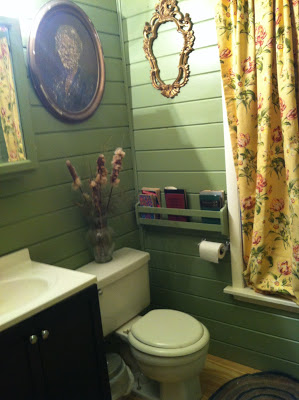
Campy Bath Goes Glam (and Green!)


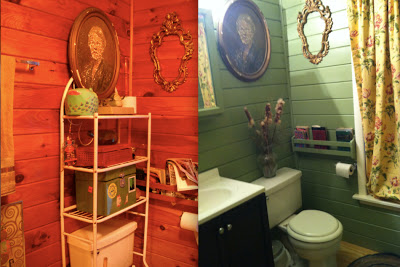
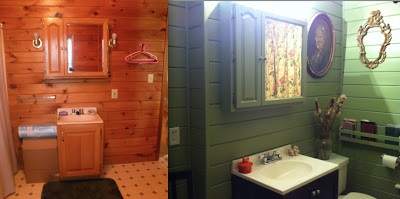
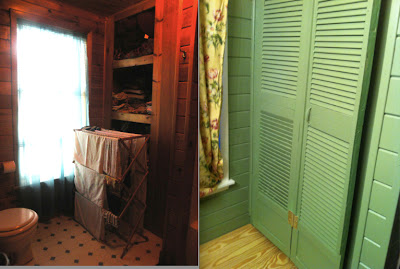
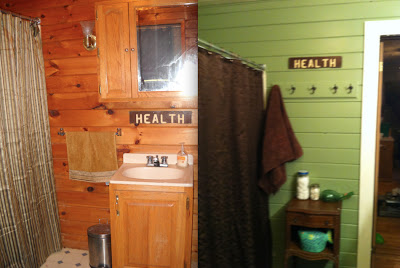
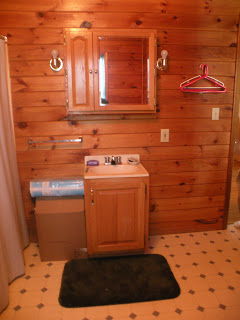
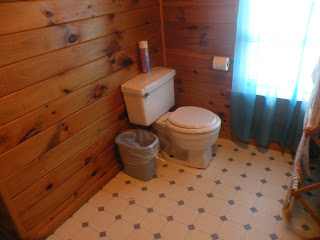
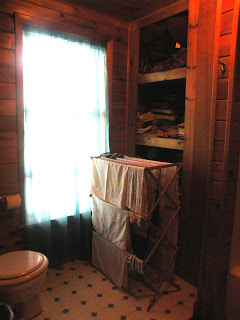
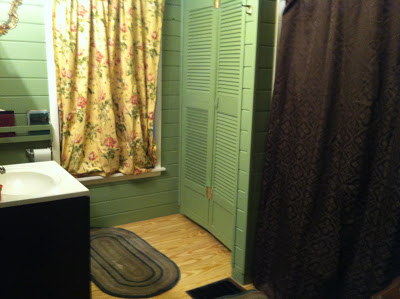
We were passed-due for a big overhaul and update on Better Farm's downstairs bathroom; but with the space being structurally sound, it was low on the priorities list. Three years since our start, and with a renovation project bearing down to create a master suite on the first floor, the opportunity arrived to shrink the downstairs bathroom, make a more sensible laundry area closer to the clothesline, and update some outdone interior design. More blogs to come about those other projects—for today, we'll focus on that downstairs bathroom and how we set about getting it glammed up in a functional way that's ready for all the high-traffic Better Farm brings.

What we did:
  • Removed the laundry area entirely to create a master bath off the bedroom downstairs, thereby shrinking the existing bathroom to a more manageable, realistic size
  • Moved the entrance door from the kitchen to the bath, spurring a refrigerator move and island addition
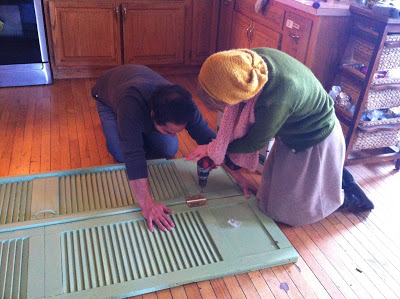
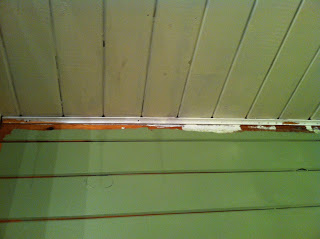
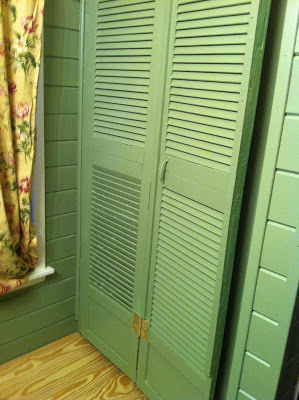
  • Took a standing three-part shutter system that hid an open shelving area in the bathroom, shrunk it to two panels, and used hinges to affix the shutters to the wall
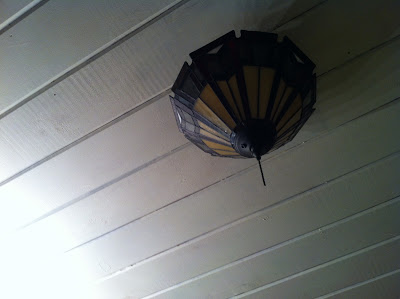
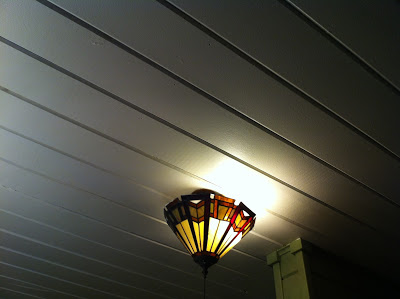
  • Updated old lighting fixtures, made them more energy-efficient
  • Used discarded tongue-and-groove pine flooring to outdo the old linoleum floor (also helped with heating efficiency)
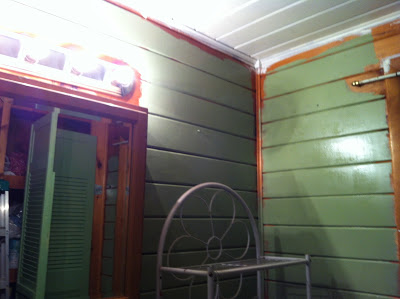
  • Added color to the old, campy walls
  • Brought in bright, insulated curtains
  • Removed clutter
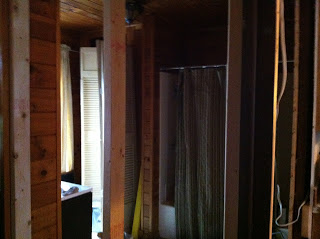
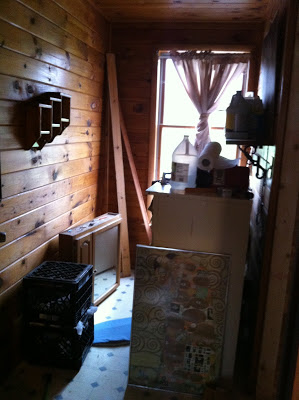
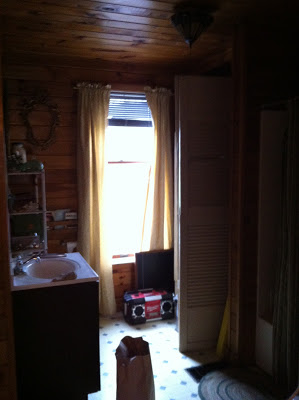
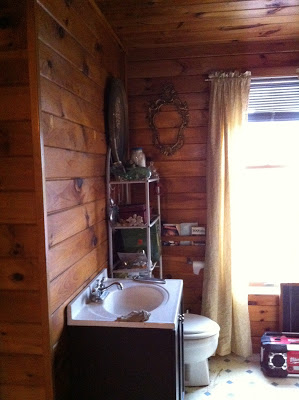
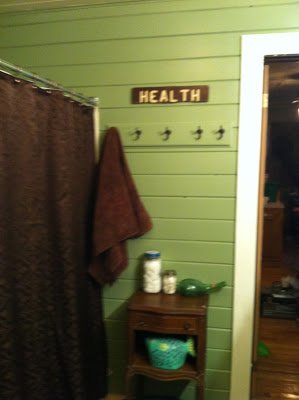
The bathroom in 2009:


...and the bathroom in 2010...


...and the bathroom's metamorphosis in the last few weeks...


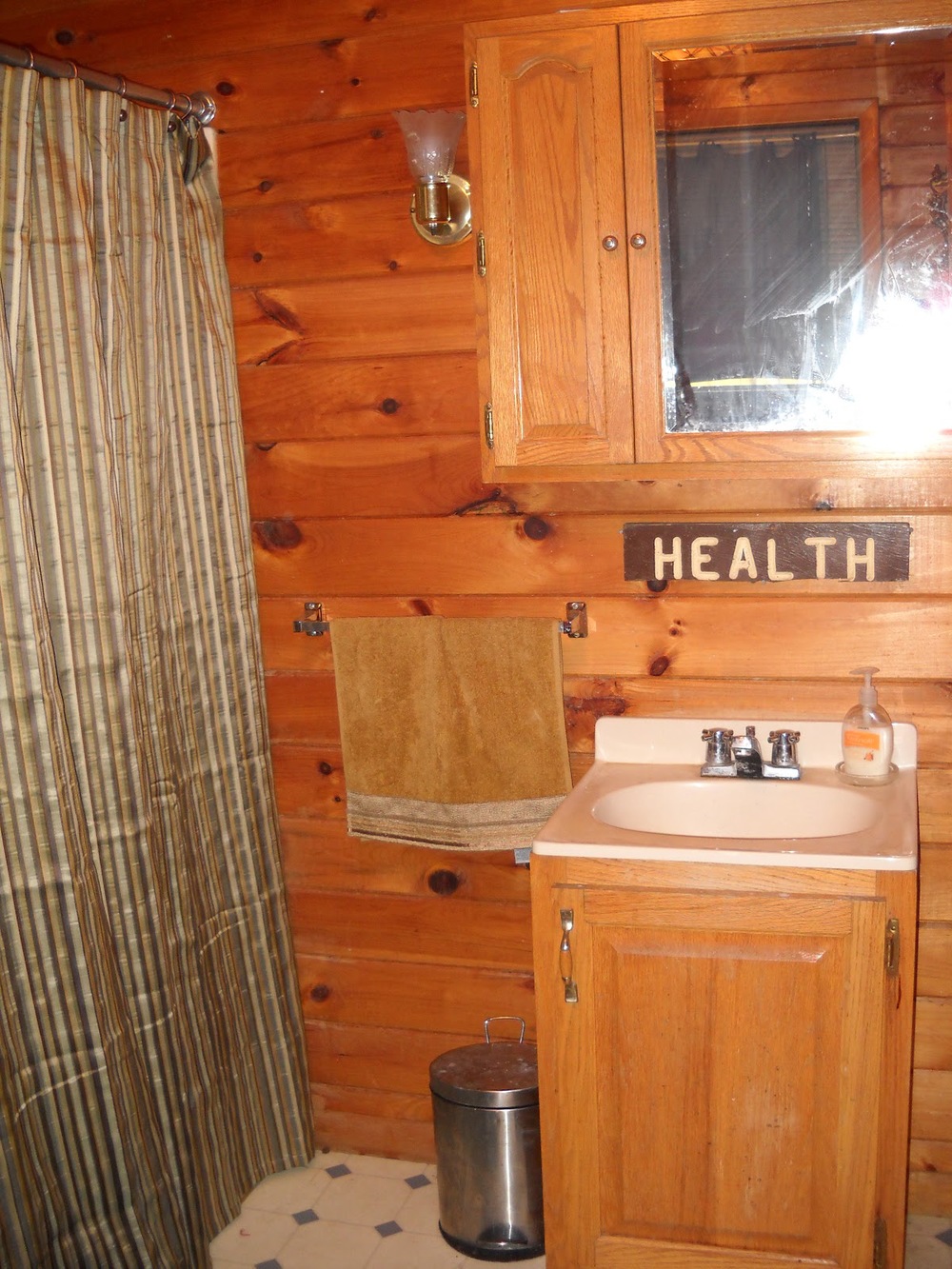
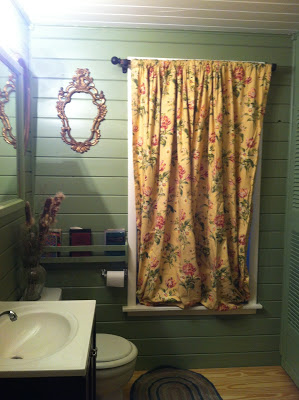
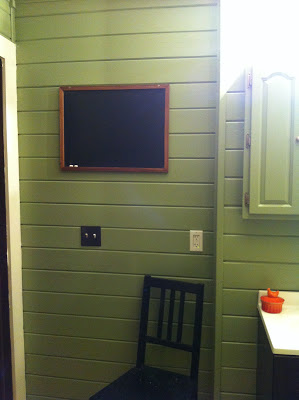
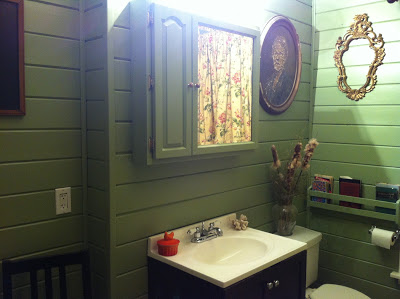
...and the final results!


Donated chalkboard, gold frame, vase. Upcycled baking dish used as soap holder. Magazine rack taken off back of church pews in kitchen. Painting is of old Grandma Caldwell!
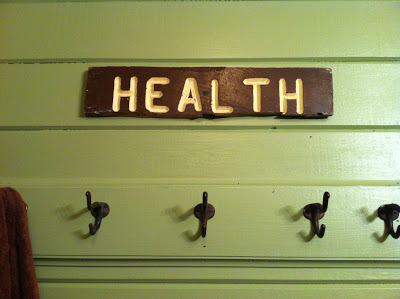
Found sign, reused hooks

Lovable hand-me-downs: shower curtain, window drape, and floor rugs were all passed down to us.

Got a great design idea you'd like to share? E-mail us at info@betterfarm.org.

Many thanks to the following people for their time, energy, donations, and work on this project:

Adam McBath
Jackson Pittman
Greg Basralian
Jaci Collins
Joel Zimmer
Nicole Caldwell
David Garlock
Kristen Caldwell
Comment

Nicole Caldwell

Nicole Caldwell is a self-taught environmentalist, green-living savant and sustainability educator with more than a decade of professional writing experience. She is also the co-founder of Better Farm and president of betterArts. Nicole’s work has been featured in Mother Earth News, Reader’s Digest, Time Out New York, and many other publications. Her first book, Better: The Everyday Art of Sustainable Living, is due out this July through New Society Publishers.

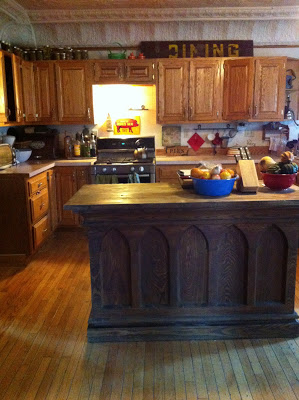
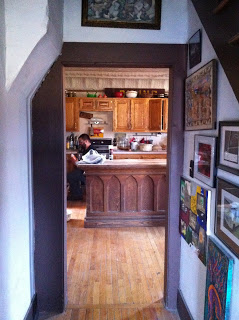
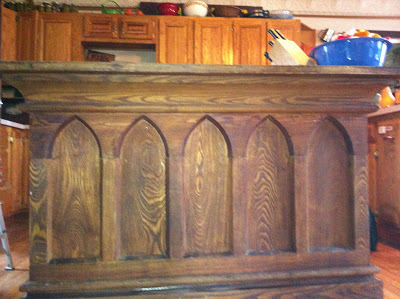
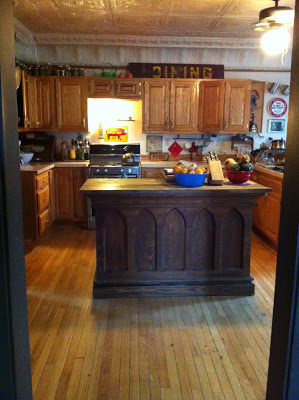
Upcycling 101: Island altar

An old church altar becomes a kitchen island.
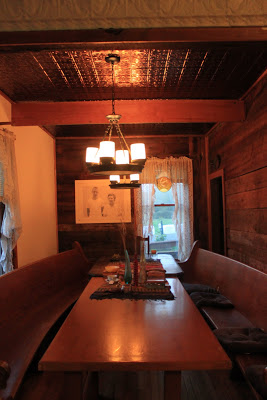
It was way back in 2009 when we scored two 12-foot church pews from Calcium Community Church and made them the centerpiece of our dining alcove. It was about a year later when we updated the alcove and gave the space a truly spiritual overhaul:
  
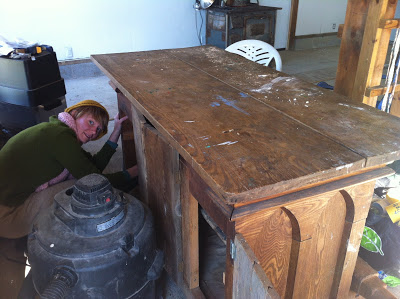
Since then, I've been eyeing a church altar (origins unknown) that was collecting dust for years out in the Art Barn. We'd cleaned it up and used it as a buffet for gallery openings; but in my heart of hearts I knew it was destined to join the church pews in the kitchen. In a recent burst of renovations that added a new bathroom, shrunk another, and moved doors and refrigerators around (stay tuned for those before and after photos!), it was time.

So, first things first. A group of us went out to the Art Barn to assess the situation and start the process of cleaning the old altar up. Here's Jaci removing some old, mismatched and cobbed-together cabinetry:

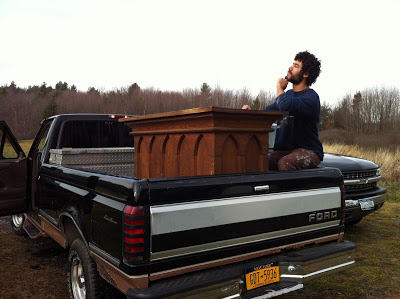
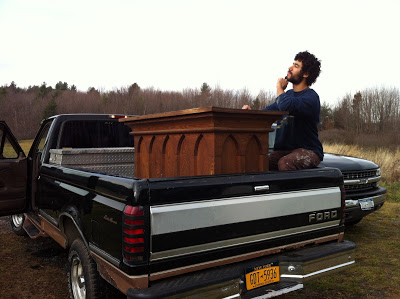
Next, Greg used a small sander to get the paint off the top of the altar. Then it came time to move it (note that new farm truck Jackson's sitting on!):
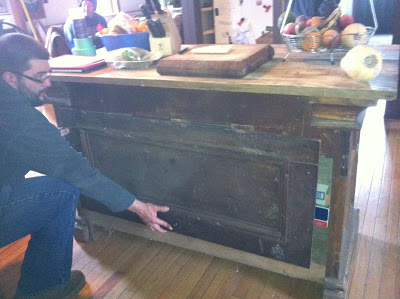
 To replace the old cabinets, we're upcycling the lower front board from our driveway piano and affixing it with pivot hinges. Here's Adam demonstrating what that will look like:


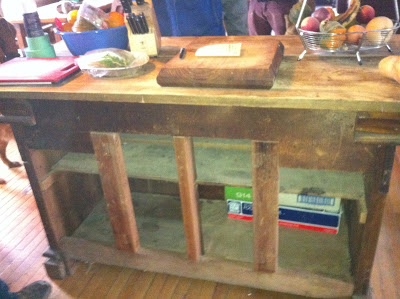
Eventually I'll have a kitchen sink installed in the center of the island. But for now, it's a great work station and spot for casual conversation while cooking is underway. Bring on the soul food.

Comment

Nicole Caldwell

Nicole Caldwell is a self-taught environmentalist, green-living savant and sustainability educator with more than a decade of professional writing experience. She is also the co-founder of Better Farm and president of betterArts. Nicole’s work has been featured in Mother Earth News, Reader’s Digest, Time Out New York, and many other publications. Her first book, Better: The Everyday Art of Sustainable Living, is due out this July through New Society Publishers.

Remodeling the Garden: Mandala update

The Rapunzels help to turn the soil over in Better Farm's future mandala garden site.
By Jackson Pittman
As we prepare for the snow, we are renovating our garden and reinventing it by adding a mandala design around the tree near the back

A four-quadrant circle is being constructed at a 200-inch radius around the tree. The former gravel pit around the tree has been dug up so the gravel can be redistributed to form a circular pathway within the mandala design and to create the quadrants. 
Here are a few shots of that process:

Before the paths of the garden will be formed the circle will get completely leveled and covered with cardboard, and then quarters in between the gravel will be mulched for fertile soil for planting. We are all really excited about it over here at Better Farm and will continue to update it as it goes on.

Meanwhile, in the rest of the garden...
I've been using spent hay from the chicken coops to direct-mulch on existing and new garden rows (the garden will be roughly doubled in size next spring); and using newer hay plus compost to create a healthy mulch for plants next season.
To learn more about our mulch-gardening methods, click here.
Comment

Nicole Caldwell

Nicole Caldwell is a self-taught environmentalist, green-living savant and sustainability educator with more than a decade of professional writing experience. She is also the co-founder of Better Farm and president of betterArts. Nicole’s work has been featured in Mother Earth News, Reader’s Digest, Time Out New York, and many other publications. Her first book, Better: The Everyday Art of Sustainable Living, is due out this July through New Society Publishers.

Research Resource: Commercial Storage of Fruits, Vegetables, and Florist and Nursery Stocks

The USDA regularly produces its Agricultural Handbook 66 – “The Commercial Storage of Fruits, Vegetables, and Florist and Nursery Stocks” to help guide long-term storage of these products. The handbook is dense, with info on optimal storage conditions for everything from Jerusalem Artichokes to Watercress. Each crop is given a brief overview which summarizes the expected loss when stored at certain conditions and also a summary of respiration rates to help with the sizing of any refrigeration that may be needed.

Many growers are probably familiar with the green book from 1986.  But did you know that a newer version is available online

Unlike previous editions, this edition presents summaries of the storage requirements of fresh fruits, vegetables, cut flowers, and other horticultural crops; as well as information on quality characteristics, maturity indices, grading, packaging, pre-cooling, retail display, chilling sensitivity, ethylene production and sensitivity, respiration rates, physiological disorders, postharvest pathology, quarantine issues, and suitability as fresh-cut product.  In addition, a number of fruits and vegetables were added, as well as sections on food safety and fresh-cut produce.

The purpose of storing plant material is to lengthen the time it can be consumed or utilized.  In doing
so, it is critical to provide an environment that minimizes deterioration, maintaining safety and quality while lengthening the marketing- or shelf-life.  The intent of HB-66 is to provide guidelines for storing produce in an optimal environment in order to accomplish this.
Comment

Nicole Caldwell

Nicole Caldwell is a self-taught environmentalist, green-living savant and sustainability educator with more than a decade of professional writing experience. She is also the co-founder of Better Farm and president of betterArts. Nicole’s work has been featured in Mother Earth News, Reader’s Digest, Time Out New York, and many other publications. Her first book, Better: The Everyday Art of Sustainable Living, is due out this July through New Society Publishers.

Sustainability Scholarship!

Annie’s Homegrown is offering $100,000 in scholarship funds to students studying sustainable agriculture. Annie's believes healthy soils and healthy farms are the foundation for healthy foods, which help make healthy people, which is why they provide the scholarships to support the next generation of farmers. Click here to learn more, or read on below! The deadline to apply is Dec. 15.


Annie’s Sustainable Agriculture Scholarship Application

Sustainable and organic agriculture is at the very root of our philosophy. We believe that healthy soils and healthy farms are the foundation for healthy foods, which help make healthy people!
We’re proud to support the next generation of farmers by offering $100,000 in funds to students studying sustainable agriculture.

Eligibility Guidelines
Annie’s Sustainable Agriculture Scholarship Program is open to full time undergraduate and graduate students studying at an accredited 2 or 4 year college or graduate school in the U.S. for the 2013-2014 school year.  Students must be focusing studies on sustainable agriculture.  International students may apply as long as they are studying at a U.S. school.  

Annie’s accepts applications postmarked between Oct. 1, 2012 and Dec. 15, 2012. If you are chosen to receive an award, you will be notified by April 15, 2013, and funds will be dispersed directly to your school on or around July 15, 2013.  

The Application

The application consists of two parts – your application and your supporting documents.
Your Application:
  1. Download and complete the application.
  2. Sign the form and draft a personal statement. 
Supporting Documents:
  1. Official copy of your transcript
  2. Two letters of recommendation who can speak to your commitment to Sustainable Agriculture.
    • The letters of recommendation must be from contacts that are NOT related to you.
    • Letters of recommendation should be in a sealed envelope and the writer should sign the seal. 
Applications and supporting documents should be in ONE envelope to: Annie’s Scholarship Committee, 1610 Fifth Street, Berkeley CA 94710.

Annie’s Scholarship Program FAQs

  • I’m in my first term of school and grades are not yet available, what should I send?Please send the transcript from your high school or undergraduate studies and your current transcript as soon as it’s available.
     
  • I’m not specifically majoring in Sustainable Agriculture, but I am majoring in a related field. Can I still apply?Students whose coursework and extra-curricular activities are related to sustainable agriculture are welcome to apply.
     
  • I’m in the process of applying to schools for the next school year, but am unsure of what school I’ll be attending. What should I do?Please indicate in the “Academic Information” section on your application that you are undecided.

Comment

Nicole Caldwell

Nicole Caldwell is a self-taught environmentalist, green-living savant and sustainability educator with more than a decade of professional writing experience. She is also the co-founder of Better Farm and president of betterArts. Nicole’s work has been featured in Mother Earth News, Reader’s Digest, Time Out New York, and many other publications. Her first book, Better: The Everyday Art of Sustainable Living, is due out this July through New Society Publishers.

Blazing a Trail

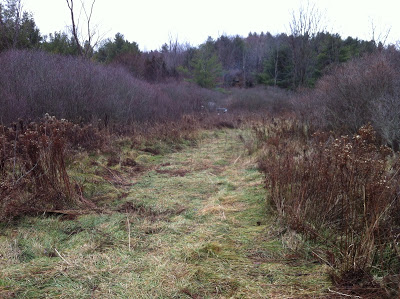
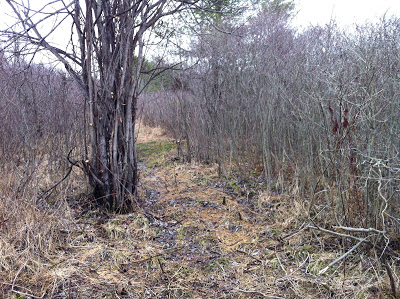
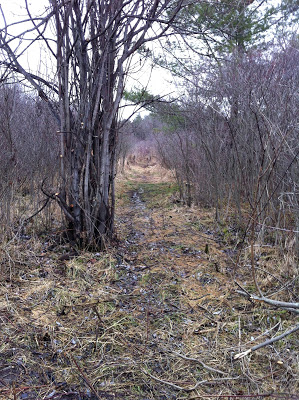
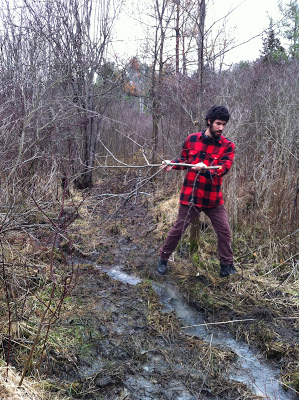
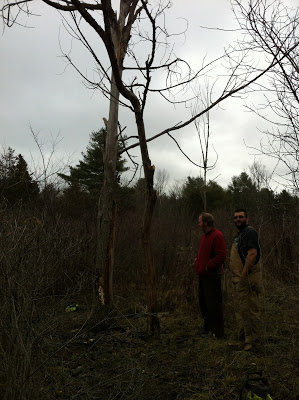
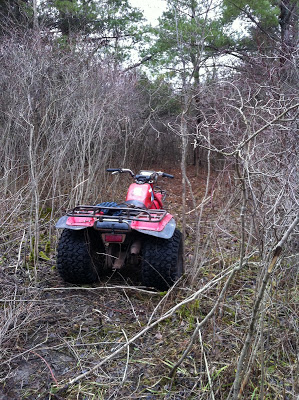
The Boys of Better Farm have been downright inspiring in their commitment to culling standing-dead trees on the property for firewood. While trudging through some back brush, they were struck by a long-idling idea: Why not carve out some trails in the woods for four-wheeling, snowmobiling, cross-country skiing, and good-old fashioned hiking?


They've been hard at work in the last few weeks laying out an initial series of trails. Here are a few shots of the network; more to come soon!


Care to volunteer on this or any other project? Get in touch with us at (315) 482-2536 or info@betterfarm.org.
1 Comment

Nicole Caldwell

Nicole Caldwell is a self-taught environmentalist, green-living savant and sustainability educator with more than a decade of professional writing experience. She is also the co-founder of Better Farm and president of betterArts. Nicole’s work has been featured in Mother Earth News, Reader’s Digest, Time Out New York, and many other publications. Her first book, Better: The Everyday Art of Sustainable Living, is due out this July through New Society Publishers.

Compost in the City

By Jackson Pittman

Composting is a great and easy way to put garbage to a real use. By harnessing scraps and organic waste as fuel for plants we can cut down our what we put out to a landfill, and also accommodate life! Stores offer a wide variety of compost and worm containers, but a simple one can be built without having to buy anything! These DIY methods even prevent rodent attraction and block odors if fed the right kinds of waste.

DIY Compost Bin

What you will need:

2 containers (one should be able to fit in the other with room), 1 lid for the larger container, drill, 1 brick and soil or wood chips.

Instructions

Drill half an inch in diameter holes across the bottom and up the sides of the smaller container. Put brick in the bottom of larger container and sit the smaller container on top of it. Fill the space in between the containers with wood chips or soil and place the lid over the larger container.

Wastes to put in

: fruits, vegetables, eggshells, coffee grounds and filters, tea bags, nut shells, shredded newspaper, cardboard, paper, grass clippings, houseplants, hay and straw, leaves, sawdust, wood chips, cotton and wool rags, dryer and vacuum cleaner lint, hair, fur and fireplace ashes

Compost should be ready in 2-5 weeks.

Wastes which will attract pests and produce odors: dairy, eggs and meat products, oils, greases and pet wastes

DIY Worm Bin

What you will need:

composting worms, container (not translucent), lid or rag, lots of shredded paper, several fruit or vegetable scraps

Instructions

Composting worms need 6-7 inches of bedding, and a gallon of worms need about a square foot of space, keeping in mind the worms reproduce and will need to expand. At the end of the vermicomposting cycle more bins will be necessary to accomodate the growing worm population.

Once the right size container is chosen, soak the shredded paper, and then dry it by hand until it has the moisture of a run out sponge. There should be enough paper to spread six to seven inches of bedding across the bottom of the container, and once this is done, throw some produce scraps on so the bacteria can begin to propagate before the worms are introduced (worms love bacteria). Add the worms and close the container-- however since the worms need air you can drill holes in a lid, leave the lid slightly ajar or place a wet, dark , wrung out cloth over the bin (this eliminates light (worms hate light) and keeps the bedding moist while keeping out flies or other pests).

Well-kept worms will be reproducing a lot and can live several years!

Wastes to put in: Fruits, vegetables, paper, plant matter and any food scraps without dairy, meat or grease.

Comment

Nicole Caldwell

Nicole Caldwell is a self-taught environmentalist, green-living savant and sustainability educator with more than a decade of professional writing experience. She is also the co-founder of Better Farm and president of betterArts. Nicole’s work has been featured in Mother Earth News, Reader’s Digest, Time Out New York, and many other publications. Her first book, Better: The Everyday Art of Sustainable Living, is due out this July through New Society Publishers.