Doing the Dirty Work of Better Farm

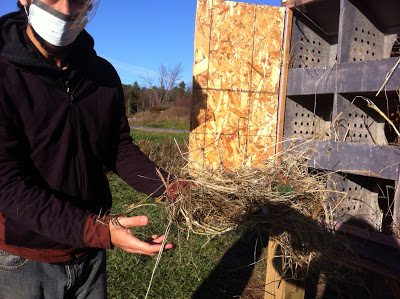
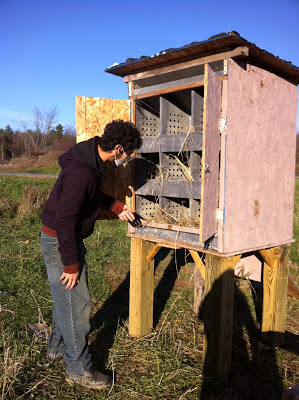
The author, cleaning out one of Better Farm's chicken coops. Photo/Lily Chiu
By Jackson Pittman
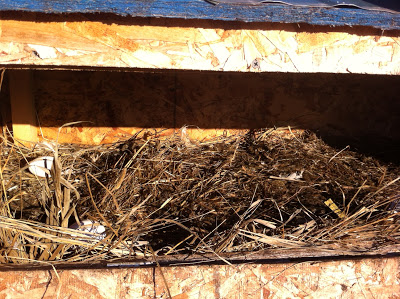
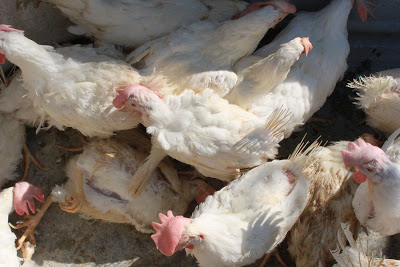
Here at Better Farm, we have a lot of things that stink. Stinky compost bins, the stinky dogs, and of course, stinky chickens. In fact, it's not that our chickens reek especially bad, its more that they leave a lot of droppings—and for a chicken, steering clear of its own excrement doesn't rate high on the priority list. Some of you may wonder why we have so many chickens when they produce so much more poop than eggs. Well, the answer is simple—and beautiful.
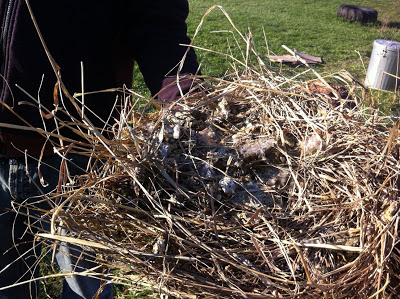
The chicken poop (as most gardeners would know) is excellent fertilizer! Once it is broken down, chicken manure has 4 times as much nitrogen, 11 times as much phosphorous, and 2.5 times as much potassium than horse manure (2.8 percent nitrogen,2.3 phosphorous, 1.7 potassium). While it's true that we don't want to put the dung directly onto the crops because the nitrogen and bacteria levels are so high it can damage or contaminate the vegetables we grow, we still have plenty of other things we can do with our vast amounts of chicken droppings (really... they poop a lot... it's 33 chickens).

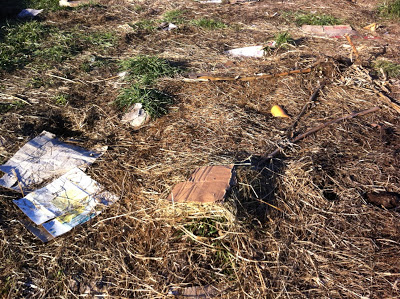
At this time of year, when the garden isn't producing nearly as many vegetables as it does at its peak, there's plenty of open space that we're mulching with hay and cardboard (the cardboard is to keep weeds from popping up, and the hay is to get broken down by the snow and turn to fresh soil). Since we have our chickens pooping on hay, on top of cardboard, it's ridiculously easy to find a nice empty spot that could used some extra insulation and let the fertile chicken manure get broken down with the hay over the winter to make the soil all the richer. This is our current technique, but there are plenty of other uses for the chicken poop we have in such abundance. So this is the short list of chicken manure uses that I (as the farm intern) was surprised and interested by:

  •  Biogas!! Whaaat! It's crazy, right?... The same chicken poop that can easily gross out the inexperienced onlooker can be converted to natural fuel? This innovative process is done by mixing the droppings with a by-product of ethanol production to produce a powerful biogas, but the real magic of it is done simply by the bacteria living in the poop! It's just three simple steps... Stage one: One bacteria type reduces the manure to fatty acids. Stage two: Another bacteria type reduces the fatty acids to acetic acid. Stage three: The third bacteria type turns the acetic acid into bio-methane gas. Incredible, right? Bio-methane gas out of poop through the natural cycle of anaerobic bacteria... life is beautiful.
  • Bio-Oil?!? Let's leave this one to the expert's explanation: "First, the manure needs to be dried so it can be burned... That makes it possible to move to the next step: rapidly heating the mixture in a bubbling, fluidized bed reactor that has no oxygen. It's a process called fast pyrolysis. The process thermochemically breaks the molecular bonds in the mixture. It produces charcoal that can be used to enrich soil. And it produces vapors that are condensed to a thick, dark bio-oil." Wow... all that from chicken poop. I'm practically speechless. Although this process doesn't sound like something we're ready to do at Better Farmyet, it really changes the way you see the manure, and the way we treat dispose of our waste.
  • Chicken Manure TEA?!?!? Not the kind you can drink! During the growing season, the compost pile can get full pretty quickly and when there's tons of chicken poop it can be nice to find a more direct use for it without having to way for it to decompose. Now there are many ways to make fertilizer, but this one in particular is nice because it creates a liquid you can spray your crops with to give them nutrients! To make fertilizer tea, scoop the chicken manure into a burlap bag. Then, throw a rock into the bag to weigh it down and place the whole thing into a 35-gallon garbage can. Fill the garbage can with water and let it sit for about three weeks. Once the three weeks are over, you will have nutrient-rich chicken manure fertilizer tea as the water becomes infused with the nutrients from the chicken manure. You can use this fertilizer tea to water your plants to give them a vitamin boost. 
Well, that about wraps up our summary on the fun side of poop. I hope you guys enjoyed it as much as I enjoy it twice a week! Remember, all waste has a purpose! 

All photography by Lily Chiu
Comment

Nicole Caldwell

Nicole Caldwell is a self-taught environmentalist, green-living savant and sustainability educator with more than a decade of professional writing experience. She is also the co-founder of Better Farm and president of betterArts. Nicole’s work has been featured in Mother Earth News, Reader’s Digest, Time Out New York, and many other publications. Her first book, Better: The Everyday Art of Sustainable Living, is due out this July through New Society Publishers.

Garlic Season

Some selected garlic we grew this year, in background, supplemented with organic elephant garlic purchased at Territorial Seed.
After a full growing season that started almost a full month earlier than normal, we're doing our fall garlic planting a full month later than last year.

While we waited for nightly frosts to start in the North Country, intern Jackson Pittman has kept remaining vegetables insulated with hay, mulch, and compost. The work has paid off, as our broccoli, kale, cauliflower, cabbage, celery, sage, and parsley have continued producing. And because Jackson pulled our green tomatoes before the first frost hit, we've been ripening the fruits inside for the last month and enjoying fresh red tomatoes every day.

Below photos from today's planting is last year's blog post outlining exactly how to plant garlic in the fall. 

Intern Jackson Pittman, standing, and aritst-in-residence Lily Chiu plant garlic cloves in Better Farm's raised beds.


Prep Your Soil!
Garlic is extremely hardy and will grow in many different kinds of soil—though it prefers soil with lots of organic matter in it (big bonus for those of you employing mulch-gardening methods!) and good drainage. Garlic loves compost, compost manure, worm dirt, and even ground-up fish bones.

When to Plant
Now! In most climates, fall is the best time to plant. Roots should have time to develop, but tops shouldn't break through the surface before winter. The idea is to get some root growth and then the frost/beginning freeze triggers the bulb formation.


Preparing Your Cloves for Planting
Your garlic will come to you as a fully formed bulb. It's up to you to "crack" that bulb so you can plant individual cloves. Be sure to separate your garlic cloves as close to planting time as possible. Doing this at the last minute will prevent the root nodules from drying out and will allow the plant to root more quickly.

When you crack the bulb, each clove should break away cleanly. Root nodules grow from the edge of the "footprint" on the bottom of the clove. Be careful not to damage this footprint!

Set aside the very small cloves to eat soon, to make into pickles, to dry, or to plant tightly together for eating in the spring, like green onions. Each larger clove will produce a good sized bulb by the end of the growing season. The smallest cloves require just as much space, care and attention in the garden and produce significantly smaller bulbs.

Planting
Plant your garlic pointed-side up, about two inches below the soil's surface. Cloves should be spaced between four and eight inches apart. The closer you plant them, the smaller the bulbs will be. After you've planted, you may want to cover your garlic with about four inches of mulch to retain moisture, moderate the soil temperature, and inhibit weeds throughout the winter and early spring. By the time the weather warms up, the mulch will have settled to about two inches and will be perfect for spring and summer growth of your garlic plants.
Comment

Nicole Caldwell

Nicole Caldwell is a self-taught environmentalist, green-living savant and sustainability educator with more than a decade of professional writing experience. She is also the co-founder of Better Farm and president of betterArts. Nicole’s work has been featured in Mother Earth News, Reader’s Digest, Time Out New York, and many other publications. Her first book, Better: The Everyday Art of Sustainable Living, is due out this July through New Society Publishers.

Don't Forget to Vote!

To everyone who says all politicians are liars, that no one's vote actually matters anyway, that there's no point in voting until there is a candidate truly representing our best interests... this is a message urging you to vote.

I'll be the first to agree that neither presidential front-runner fits in line with the stuff I'm 100-percent sure needs to be dealt with (read:

ENVIRONMENT, GLOBAL WARMING, ALTERNATIVE ENERGY, SUSTAINABILITY!!!!

). But I can't pretend Romney and Obama are the same, either. From their stances on women's health to gay marriage to basic environmental policy, I see some distinct differences. But they're not the only people running, either.

  • Green Party candidate Jill Stein wants to raise the minimum wage, renegotiate NAFTA and other "free trade'' agreements that export American jobs, directly address climate change, and enact a "Green New Deal" that she says would move America quickly out of crisis into a secure, green future.

  • Libertarian Gary Johnson wants to do away with most federal spending,  cut down on nation-building abroad, and has this to say about environmental and energy policy: "We must have laws and regulations to protect Americans from environmental harm. However, the government should stay out of the business of trying to promote or “manage” energy development. The marketplace will meet our energy needs in the most economical and efficient manner possible – if government will stay out of the way." Like his small-government, hands-off approach? Then get this: If he can score 5 percent of the vote, it will allow Libertarian candidates in the future equal ballot access and federal funding as Republicans and Democrats.

National politics got you down? Then get in your polling place to give voice to local candidates, who will certainly affect how things operate in your city, town, and county.

Feel like the electoral college is unfair, that the system is stacked against you, that you're making a statement by staying home? Think again. Whether you write in "None of the Above", vote only for local officials, or give a vote to a smaller-party candidate like Green or Libertarian, you are making a wave. Our system's not perfect, but it's ours—and it isn't going to change if we all turn apathetic.

Borrowing from a

list published yesterday on Huffington Post

, here are reasons I will vote.

  • I will vote because I can. In 1912, just one hundred years ago, women were not allowed to vote, which meant my grandmothers did not have the option as young women. They would be angry with me not to.

  • I will vote because I've been given a voice. I will use it. We all complain when we are not heard. A vote is our chance to exercise that voice.

  • I will vote because my vote does count. And so does yours. And the next person and the next. Collectively, we make a difference.

  • I will vote because apathy is not an attractive quality. Thinking my vote will not make a difference is a cop out. It does and it will.

Let's remember too the cautionary tale of

Florida

; and keep in mind that every vote really does matter.

Need to find out where to go?

Click here

to enter your address and receive your polling location.

Comment

Nicole Caldwell

Nicole Caldwell is a self-taught environmentalist, green-living savant and sustainability educator with more than a decade of professional writing experience. She is also the co-founder of Better Farm and president of betterArts. Nicole’s work has been featured in Mother Earth News, Reader’s Digest, Time Out New York, and many other publications. Her first book, Better: The Everyday Art of Sustainable Living, is due out this July through New Society Publishers.

Welcoming BetterArts Resident Lily Chiu

Lily Chiu is a writer and poet joining us this month at Better Farm through a betterArts residency.

"I believe the best stories elicit truths about our humanity," Lily wrote to us in her application. "When my father told stories at night, I insisted on no fairytales. I wanted to hear about his childhood in Taiwan. I wanted the grit of how his brother, using a heavy iron bell, inflicted a blow to his forehead that left a scar still visible to this day. Without knowing it at the time, I wanted the truth of his experience.

"When I write, I am grasping for that same truth, not the kind defined by facts, but the emotional center, what Henri Cole described as 'feeling the flesh of what is human.' I am interested in contradictions—the sweet married to the bitter, how presence is defined by absence, how, in Rilke's words, 'it is alternately stone in you and star.' I want to explore how we live despite and because of them."

Lily's a Stanford University graduate who's alternately worked as a project manager for Boltnet, director of Marketing with eduFire, and senior sales engineer with Omniture. She's taking this month to focus solely on her writing. Lily will spend her betterArts residency continuing a body of work about contradictions; particularly what it means to be alive through the juxtaposition of nature and human beings. Ultimately this work is moving toward a larger collection of her writing.

Lily grew up in Oneida, N.Y., leaving when she was 10 years old for a small desert town in Southern California. "My fondest memories," she told us, "the ones that haunt my writing, are those of morning glories unfurling at first light [in Oneida], and the stark silhouette of weeping willows in our backyard at dusk. I have wanted to return for a long while now. I can't imagine a better place for my writing than betterArts."

For more information about betterArts' residency program, click here.
Comment

Nicole Caldwell

Nicole Caldwell is a self-taught environmentalist, green-living savant and sustainability educator with more than a decade of professional writing experience. She is also the co-founder of Better Farm and president of betterArts. Nicole’s work has been featured in Mother Earth News, Reader’s Digest, Time Out New York, and many other publications. Her first book, Better: The Everyday Art of Sustainable Living, is due out this July through New Society Publishers.

Earth Ships: Intro to earth-rammed construction

Jackson Pittman

We've been taking on a lot of projects at Better Farm since the garden doesn't require as much maintenance. The hobbit house area is being cleared for its construction in the spring, and the mandala garden is being designed so that the base can be laid out before winter.

Another project we've been working on, is the creation of our Earth Ship, which is a personal favorite of mine because of the construction techniques and use of available resources. Indeed, the Earth Ship construction process may well stand as a model for the hobbit house when it comes to creating the essential earth rammed tires, a cost-effective and environmentally efficient (although labor intensive) construction material. Read on to learn more about the origins and regulations of rammed earth construction!

Origins of Earth-Rammed Construction

Believe it or not, although building things out of the earth may seem like a modern "alternative" to more traditional materials such as wood and brick, earth-rammed construction is actually a much older practice with surprising benefits. The earliest recorded city in history, Jericho, was built out of earth; and ancient Egyptian cities, Middle Eastern mosques and temples, and those in ancient China all used earth not only to build houses, but also to construct the template of the Great Wall.

Romans and Phoenicians brought the method to Europe, where it was used for a couple thousand years. In the United States, houses until 1850 were made out of earth. These were eventually replaced by wood and brick, which were mass-produced and took less time to build houses with. This continued until the Great Depression, when there was a shortage on such building materials and the idea of people creating their own houses from available resources became appealing again. However, at this time the process of building earth houses had been somewhat forgotten, so the Department of Agriculture published a manual called

Rammed Earth Walls for Buildings, and hundreds of journals and magazine articles were published regarding the topic of earth-rammed construction.

After the second world war, factories began to produce materials that were faster to construct with. Once again, earth building was forgotten until the 1970s when it was popularized among the environmentally conscious by Michael Reynolds. His technique of using tires for rammed-earth construction became increasingly practical as time went on due to their amazing benefits. The thick, dense walls of tires filled with earth are virtually soundproof, fireproof, rot resistant and impervious to termites. Aside from that, they are made to withstand temperature swings, and use 80 percent less energy.

And now, here at Better Farm, we are in the process of constructing our first earth ship! We are doing our part in fortifying the foundation for an environmentally efficient future! We described in a previous post the basic, step-by-step process of building an Earth Ship. But as we dig deeper into the procedure, we have run across a couple of road blocks.

The first was when stacking tires on top of one another, how to stop dirt from falling out the cracks where the holes in the tires don't entirely overlap. The answer to this, solved through a little research, is a common resource we utilize here at Better Farm: cardboard! Simple as that, if earth is falling out of the tires on the second row of your ship or higher, simply place cardboard along the bottom of said tire to keep the earth packable.

The second problem we came across was the most efficient way to pack the tires completely; after all if the tires aren't fully packed they don't provide the necessary insulation, and the backside of the shovel is not the most efficient or compatible packing tool for those hard to reach tire corners. The solution is once again an easy fix with a tool we use on farm anyway: the sledgehammer! It makes so much sense but it had slipped our minds when trying to figure out how to pack the tires as much as possible, but now that we know, it works like a charm.

When doing a homemade construction project like this, you really can't afford to make any mistakes, so as tedious as it can be, it's truly necessary to pack the tires as much as possible and make sure you're doing things the safe and proper way. That's why we had to remodel the bottom tire layer even though most of the tires had been already been painstakingly packed. We had overlooked the crucial ingredient of tire size. One of the most important safety regulations when building something like this is that it is architecturally sound. Now the entire bottom layer of our Earth Ship has tires 29+ inches in diameter to make sure the foundation is solid and supportive. That is necessary for an Earth Ship six layers high and although we don't plan on making ours that high its good to have stability. In addition, another thing we learned is that the tires need to stand on level soil, free of organic matter such as weeds and roots to ensure there will no rotting. More regulations from the tire building code: Tire walls over six courses high must have a ground course of tires #15 or larger exclusively. Safe and productive building to all!

Comment

Nicole Caldwell

Nicole Caldwell is a self-taught environmentalist, green-living savant and sustainability educator with more than a decade of professional writing experience. She is also the co-founder of Better Farm and president of betterArts. Nicole’s work has been featured in Mother Earth News, Reader’s Digest, Time Out New York, and many other publications. Her first book, Better: The Everyday Art of Sustainable Living, is due out this July through New Society Publishers.

Spent Hens: Two months later

At left, Rapunzel present-day. At right, Rapunzel Aug. 23—the day we rescued her from a local egg farm.

At left, Rapunzel present-day. At right, Rapunzel Aug. 23—the day we rescued her from a local egg farm.

Back in late August, we adopted 20 "spent hens" from a local egg farm. There, the female birds' confined space didn't allow the ladies to stretch their wings or legs, or fulfill normal behavioral patterns or social needs like scratching in the dirt, chasing bugs, and taking dust baths. This was a sad-looking bunch of birds.

Spent hens, day one.

Spent hens, day one.

As you can imagine, constantly rubbing against the wire cages meant these birds—all of whom we named Rapunzel—lost a lot of feathers; and many of the ladies had lots of bruises and abrasions. In order to reduce injuries resulting from excessive pecking—a behavior that occurs when confined hens are bored, stressed, or frustrated—the front of the laying hens' beaks had been cut off.

Here are all our Rapunzels on the day of their rescue:

Since then, we've given the birds plenty of space to run around at Better Farm, scratch in the dirt, learn all about dust baths, and eat to their hearts' content under the bright sun, blue sky, and fresh air. We've fed them a steady diet of layer feed mixed with cracked corn (to help them put on weight against the cooler temperatures) and lots of delicious food scraps from Better Farm's kitchen.

Two months have never seemed so critical, or life-altering. Check out the same birds last week:

Like what you see? It only costs $5/month to sponsor one of our rescued hens! To sponsor your own Rapunzel for a year and receive monthly updates and photos, email info@betterfarm.org.

.

Blow, Wind, Blow

The calm after the storm.
Hurricane Sandy last night provided the North Country with wind gusts strong enough to do damage across Jefferson County and stir up all kinds of excitement on the lakes and river.

While these shots were coming out of New York City:
Uptown subway flooding
86th Street subway station flooded
East Village flooded
New Jersey's Hoboken PATH station flooded
...Redwood was getting a little storm of its own. At Better Farm, wind gusts knocked over our piano planter on the driveway, and one of our chicken coops. Luckily, all the little girls and boys are okay:


Best part? The ensuing double-rainbow this morning:


Comment

Nicole Caldwell

Nicole Caldwell is a self-taught environmentalist, green-living savant and sustainability educator with more than a decade of professional writing experience. She is also the co-founder of Better Farm and president of betterArts. Nicole’s work has been featured in Mother Earth News, Reader’s Digest, Time Out New York, and many other publications. Her first book, Better: The Everyday Art of Sustainable Living, is due out this July through New Society Publishers.

What Climate Change?

Hurricane Sandy is seen on the east coast of the United States in this NASA handout satellite image taken at 0715 GMT, Oct. 29, 2012.
A great irony: After the first presidential debate series in 25 years to completely ignore climate change, presidential candidates Barack Obama and Mitt Romney have had to adjust this week's campaigning schedule to accommodate the incoming Hurricane Sandy—which happens to be yet another piece of predicted evidence of climate change.

What can Mother Earth do to be any more obvious?


Sandy truly will be the perfect storm—not just because a hurricane is meeting a northern blockage that will fuel its strength as it hits land as well as another western storm system, but because Sandy is set to strike the richest and most populated part of the U.S. “We’re looking at impact of greater than 50 to 60 million people,” said Louis Uccellini, head of environmental prediction for the National Oceanic and Atmospheric Administration (NOAA). A drone strike couldn’t be better targeted to cause maximum damage than this storm. (Time)

As New York's subways, trains and buses prepared to shut down on Sunday night, and hundreds of thousands of New Yorkers geared up to evacuate the city, close to 100 activists, 350.org supporters and passersby held a banner emblazoned with the words "End Climate Silence," clear enough to be legible from Times Square's surrounding skyscrapers.

In a statement, 350.org president and best-selling author Bill McKibben said meteorologists have called Sandy "the biggest storm ever to hit the U.S. mainland, which is a reminder of how odd our weather has been in this hottest year in American history."

Meteorologists have pointed to warmer ocean temperatures as a key factor in the power and speed of recent storms, including last year's Hurricane Irene. The National Climatic Data Center concluded that September 2012's ocean temperatures were tied with 2005 temperatures for the warmest in history.

And from KERA News:

It was not a good year for people, weather and climate. The winter was strangely warm in many places and the summer ridiculously hot. As a large fraction of the country suffered through extreme or even extraordinary drought many folks naturally wondered, "Is this climate change?" Then along came a presidential election in which the words "climate change" disappeared from the dialogue. Now, just a week or so before voting day, the convergence of westbound Hurricane Sandy with a eastbound cold front is creating a massive storm, a Frankenstorm even, that is threatening millions of Americans. Weird weather is making yet another appearance in our lives and once again we ask, "Is this climate change?"

The hyper-charged political landscape we are crossing now creates its own sparks when trying to answer that question. In a world looking for "wake-up calls" and "smoking guns," how do scientists address the thorny issue of attribution? Did anthropogenic climate cause the storm that rained out your picnic yesterday? Is it causing the terrifying storm crawling up the East Coast now? There are deep, powerful and potent issues here that touch on both science and the relationship between science and politics.

For years, most climate scientists would say it's impossible to link an individual weather event with climate change. That, in fact, is the difference between weather and climate. Climate is all about long-term trends—not the 5-day forecast.

Researchers like Randall Dole of NOAA, for example, might ask what percentage of an extreme event's magnitude came from a changing climate. Peter Stott of the UK Met Office frames the question differently. He looks at the odds for a given extreme weather event to occur given human-driven climate change. Kevin Trenberth of NCAR takes a third view, asking: Given a changed background climate, how should we expect weather to change?

All of these different perspectives (sometimes framed as "Weather on Steroids") have led to new quantitative explorations of climate change's role in what is happening now, not 30 years in the future. In an early example of attribution science Peter Stott and colleagues took on the extraordinary heat waves that struck Europe in 2003 (killing thousands). Their conclusion?
"...we estimate it is very likely (confidence level >90%) that human influence has at least doubled the risk of a heat wave exceeding this threshold magnitude."
This kind of science has allowed researchers to get a much better handle on attributing climate change as a game changer for events like this summer's killer heat and drought.

So how about the Frankenstorm?

One thing that does seem clear is that warmer oceans (a la global warming) mean more evaporation, and that likely leads to storms with more and more dangerous rainfall of the kind we saw with Hurricane Irene last year. In addition, a paper published just last month, used records of storm surges going back to 1923 as a measure of hurricane activity. A strong correlation between warm years and strong hurricanes was seen. Thus if you warm the planet, you can expect more dangerous storms. Which brings us to our bottom line. The science of climate attribution is very exciting and full of cool, new ideas. It has already provided us with first steps towards more precision in understanding how climate change is changing climate now, already. For hurricanes, however, sticking to the science means it is still hard to point to an individual storm and say, yes! Climate change! A more reasoned approach is to take the full weight of our understanding about the Earth and its systems and go beyond asking if any particular event is due to global warming or natural variability. As Kevin Ternbeth of NCAR says "Nowadays, there's always an element of both."


* * *

In a Science 2.0 article this morning, Robert Cooper outlines coverage of the storm and how it connects to the climate change debate. A reprint of those concepts is below:

Hurricane Sandy, 2012:
Massive and dangerous Hurricane Sandy has grown to record size as it barrels northeastwards along the North Carolina coast... -Jeff Masters, Weather Underground, Oct. 28 2012.
Science paper, 2010:
Fewer but fiercer and more-destructive hurricanes will sweep the Atlantic Basin in the 21st century as climate change continues, a new modeling study by U.S. government researchers suggests. -commentary by Richard Kerr on Bender, M.A. et al., 2010. Science, 327(5964), pp.454–458.
Hurricane Sandy, 2012
If ‘Frankenstorm’ pans out to be as powerful and odd as the models currently forecast, then it may be said that this storm will be unique in the annals of American weather history. -Christopher Burt, Weather Underground, Oct. 26, 2012
Report by the National Research Council, 2010:
The destructive energy of Atlantic hurricanes is likely to increase in this century as sea surface temperature rises -"America's Climate Choices: Adapting to the Impacts of Climate Change".  National Research Council, National Academies of Sciences, 2010
Robert Cooper reporting: Where I sit in New Jersey, we are preparing for a direct hit from a record-setting hurricane. We all know that no one event can be blamed on climate change. But this freak storm certainly seems to match the warnings we've gotten over the past decade. There are at least three factors making Hurricane Sandy such a threat: 1) Warm sea surface temperatures, 2) A "blocking pattern" shoving the storm back on shore, 3) A merger with a winter storm.

1) Warmer oceans. Global warming has been raising sea surface temperatures around the world.  The water off New England set record highs this year, meaning that Sandy will have more energy to feed from than usual as she churns North.
Sandy will draw energy from the abnormally warm ocean just off the Atlantic coast.  Note this is in Celsius.  The water off NJ is about 5°F higher than average, and set record highs in 2012. Source: NOAA National Hurricane Center.
Yes, there are natural variations that affect sea surface temperatures, in particular the Atlantic Multidecadal Oscillation.  But consider the steady climb of North Atlantic temperature changes from normal.  The ~60 year oscillation is clear, but so too is the fact that each peak is stronger than the one before.
North Atlantic sea surface temperature anomalies (°C). Source: Wang, C.&Dong, S., 2010. Geophys. Res. Lett, 37, p.L08707.
2) Blocking pattern.  A blocking pattern is essentially when the jet stream gets kinked.  The current kink is pushing Sandy back on shore where most hurricanes would keep veering out to sea. A recent analysis showed that blocking patterns like this are more likely thanks to a warming Arctic. As Arctic sea ice keeps melting to new record lows, the darker water absorbs more heat, which it later releases to the atmosphere. The effect of all this is a weaker jet stream more prone to kinking.

3) Merging with a winter storm.

Prediction: Rising temperatures will give hurricanes warmer oceans to feed from, and more moisture to dump on us, making them more destructive.  Observation: we are about to get walloped by what looks to be a history-making storm.  Prediction: ocean temperatures will keep rising and blocking patterns will become more frequent. Observation: Hurricane Sandy is feeding off of record ocean temperatures and a kinked jet stream.

Now, it is certainly true that we still don't completely understand hurricanes.  It is true that models are not perfect.  It is true that Hurricane Sandy could have happened even without climate change.  It is true that climate change doesn't "cause" an event, just like doping alone won't win you the Tour de France.  And, as always, it is true that we should not draw conclusions from a single event.  So then, is Hurricane Sandy just a freak event, or is she an instructive example of what we should expect more often?  Let's look at a paper just published in PNAS, which put together a long-term data set of hurricane activity based on storm surges.  That means this is not a model – it is empirical evidence from the past 90 years.
We observe that [hurricane activity is greater in] warm years... than cold years and that the relative difference... is greatest for the most extreme events. -Grinsted, A., Moore, J.C.&Jevrejeva, S., 2012. Proceedings of the National Academy of Sciences.

Comment

Nicole Caldwell

Nicole Caldwell is a self-taught environmentalist, green-living savant and sustainability educator with more than a decade of professional writing experience. She is also the co-founder of Better Farm and president of betterArts. Nicole’s work has been featured in Mother Earth News, Reader’s Digest, Time Out New York, and many other publications. Her first book, Better: The Everyday Art of Sustainable Living, is due out this July through New Society Publishers.

This Week in Review

Happy Friday! In this week's sustainability and green initiatives round-up, we've got good news and bad news news.

Bad news first.

This year's presidential debates.

Our leaders have let us down by not so much as acknowledging climate change in any of this year's presidential or vice presidential debates (primaries not withstanding)—the first complete omission of the topic since 1984. From the Huffington Post:

Nearly 25 years after NASA scientist James Hansen famously told Congress that the science behind the greenhouse effect was clear—and after similarly long-lived efforts to raise awareness of global warming and to force the topic into the national dialog -- the meaning behind Monday's milestone is likely to be hotly debated. To some, it is a sign that climate change has become a niche issue -- and is now being treated like any other special interest. To others, the candidates are merely playing the political odds in an election in which Americans are highly focused on jobs and other more immediate concerns.

Want to learn more about the candidates' environmental policies?

Click here

for Obama,

or here

for Romney.

Thankfully, other people are taking their own initiatives to reduce their carbon footprints.

Out in Oakland, Calif.,

Kijani Grows

is a farming technology organization using aquaponics to improve lives in urban and rural communities by utilizing traditional concepts, local materials, and modern technologies to providing delicious, healthy produce grown aquaponically underneath a maze of overpasses and highways.

And over at Kean University in Union and Hillside, N.J.,

the school's composting operation processed its 100th ton of material

. Less than a year ago, Kean University made a significant commitment to New Jersey’s environment: Moving forward, the university would gather food scraps from its cafeteria facilities and reuse the material through composting rather than simply add to the institution’s solid waste footprint. The 100th ton of material means the school has diverted some 200,000 pounds of food scraps away from the region’s landfills and incinerators. Instead, the waste material has been processed in the composter and has been used in a variety of landscaping applications throughout the campus. Some material has been used to enrich the soil of the University’s new farm on its Liberty Hall Campus – fresh vegetables from that site supply the school’s cafeteria and a new restaurant, Ursino, on the campus grounds.

Comment

Nicole Caldwell

Nicole Caldwell is a self-taught environmentalist, green-living savant and sustainability educator with more than a decade of professional writing experience. She is also the co-founder of Better Farm and president of betterArts. Nicole’s work has been featured in Mother Earth News, Reader’s Digest, Time Out New York, and many other publications. Her first book, Better: The Everyday Art of Sustainable Living, is due out this July through New Society Publishers.

Top Survival Downloads

Preppers Network has prepared this spectacular list of top 10 survival downloads everyone should have.

Really. Everyone.

Here's a reprint of the article:

Top 10 Survival Downloads You Should Have

The following article has been generously contributed for your reading pleasure by Rourke at

Modern Survival Online

. We strongly urge our readers to take Rourke’s advice and download or print (or both) the following guides, which are available 100% free. Ideally, retain a paper copy if you have a survival folder, and save a copy to your reserve USB drive, which should be a component of your bug out survival bag or stored at your bug out location.

There are tons of good downloads in the

Survival Database Download

section of this website. For this article – I have selected 10 that everyone should have either printed and put away, or placed on a USB drive – or better yet both. So – let’s get to it:

#10.

FM 4-25-11 First Aid (2002)

Military First Aid Manual

.First aid information is a must – get training before you need it – use this manual for reference.

#9.

Guide to Canning

– Being able to preserve crops to be able to provide for yourself and your family long after the growing season is over is important. This guide will help with that.

#8.

Rangers Handbook

(2006) – Crammed with info on demolitions, booby traps, communications, patrolling, tactical movement, battle drills, combat intelligence and much more.

#7.

Where There is No Dentist

– The author uses straightforward language and careful instructions to explain how to: examine patients; diagnose common dental problems; make and use dental equipment; use local anesthetics; place fillings; and remove teeth.

#6.

NATO Emergency War Surgery

– While this is certainly not a manual that would stand alone in most persons emergency/disaster library, it is an absolutely necessary resource if you expect to handle any type of trauma where immediate comprehensive medical care is not available.

#5.

A Guide to Raised Bed Gardening

– This is not an “all knowing” gardening book – however it provides a lot of information to the “urban gardener” before or after TSHTF.

Best to get the experience and knowledge of gardening NOW rather than later

.

#4.

FM 3-06

Combined Arms Operations in Urban Terrain

– Combat techniques covered in the manual which may be very valuable in a “Roadwarrior”-type world.

#3.

1881 Household Cyclopedia

– A massive resource of information that much of it has been lost over the past 203 generations. From

Angling

to

Knitting

– its here.

#2.

FM 21-76-1

Survival-Evasion-Recovery

(1999) – Excellent manual geared towards the soldier that finds himself behind enemy lines.

#1.

FM 21-76 US Army Survival Manual

– From

Amazon.com

: This manual has been written to help you acquire survival skills. It tells you how to travel, find water and food, shelter yourself from the weather and care for yourself if you become sick or injured. This information is first treated generally and then applied specifically to such special areas as the Arctic, the desert, the jungle and the ocean.1970 Military Issue Manual. General Introduction and Individual and Group Survival Orientation Navigation, Finding Water In All Parts of The Globe. How To Obtain Food, Start a Fire and much more!

Well, there’s my list. Best of all – they are all

100% free. So, feel free to download them all.

Rourke

Visit

Modern Day Survival Online

or subscribe to their

RSS feed for daily updates

.

Comment

Nicole Caldwell

Nicole Caldwell is a self-taught environmentalist, green-living savant and sustainability educator with more than a decade of professional writing experience. She is also the co-founder of Better Farm and president of betterArts. Nicole’s work has been featured in Mother Earth News, Reader’s Digest, Time Out New York, and many other publications. Her first book, Better: The Everyday Art of Sustainable Living, is due out this July through New Society Publishers.

Hobbit House Part II: Grounds Prep

Amazing hobbit house design by

Wooden Wonders

.

Back in September

, a few of us took a hike on

Better Farm

's property to scout out a perfect location for a hobbit house. One of our favorite potential spots was this, the foundation for the farm's original, 19th-century barn:

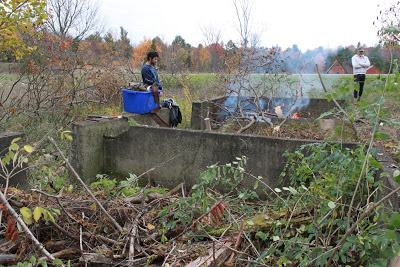
Mike and Adam last week took a chainsaw to the sumac and other trees within the foundation, which meant today was the day to clear (read: burn) all the brush so we have a blank canvas to work with.

Here are Jackson and Aaron getting to work:

...and here's the space mostly cleared out:

For the next step, Aaron will be applying his measurements of the space to determine what we need for tires to build exterior walls, and he'll be consulting with some real-deal architects to create legitimate architectural drawings to work off of.

We're going to need to pour a concrete floor or create a stone floor. Luckily, for us, we also found a bounty of original stone used for the old barn that we'll be making our hearth with. Here's the rest of our ideas list:

  • Get a work day together two to pull useable scraps together from the property and ready them for upcycling

  • Secure a source for lime mortar to be used on our walls

  • Get dimensions together for the structure, secure enough tires to build an earthship structure

  • Secure old barn wood for the interior ceiling

  • Utilize a strong roof appropriate for dirt and foliage cover

The completed space will be the start to a wellness center situated outside of the Art Barn; with yoga studio space, a sauna, outdoor shower, and more. What better use for a hobbit home?

If you would like to volunteer on this or any other projects, contact us at (315) 482-2536 or

info@betterfarm.org

.

1 Comment

Nicole Caldwell

Nicole Caldwell is a self-taught environmentalist, green-living savant and sustainability educator with more than a decade of professional writing experience. She is also the co-founder of Better Farm and president of betterArts. Nicole’s work has been featured in Mother Earth News, Reader’s Digest, Time Out New York, and many other publications. Her first book, Better: The Everyday Art of Sustainable Living, is due out this July through New Society Publishers.

A Day in the Life

Jackson Pittman, left, and Adam McBath finish work on a trailer for Rapunzels' new chicken coop.
A lot of people have expressed interest in what a "typical day" consists of at Better Farm. Simplest answer? It depends. Every day starts and ends with chores (feeding the animals, flipping on the grow light in the aquaponics, checking for eggs, herbs, veggies, and fruits ready for harvest, opening and closing the chicken coops), and on most days (weather permitting), the interns are outside all day working in the gardens or on a construction project. Other days (and in inclement weather), we get the morning chores done and have time to take a field trip, do some research, clean up inside, make house renovations, or have some down time.

While our interns have a set schedule and daily chores, our artists design their own days. They help out throughout the week on different activities, chores, and projects, but their focus is on their art. So an artist might keep to himself or herself for days at a time, reappearing for a flurry of activity. Our recent visiting betterArts resident Kevin Carr described one of his busy days like this:
Woke up at 8:30, fed chickens, harvested heirloom tomatoes, zucchini, cucumbers, broccoli, cherry tomatoes, and corn with Elyna,  stacked the other half of the fire wood, jarred the dried mint, figured out what the mystery herb was (lemon basil), and made lunch....and it's only 1:15. Now to shower, pick some herbs, make some bottle cap sculptures, and enjoy the rest of the day!
Meanwhile, our intern Jackson completed this list recently:
Fed fish, switched on grow light in aquaponics
Fed, watered chickens, checked for eggs
Organized green tomatoes inside according to ripeness
Cleaned upstairs bathrooms
Completed work on a trailer for one of the chicken coops
Went jogging 
We invite those staying at Better Farm to come up with projects that interest them, so the set curriculum here is always subject to change. Meeting the demands and imaginations of the people staying here has enriched our programming to include past and ongoing projects, including:
  • An upcoming hobbit house
  • Rainwater catchment systems
  • Cold frame construction
  • Forge building
  • Wood splitting
  • Aquaponics
  • Canning, blanching, and preserving
  • Vertical gardens
Better Farm functions for our interns and artists as a living laboratory in which to experiment, grow, and learn. But there's also an awful lot of bonding that goes on around here; with people opting to cook many meals together and invite members of the community out to enjoy family dinners, or participate in different projects on the property. Community outreach projects are determined by the people staying here; whether it's tabling at a local event, helping to paint the post office, offering workshops to the public, or building a community greenhouse.

Interest piqued? Click here to find out more.
Comment

Nicole Caldwell

Nicole Caldwell is a self-taught environmentalist, green-living savant and sustainability educator with more than a decade of professional writing experience. She is also the co-founder of Better Farm and president of betterArts. Nicole’s work has been featured in Mother Earth News, Reader’s Digest, Time Out New York, and many other publications. Her first book, Better: The Everyday Art of Sustainable Living, is due out this July through New Society Publishers.

Star Wars Update!

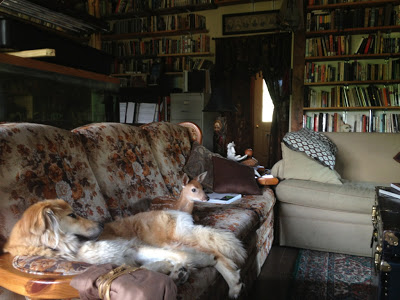
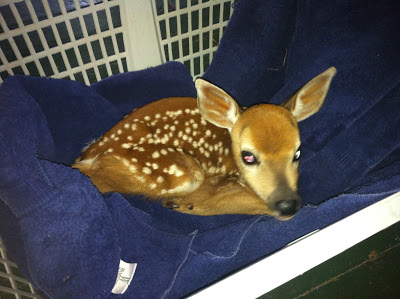
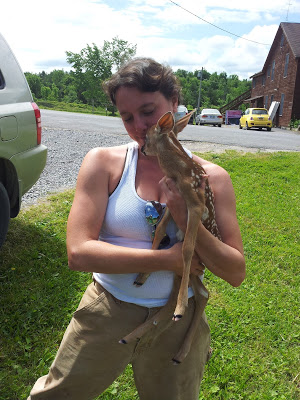
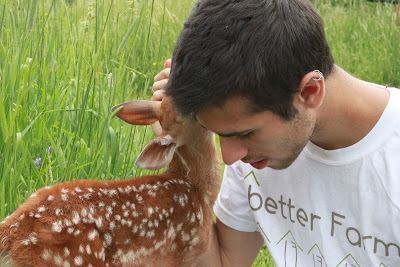
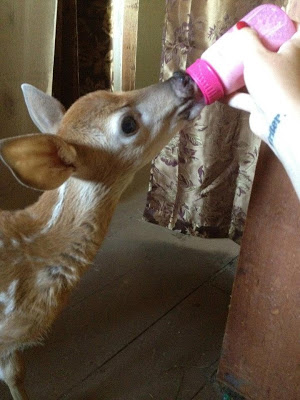
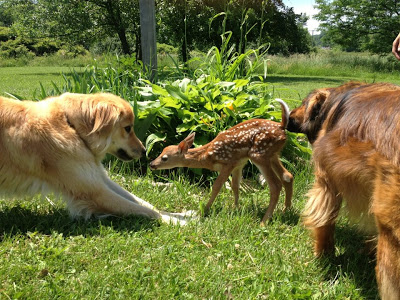
Back in June, an orphaned baby deer called Star Wars was delivered to Better Farm. Only a few days old and without a home or shelter in which to stay, we adopted the baby and raised her on special formula until she could go out on her own to forage in the wild.

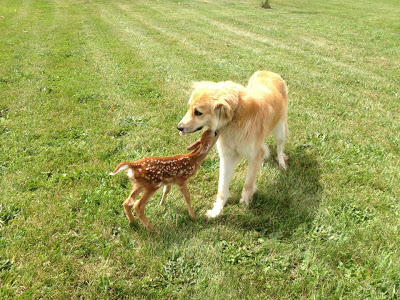
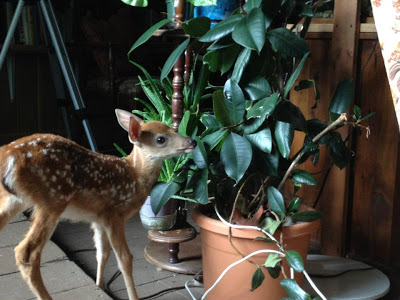
For almost two months she lived with us inside the main house (much to the dogs' delight), resting on couches, chewing on houseplants, and overnighting in laundry baskets, under beds, and on doggy blankets. We gave her as much time as possible outside so she could learn how to be self-sufficient and find her own food—as tempting as it was to just hold her and snuggle all day!


She cuddled, and explored the yard and garden, and bonded with people and dogs alike.
Then, one day, she went out on her own. The interns worried. The artists fretted. But Star Wars kept coming back—first she came by a few times in a day, then once a day to suck down a bunch of formula, then every other day, until we didn't see her anymore. A few times we saw her bounding in the far back if we crooned on a kazoo or otherwise mimicked her bleats. Then, nothing.

Almost three months have passed; and with the strong coyotes in the area and the recent start to hunting season, it's been questionable as to whether a baby deer raised by people and dogs would survive.

But yesterday, a neighbor was sitting in his tree stand a few hundred yards up the road from us. A small doe came out into a clearing. Our neighbor recognized the markings on the face, the shape of the head, and the movements. She began to bleat in an unmistakable way. When our neighbor answered the bleat, the small lady deer jumped, started. Then she pressed herself low to the ground. Our neighbor called out to her again. She jumped straight up into the air and bounded around in circles as we've only seen Star Wars do. She danced through the fields, circled back around, then was gone.

Stay tuned for photos...

Editor's note: If you ever find a wild animal in need of care, please make your first option a wise one and contact local authorities, shelters, and rehabilitation centers. Baby animals are surely adorable—but they are meant to be wild! Without careful, round-the-clock care, the results can be disastrous for everyone. Give every animal the space it requires to behave as it would in the wild. Animals you find are not pets!
Comment

Nicole Caldwell

Nicole Caldwell is a self-taught environmentalist, green-living savant and sustainability educator with more than a decade of professional writing experience. She is also the co-founder of Better Farm and president of betterArts. Nicole’s work has been featured in Mother Earth News, Reader’s Digest, Time Out New York, and many other publications. Her first book, Better: The Everyday Art of Sustainable Living, is due out this July through New Society Publishers.