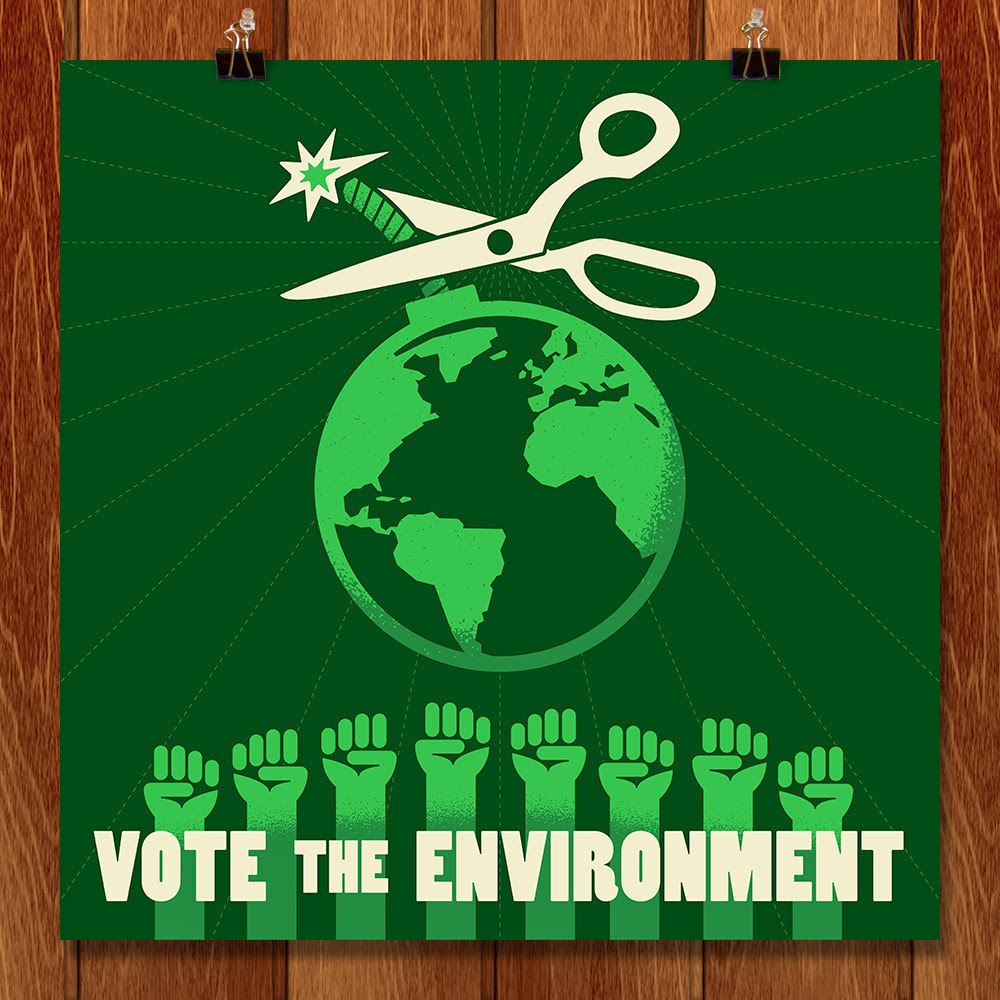
Vote the Environment, Why Don't You!

Poster by Erika Pitcher. Prints available here.
Consider the environment when you vote today.

Really. Think about it.

You may be really very seriously concerned about economics. Job growth. War chests. Gun control. Abortion. Maybe you are planning on voting for someone you don't like in order to ensure the incumbent gets tossed. Say you're voting based on who's better on women's rights. Gay rights. Civil rights. Healthcare. Balancing the budget. Supporting our military. Maybe you just really hate democrats.

Well, listen up: There's only one fundamental truth where each of us is concerned: We live or die based on the condition of the earth.

You don't get job growth without safe drinking water. There is no debate over gun safety without nourishing food. We have no security, no safety without fresh air to breathe. There is one thing that comes before every selfish, philanthropic, compassionate, arrogant stance we take in this world and that's the environment. She shields us, clothes us, feeds us, warms us, cools us, and only ever operates from a neutral, vibrant place.

It's time to stop carrying on in spite of her and start making moves because of her. These moves come in large part out of where we put our money and whose name we check on our voting ballots. Which politicians are willing to stand up and defend her? Who is unwavering in their devotion to Mother Dearest? Who understands the gravity of our environmental situation and the stakes? Whoever that is, that is who you need to go out and support. Today. Right now.
Poster by Kevin M. Fitzgeral. Prints available here.
A mere one-quarter of Americans between 18 and 29 years old are expected to vote in today’s midterm election, according to a study conducted by Harvard University. That is horrendous. Embarrassing. Too few. Hey, young people! We need you! Old people too! Everyone!!  I don't care if you're disillusioned by the two-party system or—gasp—whether you've finally figured out that all politicians are corrupted liars. Feel that way? Then start voting for the other person, the underdog, the green party or libertarian or independent. Better yet, why don't you put your neck out and run for something next go-round? Elected officials in small towns can actually make big changes for communities. In some ways, there's more power to effect change on the local level than there is for some puppet politician at the federal level. So get involved!

Look back in time, two, three, even four decades ago. There were glimmers then about what we were doing to the environment and to each other. A whole lot of people got together back in those days for the anti-war movement. John Lennon and Yoko Ono staged their bed protests: Hair Peace. Bed Peace. People harnessed their energy and pressured the political arena. And you know what? We pulled out of Vietnam. It happened. The republic had spoken. So why would it be so far-fetched to think that in this era, we might be able to harness that public energy again in order to make big, environmental changes? To abolish fracking once and for all? To finally put an end to drilling for oil? Or overall demand for oil? Or an overwhelming shift in perspective about how we live our lives in general? If the general public can end wars and push uptight politicians to accept recreational marijuana use, is it so far-fetched to think we could make compost toilets the norm and end our reliance on fracked gas and oil? Or that we could put an end to the endlessly diverted waterways out west? That we could refuse, with the force of millions, to subsidize huge corporations that couldn't care less about us?

It's not fair that we would have to be drowning below sea level or actually have run out of wild-caught fish for people to vote for the environment. California shouldn't have to dry out entirely for us to consider our elected officials' stances on water conservation. Glaciers shouldn't have to go the way of the woolly mammoth before we are willing to discuss climate change on a political level. Ditto for lakes and rivers being deemed unfishable, unswimmable before we're willing to vote for someone who will protect our waterways. Don't wait for every last ounce of oil to be drawn from the ground and every reserve to be cashed in on. Don't let some bigwig frack in every available spot, provide jobs for the next 80 years and make some fat cats even fatter; before we realize we can't actually eat all those dollar bills.

Give me a break.

Vote the Environment. She's the only renewable resource on the planet besides hope and love.
Vote Mother Earth. She's the only politician with a literal platform: the ground beneath your feet.
Vote the Planet: Because manufactured meat, farmed salmon, and GMOs ain't gonna cut it.

We are in the middle of a crisis far more interesting, exciting, terrifying and opportunistic than Miley Cyrus' latest rant, Lena Dunham's embarrassing memoir, or Brangelina's wedding photos. We're talking climate change. Extinction. Destruction of wild places. Record droughts. Rising sea levels. Severe storms and weather patterns. Dogs and cats, living together! It all keeps happening, even while we keep arguing over who we'll vote for based on who gives a crap about health care, birth control or how many bullets can go into a gun. This is like a magician getting you to look at one hand while he sleights with the other.

Stop being so distracted!

What if we refused to vote for the lesser evil in the polls and instead rooted for independents, libertarians, the Green Party—anyone who refused to stand down on environmental issues? What if we told the two-party system to take a hike?

It's time to draw the proverbial line in the sand: DO NOT CROSS! We will not let you! This has gone too far. We've had it!

So compost. Host farm-to-table dinner parties. Love each other and forgive and go love some more. Eat organic. Ditch sugar. Pick up trash, recycle, help to conserve our wild places. And, for goodness sakes, vote for priority numero uno! What good is that voice the world gave you if you don't use it to defend her?
Comment

Nicole Caldwell

Nicole Caldwell is a self-taught environmentalist, green-living savant and sustainability educator with more than a decade of professional writing experience. She is also the co-founder of Better Farm and president of betterArts. Nicole’s work has been featured in Mother Earth News, Reader’s Digest, Time Out New York, and many other publications. Her first book, Better: The Everyday Art of Sustainable Living, is due out this July through New Society Publishers.

Arts. Beats. Eats. Show Friday Nov. 7!

The North Country Arts Council's annual fall art show Arts Beats Eats has an opening evening and awards reception slated from 5:30-8:30 p.m. Friday, Nov. 7 at the Dulles State Office Building in Watertown.

Live entertainment, snacks, and refreshments will be provided. These include:
  • Performances by international recording artist, David R. Maracle, who plays spirit flutes as well as a variety of drums from around the world
  • Living statues by Fire Magic
  • Catering for the gallery opening by Northern Exposure 
  • Signature martini bar by the Paddock Club
  • Body- and face-painting by BrushStrokes by Melina
  • Live-painting demonstration by muralist Garrett McCarthy
  • Aaron Hall Photography Photobooth
Invitational artists for this opening include Better Farm and betterArts artists, David R. Maracle, Paul N. Pedersen, River Community Wellness Program, Soldier Art, and juried art from 65 artists throughout Northern New York.

A fundraiser will be held during the event for Dragonfly Pottery, a local business whose studio recently burned down. Pottery donated by area potters will be for sale. All proceeds from sales will be donated to Ann and John Donovan.

BONUS!! Combine your enjoyment with the Lyric Theater production of South Pacific. Musical begins at 7 p.m. Only 100 bundle tickets will be available! Save $2 off your Lyric ticket and your Arts Beats Eats ticket.

Tickets are $12 and on sale now online at www.nnyart.org or at these locations in Watertown, N.Y.:
  • Arts on the Square, 52 Public Square
  • Sherwood Florist at 1314 Washington St.
  • Kinney's Drugs locations on Washington Street, State Street and Coffeen Street
Here are bios of the "Better" contributing artists for this event:

Melissa Aulet, photography
Melissa Aulet is a transplant to the area who moved to Watertown in 2010. She is originally from New York City, where she went to college at the Fashion Institute of Technology. Since moving to the North Country, Melissa has worked as a Senior Account Executive at Tunes 92.5 Radio Station in Watertown. Her work there has included helping to create commercials, voice commercials, write proposals, create imaging for the website and facebook, and take photos for concerts and events. Melissa additionally runs her own photography studio called Sarissa Melissa Photography. That studio has grown exceptionally in just a few years from starting off taking family photos to shooting the Heart concert, Reba concert, to photos for the Hilton Gardens Billboard. Melissa has used the medium of photography in many different facets enjoying nature and landscape photography as a way to explore, and grow her talent, as well as study light, and color. She hopes to grow her business in the new year to include more spectacular nature and landscape pieces for collectors, in addition to creating art for families with customized family sessions. The possibilities are endless. Melissa most recently joined the board for BetterArts, a local arts and culture non-profit based out of Better Farm in Redwood. For that endeavor, Melissa utilizes her knowledge in marketing to promote the group and its many great events here in the North Country. In the next few months, Melissa will be working with the betterArts team on future events and the launch of Better Radio on WBTS 88.5 FM.
  
Nicole Caldwell, collage
Nicole Caldwell is the co-founder of Better Farm, a 65-acre sustainability campus, organic farm, and artists' colony which serves as a blueprint for environmentally conscious living. Better Farm attracts those who are interested in doing "better"— growing from each experience, serving their communities, and creating something that benefits the world around them. Nicole is president of the not-for-profit arts and music outreach initiative betterArts, which works in tandem with Better Farm to explore the intersection between sustainability and art. She also works as a professional writer and editor; her work has been featured in Mother Earth News, Reader's Digest, Time Out New York, and many others. Her first book, Better: The Everyday Art of Sustainable Living comes out in June 2015 through New Society Publishers.

Erica Hauser, Watercolor
Erica Hauser is a painter and illustrator currently based in Newburgh, NY. She grew up on a half-dirt road by a reservoir in Brewster, NY, and graduated in 2002 with a BFA from School of Visual Arts, after studying at both Cornell University in Ithaca and the Art Students League of NY. She lived in NYC for 7 years and moved to the Hudson Valley in 2007. Erica was a visiting betterArts resident during June of 2011.
www.ericahauser.com

Kathryn Mollica, woodburning
Kathryn Mollica graduated from Better Farm's Sustainability Education Program in August of 2013, and has since become the organization's director of education and farming. She graduated with a degree in business from Fairleigh Dickinson University and is in the process of laying the groundwork for her own business—a bakery called, fittingly, Mollica.
www.facebook.com/bakery.mollica

Natalie Collette Wood, sculpture
Natalie Collette Wood has degrees from Herbert H. Lehman College City University of New York and School of the Art Institute of Chicago. Her sculptures are like mythical creatures or submarine life forms with clear geometries and free form appendages in equal number. Created from found objects, the work is built from the PVC legacies of our civilization. Natalie lives and works in New York City. She was a visiting betterArts resident in August of 2013.  
http://nataliecollettewood.com 

This event is co sponsored by Stewarts Shops. The Dulles State Office Building is located at 317 Washington St. in Watertown, N.Y. for more information about this event, visit www.nyart.org.


Comment

Nicole Caldwell

Nicole Caldwell is a self-taught environmentalist, green-living savant and sustainability educator with more than a decade of professional writing experience. She is also the co-founder of Better Farm and president of betterArts. Nicole’s work has been featured in Mother Earth News, Reader’s Digest, Time Out New York, and many other publications. Her first book, Better: The Everyday Art of Sustainable Living, is due out this July through New Society Publishers.

Sustainable and Budget-Wise Living go Hand in Hand

By Helen Young

Many people assume that sustainable living is expensive and a luxury that only the very wealthy can afford. After all, organic vegetables cost more than regular vegetables,  and organic and sustainable living is very popular in the most affluent as well as the most forward

-

thinking areas of the country. 

This is a huge misconception.

Anyone can choose to live a sustainable lifestyle

 and pay attention to the environmental impact of the food they eat each day, and this can go hand in hand with budget living. In fact, you may even find that living sustainably is cheaper than living a mainstream lifestyle! Thinking about making the move to sustainable living and eating but have no real idea where to start? Here are a few hints and tips to gently introduce yourself to sustainable living:

Think About Where Your Food Comes From

One of the first and most simple changes to make if you’re working towards sustainable and environmentally friendly living is to 

think about where your food comes from

. Of course surest way to eat sustainably is to grow and produce everything you eat yourself; but whilst some people may relish the idea of starting their own small vegetable patch, very few will have the land available to grow absolutely everything they need. If that’s the case then why not try to source all of your fruit and vegetables from local organic farmers instead? There are many benefits that come from buying direct from your local farm: firstly you’ll know where your food is coming from and can speak to the farmer directly about their growing methods and any chemical processes they may use. In buying locally you’ll also minimize the number of food miles your veggies have to travel before they reach your plate thus lowering the ultimate carbon footprint of their production. Concerned about your budget? It may surprise you to know that buying your veggies directly from where they’re grown is 

often cheaper than heading to the grocery store

, provided the veggies you are looking for are in season and plentiful. Farmers are often pleased to sell on their surplus at a lower price, particularly items that don’t meet the grocery stores stringent aesthetic rules about size and shape but are otherwise tasty and delicious.

Reuse, Reduce, Recycle

It is the simplest of all sustainable methods and one that most children are taught at elementary school. 

Reuse, reduce, recycle

. Reuse whatever items you can, reduce the amount of waste you send to land fill, and recycle whenever possible. Yet it is mind boggling and amazing how few adults manage to stick to this simple lesson! If your keen to make your home a more sustainable environment then start thinking about the waste you are producing; what could you be recycling, what could you be reusing? Small changes, such as purchasing a reusable shopper bag and using it in lieu of a plastic bag whenever you visit your local store is a very minor change but can have a big impact. Reusing and recycling can also help you to save money; you simply need to readjust your mindset and think creatively about the additional purposes goods you might ordinarily throw away could serve.

Work With The Wider Community                     

One of the most important ways that you can begin your journey towards a sustainable lifestyle is by embracing the sustainable community and working together with your own community leaders. This will prove particularly useful if you are new to the concept of sustainability and would like some guidance and support: there are many local sustainability groups located throughout the country. Here you will be able to swap hints and tips, organic growers will be able to share or swap any surplus of produce and you may even find a volunteer network that you can join with the aim of supporting local projects and simultaneously spreading the sustainable message.

There’s no denying that true sustainable living is hard work and will take a huge amount of dedication. But it is possible to begin taking steps towards sustainable living, and bring an important sustainable message to your family, without making too many significant changes to your existing lifestyle.

Helen Young is a contributing writer to Better Farm's blog. She worked in health for more a decade before

becoming a mother made her reassess things. With work being so busy and intense, she wanted to step back, spend more time with her babies while they were still young, and develop her passion for writing. Helen's work covers many topics from physical and mental health topics to food, nutrition

and sports.

BetterArts Board Member Opens New Gallery Space in Rutland Center

Kari Zelson Robertson

presents

Soft Open

From 12-5 p.m. Nov.1 2, the little gallery will be open, displaying a selection of my ceramic work, handbuilt and wheel-thrown.

Located at 28279 Route 126, Rutland Center, our place is about 3.5 miles east of Watertown, NY. Look for that cute little building and the tall silo.

The studio, attached to our farmhouse, will also be open! Light refreshments and snacks, too.

Come out and and hang, talk, nibble, see my new work. I look forward to seeing you! Kari Zelson Robertson is a board member with betterArts, a non-profit whose mission is to increase access to the arts throughout the North Country. To learn more, click here.
Comment

Nicole Caldwell

Nicole Caldwell is a self-taught environmentalist, green-living savant and sustainability educator with more than a decade of professional writing experience. She is also the co-founder of Better Farm and president of betterArts. Nicole’s work has been featured in Mother Earth News, Reader’s Digest, Time Out New York, and many other publications. Her first book, Better: The Everyday Art of Sustainable Living, is due out this July through New Society Publishers.

Photos from Sackets Harbor's Fall Faire

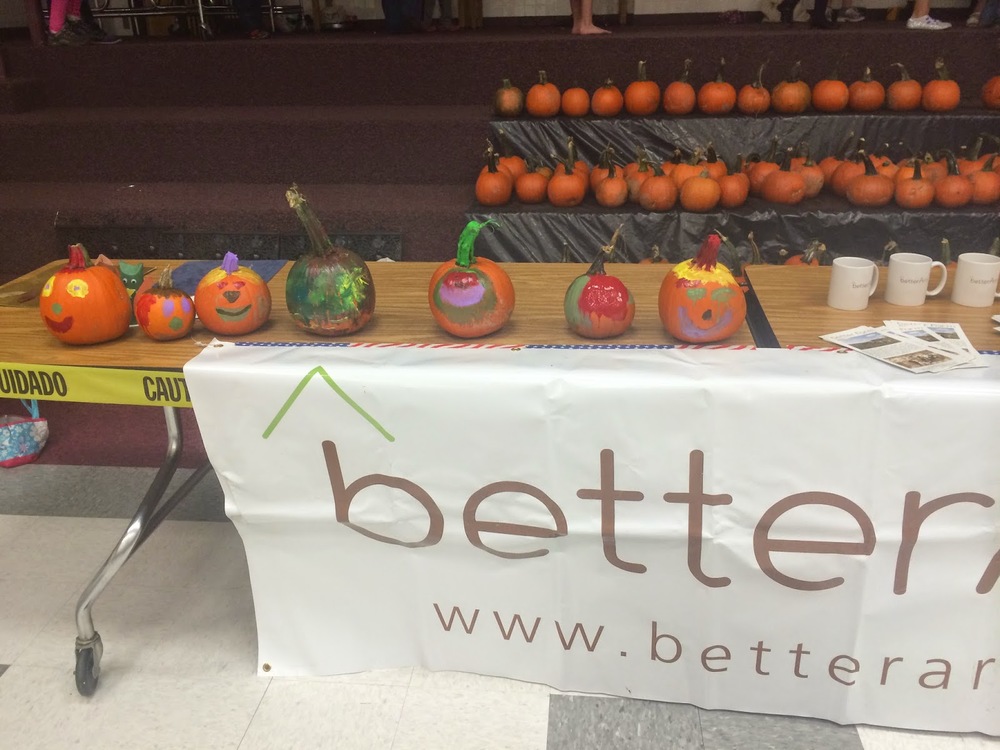
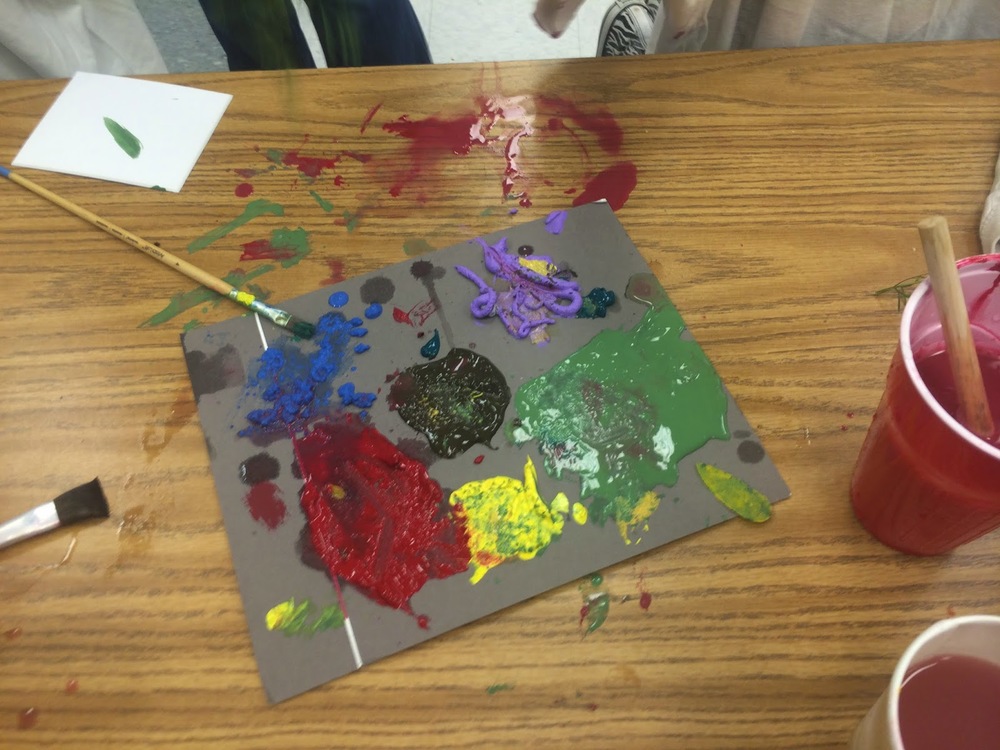
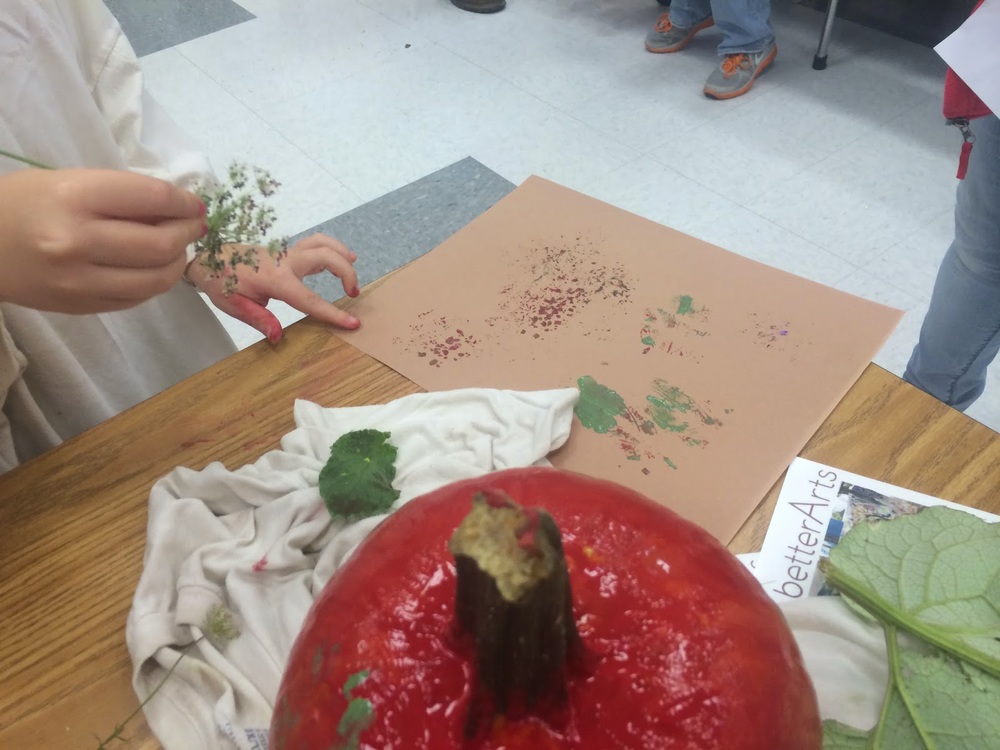
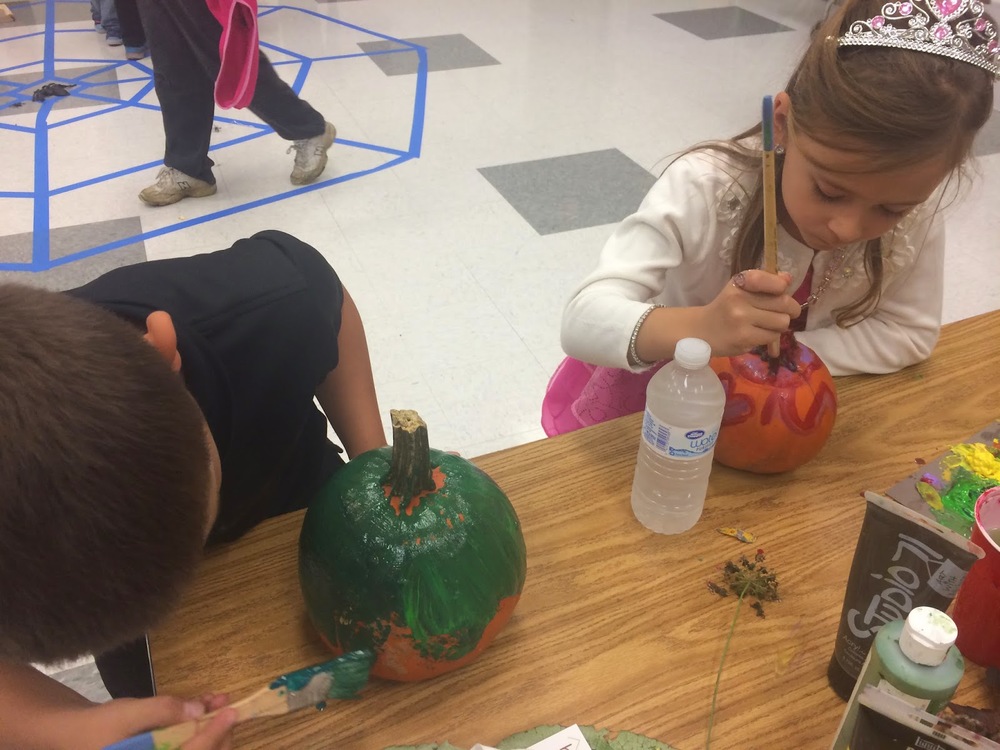
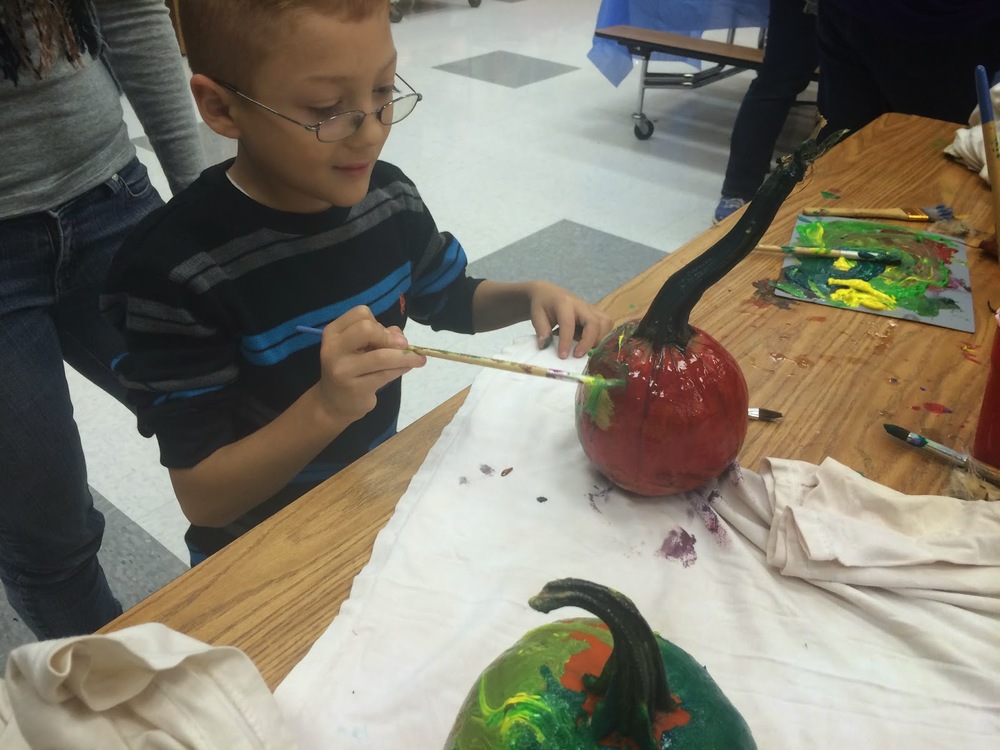
BetterArts on Saturday participated in Sackets Harbor PTO's Royal Fall Faire at Sackets Central School in order to provide children with an arts 'n' crafts station that included leaf printing, decorating pumpkins, and face painting.

The kids had a blast making their pumpkins totally expressive, colorful works of art. And yes, the adults enjoyed getting their hands dirty as well! Here are some photos from the day:


Many thanks to the Sackets Harbor Central School PTO for inviting betterArts to this wonderful event! For more informatio on the work of betterArts, visit www.betterarts.org.
Comment

Nicole Caldwell

Nicole Caldwell is a self-taught environmentalist, green-living savant and sustainability educator with more than a decade of professional writing experience. She is also the co-founder of Better Farm and president of betterArts. Nicole’s work has been featured in Mother Earth News, Reader’s Digest, Time Out New York, and many other publications. Her first book, Better: The Everyday Art of Sustainable Living, is due out this July through New Society Publishers.

Heating the Home with Renewable Resources

In the United States, energy use accounts for 82 percent of our greenhouse gas emissions. Fracking for shale gas brings with it a host of environmental concerns (shale gas is expected to comprise 50 percent of all natural gas produced in the U.S. by 2035, by the way), while our continued reliance on coal and oil are killing the planet (if you want to ruin your day, check out this ever-timely article by Bill McKibben in Rolling Stone). But there are renewable resources we could be tapping into in order to heat our homes this winter.

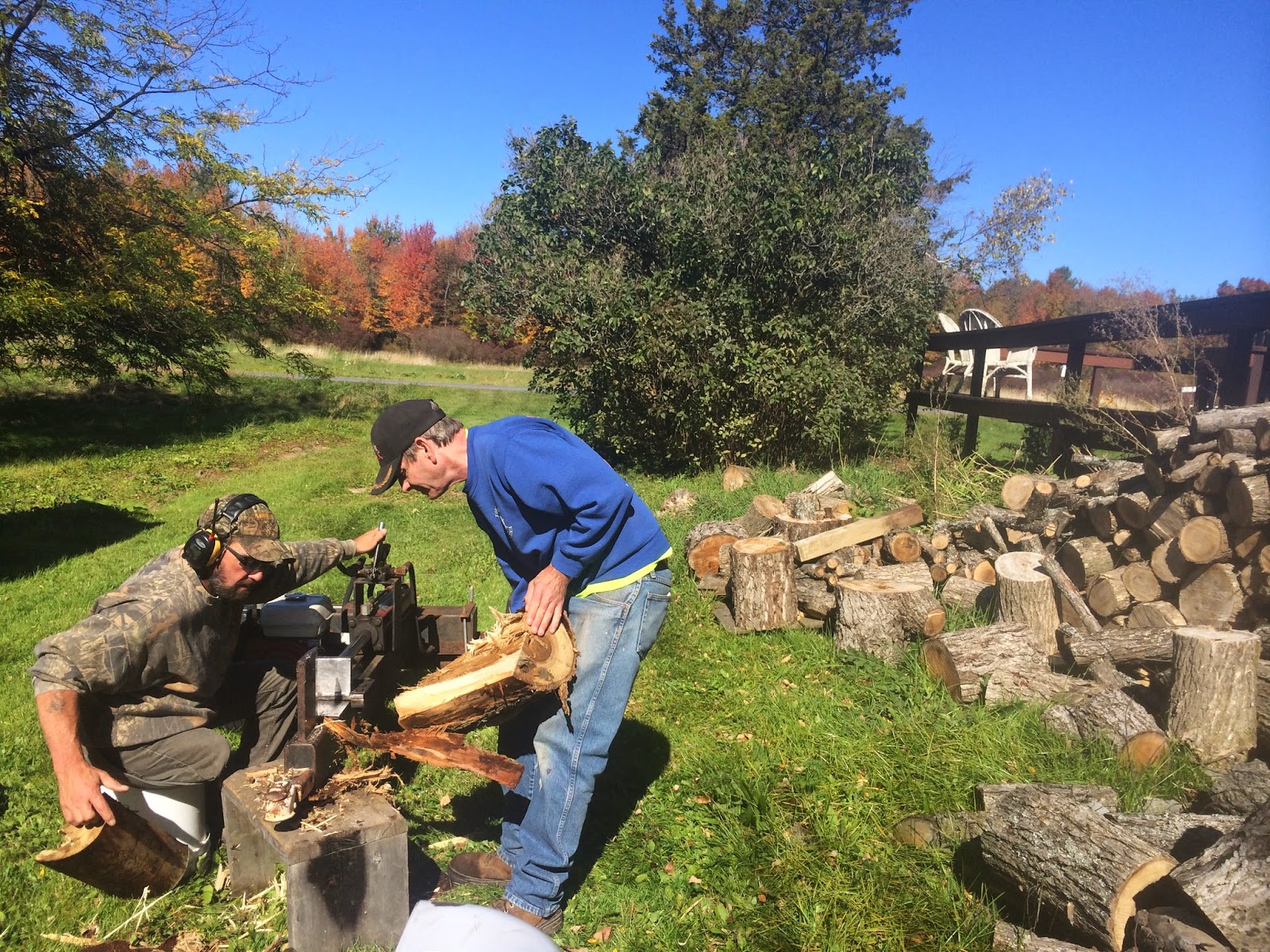
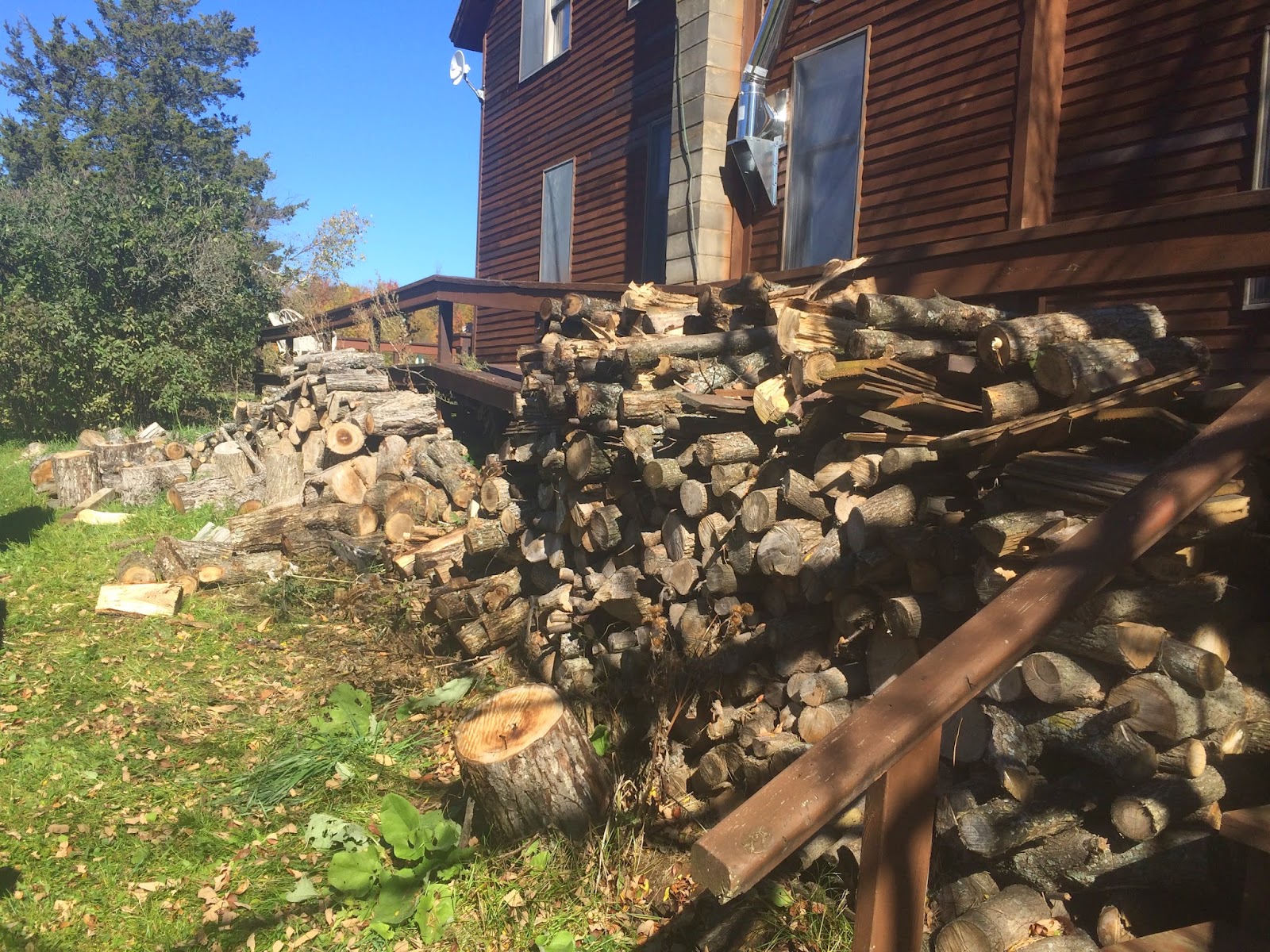
To get Better Farm off its fuel-oil furnace, we're now sporting a wood stove (utilizing standing-dead trees on the property and logs from a woodlot three miles away) and pellet stove. We of course realize these options aren't available to everyone. So depending on where you live and what's available to you, consider looking into one of these options for producing heat in your home this year.

Geothermal

Geothermal solutions are prized for their efficiency. These all-in-one 'forced-air' or 'water-to-air' systems can provide comfort to your home more efficiently than any other type of ordinary system. Put simply, geothermal is a method for heating and cooling a structure using the constant ground temperature. In reality the Earth is the world’s largest solar collector and at depths of roughly 5 feet below grade the Earth has stored enough energy to maintain about a 50 degree temperature ( in our area of Pennsylvania) year round. Geothermal heating and cooling utilizes a ‘ground source’ heat pump to either extract heat from the ground during the winter or reject heat into the ground during the summer. While the geothermal setup will pull additional electric, a solar kit can change all that.

(Western Pennsylvania Geothermal Heating and Cooling, Inc.)

Solar-Powered Heat Pump

Modern ductless, mini-split air source heat pumps (ASHPs) run 2-3x as efficiently as traditional 'resistive' electric heat, making the cost to run the units equivalent to buying oil at $1.68/gallon.

Simultaneously, they provide air conditioning using half the energy as traditional window or central air conditioning systems. Best yet—by installing a solar electric array to power the electric consumption of the heat pumps, you effectively have a solar space-heating system. Your solar array will generate credits in the summertime (when it is sunniest) which allow you to run the heat pumps in the wintertime (when it is coldest). Your system will effortlessly generate all the 'fuel' it ever needs from clean, abundant sunshine!

(From ReVision Energy)

Pellet Stoves

The new pellet stove coming soon to Better Farm's library.

For those who like wood stoves but don't love handling firewood and tending the fire, pellet stoves are great options and utilize totally renewable resources. Pellets for these stoves are made from  compressed wood byproducts and other biomass. The appliances vary from designs that are lit manually, with heat output controlled directly by the homeowner using a dial or buttons, to those units that ignite electrically, with pellet supply and heat output controlled automatically by a wall-mounted thermostat. Wood pellets produce almost no net climate-changing carbon dioxide if they are used as fuel — although some fossil fuels typically are used in the manufacture and transportation of pellets. The technology for modern residential pellet heating systems was invented back in 1983. This technology is now reliable, mature, and effective. The main question left to answer is whether the pellet lifestyle makes sense for you. And to answer this question you need a glimpse inside the process.

(Mother Earth News)

Wood Heat

Wood is a totally renewable resource. If you live on a lot of property, there are seemingly endless reserves of standing-dead trees that can be harvested in a responsible way. We scored more than eight cords this year by doing responsible tree-felling in the woods at Better Farm alone, and there is plenty more where that came from. A few wood heat facts:

  • Wood-burning stoves are better in environmental terms as the amount of carbon dioxide released into the atmosphere is the same as that absorbed by the tree during growth.

  • Trees are a renewable resource (particularly when derived from plantations and cultivated woodland; or in our case, when you plant new trees and only cut down standing-dead ones). 

  • Wood ashes can be used very successfully in the vegetable garden (except in the area where you plan to grow potatoes). Mix the ash thoroughly with your soil. Tomatoes seem to benefit especially from soil that has been mixed with a small quantity of wood ash.

  • Nothing is cozier than sitting around inside on a frigid day in front of a toasty-warm wood stove. Nothing.

Care to share your methods of alternative heat? Email info@betterfarm.org.

BetterArts Offers Arts 'n' Crafts at Royal Fall Faire in Sackets Harbor

Image from Art News 4 U.

BetterArts will be running arts 'n' crafts stations at Sackets Harbor PTO's annual harvest festival Royal Fall Faire from 11 a.m.-4 p.m. this Saturday, Oct. 18, at Sackets Harbor Central School.
The all-ages event features free admission, food, drinks, vendors, a cake walk, and more. Volunteers from betterArts will be at the event to offer face painting, leaf printing, and pumpkin decorating (pumpkins will be provided!).

BetterArts is a 501(c)3 non-profit organization dedicated to increasing access to the arts throughout Redwood, N.Y. and surrounding areas through the provision of workshops, community outreach, residencies, private instruction, studio and gallery space, performances and events. The group's purpose is to make the arts available to all. 

Sackets Harbor Central School is located at 215 S Broad St. in Sackets Harbor, N.Y.
Comment

Nicole Caldwell

Nicole Caldwell is a self-taught environmentalist, green-living savant and sustainability educator with more than a decade of professional writing experience. She is also the co-founder of Better Farm and president of betterArts. Nicole’s work has been featured in Mother Earth News, Reader’s Digest, Time Out New York, and many other publications. Her first book, Better: The Everyday Art of Sustainable Living, is due out this July through New Society Publishers.

Better Farm's Partnership with Airbnb Brings Tourism, Sustainability to Redwood

Better Farm since March has hosted more than 60 reservations through Airbnb, furthering the farm's mission of sustainable living—and travel.

Airbnb recently released its first environmental impact study on the sustainability of home sharing—which is what the company is all about—and found that Airbnb guests in North America use a full 63 percent less energy than hotel guests. That's enough to power 19,000 homes for an entire year.

Airbnb was founded in 2008 and allows people to search for alternative lodging to cookie-cutter hotel rooms. The company has more than 800,000 listings in 33,000 cities and 192 countries, largely comprised of room-shares or entire homes available for a night, week, or longer. Hammocks, private castles or islands, or more run-of-the-mill city apartments and bungalows are all listed on the site. Users must register and create a personal online profile before making a booking. Each property is associated with a host whose profile includes recommendations by other users, reviews by previous guests, as well as a response rating and private messaging system.

Here are some more highlights from the study:
  • In one year alone, Airbnb guests in North America saved the equivalent of 270 Olympic-sized pools of water while avoiding the greenhouse gas emissions equivalent to 33,000 cars on North American roads.
  • Airbnb hosts also tend to engage in sustainable practices. Nearly 83% of Airbnb hosts in North America report owning at least one energy efficient appliance at their property.
  • In North America, 95% of Airbnb hosts say they recycle at least one item type at their property; 94% of guests report that they recycle when possible.
  • When staying at an Airbnb, guests are 10-15% more likely to use public transportation, walk or bicycle as their primary mode of transportation than if they had stayed at a hotel.

Check out our listing on Airbnb here.
Comment

Nicole Caldwell

Nicole Caldwell is a self-taught environmentalist, green-living savant and sustainability educator with more than a decade of professional writing experience. She is also the co-founder of Better Farm and president of betterArts. Nicole’s work has been featured in Mother Earth News, Reader’s Digest, Time Out New York, and many other publications. Her first book, Better: The Everyday Art of Sustainable Living, is due out this July through New Society Publishers.

Better Radio Update: Tower Installed!


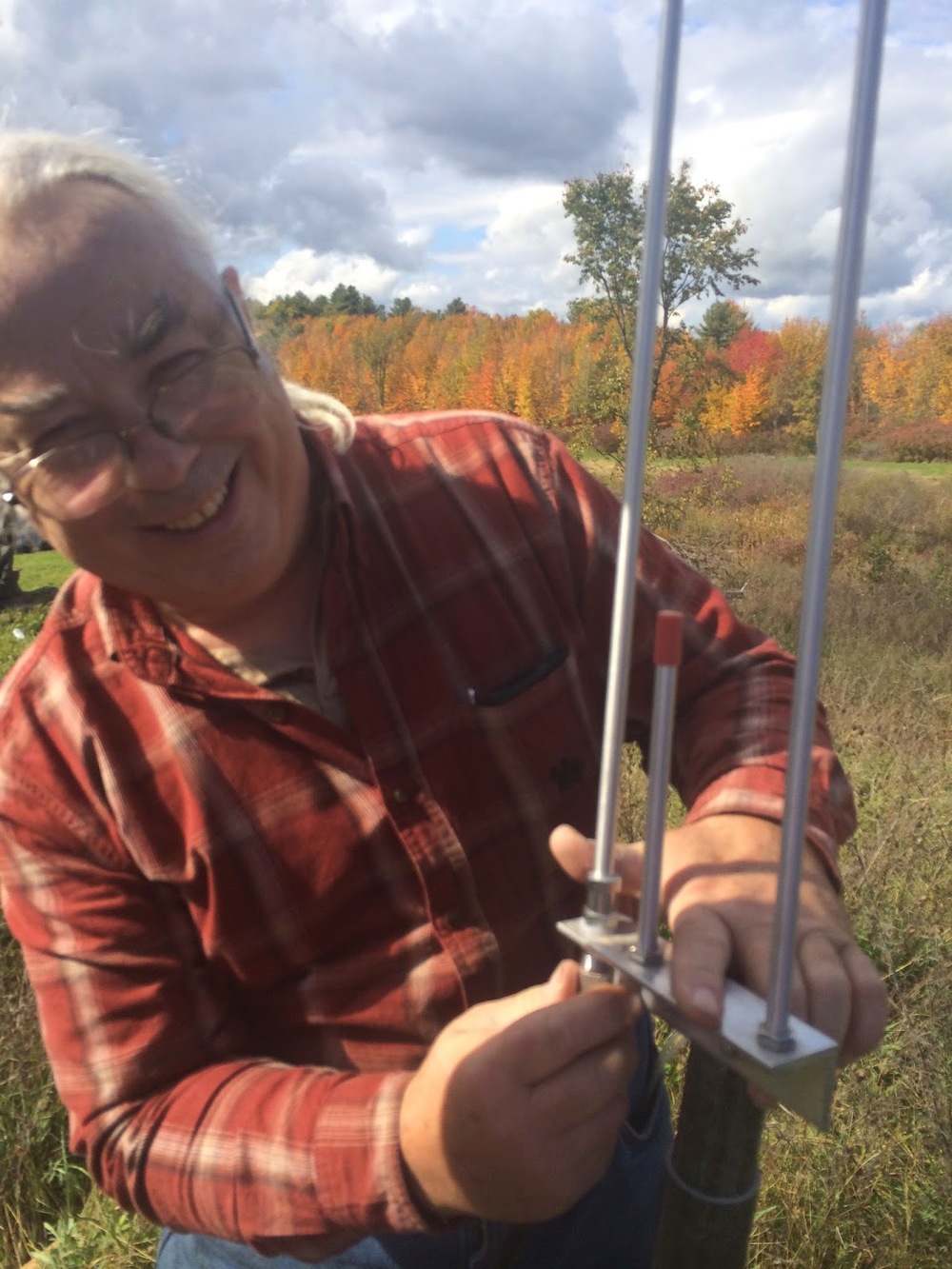
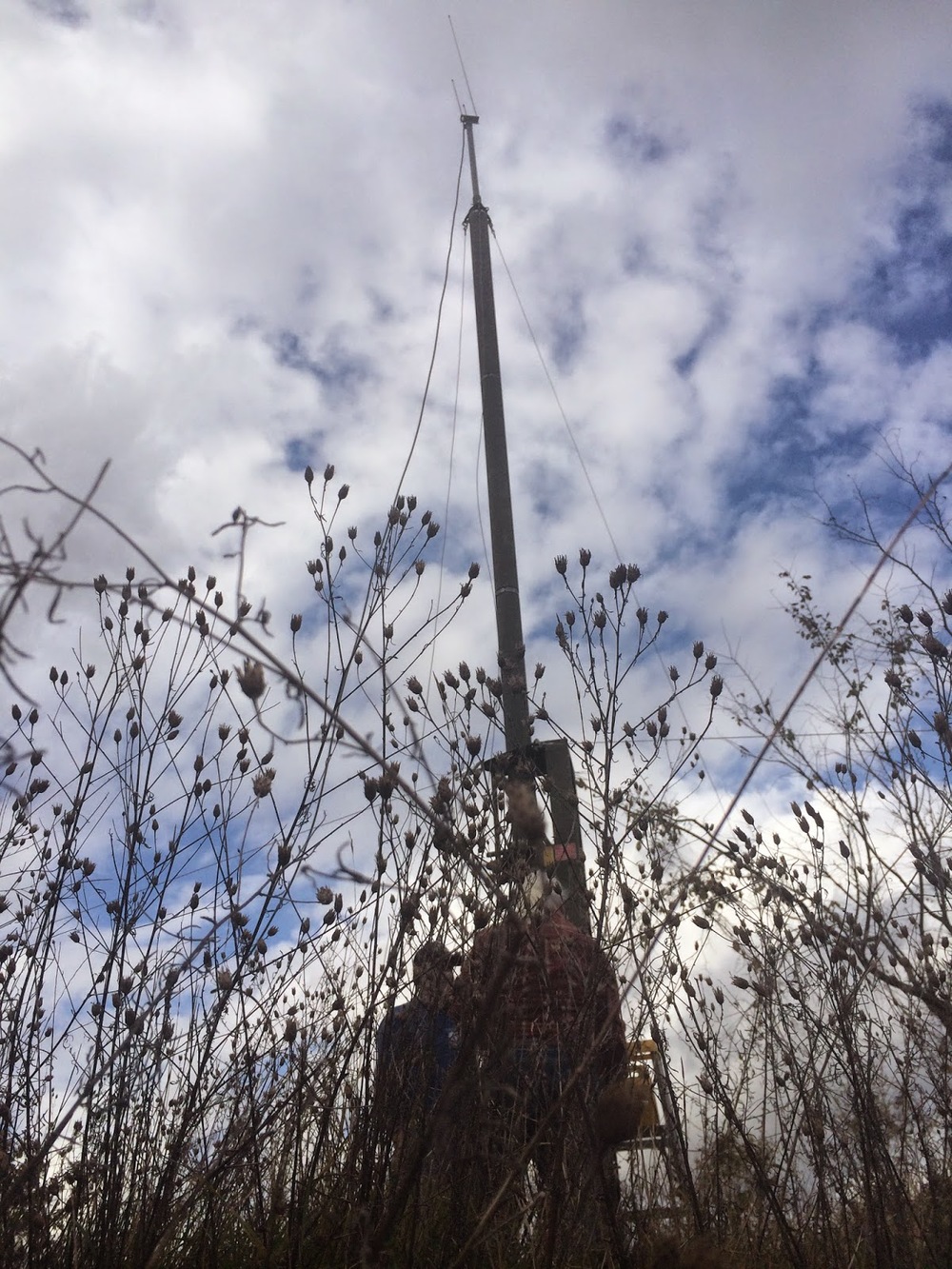
Volunteers got together over the weekend to install Better Radio's tower, which will broadcast in 2015 from WBTS 88.5 FM.

Ham radio operator Walter Dutcher out of Rochester, N.Y., shared his extensive knowledge of radio frequencies and operating procedures which allowed the Better Radio committee, a division of betterArts, to experiment with signal strength and to get a better idea of how this project will work.

Walter, along with Rossie native Carl Frizzell, installed the radio tower on Saturday; and on Sunday Better Radio volunteers Eileen Kaleel and Dave Aitcheson did a signal-strength test locally to see where Better Radio will theoretically reach.
Communiques with fellow ham-radio operators living locally, along with the test drive, produced some startling results: Better Radio's reach is further than originally thought! Here's the short list (more test drives to come!):
  • Downtown Alexandria Bay
  • Kring's Point
  • Thousand Islands Winery
  • Downtown LaFargeville
  • Downtown Theresa
  • Evans Mills (limited signal)
  • Rossie
  • Downtown Redwood
  • The Indian River Lakes
  • Hammond
Here's the technical info, brought to you by Walter:

We have a construction permit for 100 W radiated power at 88.5 MHz.  We  have done a coverage evaluation at our location using 50 Watts FM into a HAM antenna (J pole) at 146.535 MHz using the tower and location we want to use for the LPFM station.  With 50 Watts, we got very respectable coverage all around us.  We have approximately a 10-mile radius before signal begins to drop off.  So, we would like to purchase equipment that we can use at this power range with the option to crank it up to our legal limit if necessary.  We ran the test using a 50’ tower and LMR-400 cable.  We have a supply of LDF4-50A which we can use for the permanent feedline. 

We need the transmitter and a good antenna; and the transmitter needs to have the FCC approval for this type of operation and some strong features  like RDS for station identification, ability to handle emergency broadcast feed (although we may start out on the cheap for this and bring a signal into our mixing console) but need the break in  capability for future, good compression and level balancing. We have funds raised throughout the last year to put toward this purchase, with additional fundraising ongoing. (To donate to the cause, email info@betterarts.org for tax-deductible donation information.)

We would like to be on the air around June 2015 but would love to get something up before the snow flies too much here for more testing and to aid in program development.
With all of that in mind, the next few months will be spent producing and archiving content—along with a few test broadcasts. Stay tuned for more updates on that so you can tune in!

If you would like to join the Better Radio family as a volunteer, producer, station hand, journalist, or benefactor, please contact info@betterarts.org or call (315) 482-2536. 
Comment

Nicole Caldwell

Nicole Caldwell is a self-taught environmentalist, green-living savant and sustainability educator with more than a decade of professional writing experience. She is also the co-founder of Better Farm and president of betterArts. Nicole’s work has been featured in Mother Earth News, Reader’s Digest, Time Out New York, and many other publications. Her first book, Better: The Everyday Art of Sustainable Living, is due out this July through New Society Publishers.

Autumn Newsletter

Hello, Friends of Better Farm!
 

Better Farm News - Autumn 2014:


• News: All the Latest Buzz Around the Farm!

• Summer's Cast of Characters

• Better Radio Update

• Upcoming Events


The Farmer's Almanac recently listed an Upstate New York park as the best spot for witnessing fall foliage, and we can see why. New York State has some of the most unbelievable landscapes and such a variety of trees! We've been enjoying the ever-changing color palette going on all around us as we continue to pull pound after pound of organic produce from the garden, ready the grounds for winter, and take the rare few moments of free time we have to sit on the decks and simply watch the leaves turn.

We have you to thank for another record-setting summer. Read on to get the full rundown! Looking ahead into fall, we've got our radio station to set up and a flurry of seasonal events to ready for.

In other exciting news, my new book is slated for release in June 2015! Better: The Everyday Art of Sustainable Living explores the intersection of sustainability and art, showing how each of us can reinvent our lives as our greatest artistic achievement. I am so excited to share this with all of you. It's got tons of interesting Better Farm history, behind-the-scenes tidbits on my own transition to the North Country, and insights on how we can tackle environmental problems and cultural isolation in new, creative and better ways. For more information on the book or to pre-order a copy, click here. A book tour, signings, and other Better-related events will start popping up in the winter and spring, so stay tuned!

As always, check in at our blog to follow all Better Farm's daily adventures. And moving forward, you can look forward to a shorter, monthly email to keep you updated on all things better.
 
Until next time, better be.

Nicole Caldwell
Executive Director and Co-Founder
Better Farm
---


News: All the Buzz Around the Farm!

People from Better Farm and non-profit betterArts have stayed mighty busy this year with community outreach activities, projects around the farm, and new initiatives. Here's a review of all recent things "better":
  • Better Farm to be Featured in Ways of Living DocumentaryWays of Living follows a road trip around America in search of alternative and sustainable ways of life. The focus is love, posi vibes, living freely, wide open hearts, harming nothing. The film—due out this winter and produced by filmmakers Jessica Watkins and Harper Cowan—explores alternative technologies and sustainable practices, and features interviews with all sorts of people—artists, musicians, farmers, commune dwellers, earth ship builders and the like! The ladies paid us a visit last month—click here to track their progress!
  • Better Farm Takes First Place in Field Days Parade—Torrential downpours couldn't stop the Better Family from showing up en masse at the Redwood Volunteer Fire Department's Firemen's Field Days this year. We made a patriot-themed float for the Field Days Parade, and outfitted the crew in Uncle Sam and Rosie the Riveter costumes. Dancing our way along the parade route in a rainstorm with oldies blasting, we wooed the judges and took home first place. Check out photos from the event here.
  • Summer Workshops—betterArts and Better Farm this year offered workshops in weaving, beginner's piano, upcycling, building with recycled materials, poetry, film, and winemaking.
  • Summer Festivals—betterArts this summer organized two very successful festivals, Better Festival and Summerfest. Held in June and July, these events showcased local artists and musicians, offered farm tours to the public, and featured farm-fresh food, arts 'n' crafts, and a great time for all. Thanks for helping these events be so successful!
  • Better Bees—We've established a "better" beehive at the farm, and now understand the term "busy bee" in new ways. These insects have been unbelievably busy helping to pollinate produce in the garden and creating quite the honey collection. Get ready for Better Honey in Spring 2015!
  • Partnership Brings Fresh Produce to Redwood Food PantryA new partnership has turned the Redwood Community Greenhouse into a produce operation that will supply fresh greens and veggies to the Redwood Food Pantry. Local organizations Hearts for Youth, Redwood Neighborhood Association, and Better Farm have teamed up to provide volunteer hours that will cultivate fresh, organic produce earmarked specifically for use by the Redwood Food Pantry. To that end, the Community Greenhouse has been relocated to Better Farm in order to receive the round-the-clock attention and watering a summer greenhouse requires; while also taking advantage of the extended growing season a greenhouse can provide. This winter, Better Farm's chickens will heat the greenhouse to allow crops to be grown well into snow season.
  • Better Mud Run—Better Farm in July hosted a Better Mud Run that featured more than 20 obstacles and invited the fiercest  athletes and thrill-seekers to the Better Farm campus for agility obstacles, a road run, scaling mountains, and—of course—getting really, really muddy. Special thanks go out to the Redwood Volunteer Fire Department for helping us get the course good and wet!
  • Flock Expansion—Better Farm expanded its flock this year in two ways: one, with the rescue of whopping 27 more hens from a nearby egg factory; and with the stork-like arrival of a bunch of just-hatched birds representing breeds Yokohama, Light Brahma, German Spitzhauben, and Buff Orpington. We were able to adopt out several of the rescue chickens, and the remaining sponsored rescues—along with their exotic new roommates—will help to diversify and strengthen the gene pool for a fresh hatching next spring.
---

Summer's Cast of Characters

It was a women-centric summer, with the majority of visitors, residents, and students sporting double-X chromosomes. Here's a recap of our artists and students since June:
  • Allison Bachner, sustainability student in August who recently graduated St. Lawrence University;
  • Kiran Chandra, betterArts resident who created a body of work investigating notions of time, place, communication, and dialogue. She works with paper, water colors, India and colored inks, spoken word, and video. Kiran earned a bachelor's degree from St. Stephen's College at Delhi University in India before moving from Calcutta to Boston to earn a secondary bachelor's in fine art from the Art Institute of Boston. In 2013 she earned an MFA from Hunter College in Manhattan. She now lives in Brooklyn, where she is a teaching artist with various organizations throughout New York City;
  • Xuan Du, sustainability student in July and August attending Colby College in Maine;
  • Maggie Fishman, graphic novelist and betterArts resident based in Brooklyn who focuses on drawing, painting and graphic poetry. In addition to her work as a professional artist, Fishman has worked in education, activism, anthropology, and writing while exploring how we put beliefs into action, how we connect the personal with political and artistic expression and social change—and how we can nurture and educate the next generation to build the world anew. Her ongoing graphic novel, The End of Oil, is a series of drawings and paintings in ink and watercolor which Fishman is building into a book. The pieces explore how common stories and themes shared by humanity are acted out in a world we are told is near its end. Fishman used her betterArts residency to work on the second section, using her time in a community-based living situation to reflect and clarify the themes and stories in her work. Fishman possesses a PhD with Honors in cultural anthropology from New York University, a BA with honors from Haverford College, and has earned fellowships and scholarships to New York University and the New York Studio School. She has worked as a lead researcher, visiting professor, adjunct instructor, and developer for arts outreach organizations and at colleges; and is co-founder of the River School Project. Her work has been featured in solo and group exhibitions for more than 20 years;
  • April Lee, betterArts resident who spent July and August working on pieces for her senior thesis exhibition at Princeton University. A visual arts major, April explored wet media and sculpture during her residency;
  • Katie Mollica, full-time staffer who ran our sustainability education program and who also works with wood-burning, woodworking, and is starting her own cupcake business (check her baked goods out here!); and
  • Mary Negro, betterArts resident based out of New York City who works with drawings and collage. Mary's work centers around her feelings toward technology, the media, and digital methods of communication. She has degrees from Fordham University's College of Rose Hill and the Fashion Institute of Technology.
---

Better Radio Update!

We've spent the last year creating a beginning archive of content for the soon-to-air Better Radio. We've had lots of help—from the public, from students at area high schools, and from artists willing to share their music with us. We have a tentative kick-off air date of June 2015. This weekend we'll be testing our tower to see where we get the the best frequency. We've also appointed a director of content for Better Radio, Allen Briggs. Allen is a board member of betterArts and is excited to help steer this project. If you're interested in volunteering or helping to produce content, get in touch at info@betterarts.org. And let your broadcast friends know they can apply for a residency through betterArts that would focus on New Media!
---
Upcoming Events
Here's a quick rundown of upcoming events. For more information, email info@betterfarm.org.
  • Oct. 18 —Sackets Harbor Fall Festival
  • Oct. 23—Indian River Middle School Health Fair 5-7 p.m.
  • November Date TBD—Community Thanksgiving Dinner Potluck, 4 p.m. Email info@betterfarm.org or call (315) 482-2536 to sign up!
  • Dec. 8—Nicole Caldwell guest lectures at Jefferson Community College to Intro to Business students, 12:20-1 p.m.
  • December Date TBD— Hospice of Watertown Christmas party with kids
---

Better Farm's Sustainability Education Program

Better Farm’s Sustainability Education Program was created to offer individuals an immersive, introductory crash-course in sustainability initiatives. Those enrolled in the program receive a hands-on education in a myriad of seasonal topics related to sustainability and environmental issues. Instead of a traditional working farm with acres upon acres of one or a few different crops, Better Farm has many gardens demonstrating different styles of small-scale farming and stressing the need for diversity of crops instead of mono cultures. Better Farm equips students with a variety of solutions to real-world agricultural issues, including small spaces, temperamental soils, pests, and climate change. The aquaponics, hydroponics, layered gardens, fruit orchard, and forests on the property are extremely varied so students coming from all over the world will learn real-world tools that can be applied back home. The Sustainability Education Program runs in one- to three-month intervals year-round. Those attending receive daily assignments and chores all related to sustainability initiatives and organic farming, as well as the opportunity to design and implement projects on their own. Upon completion of all units and responsibilities, participants will receive a certificate from Better Farm. College students may additionally receive course credit for completion of Better Farm's Sustainability Education Program. To learn more and to apply, visit www.betterfarm.org/sustainability-internship.

---

betterArts Residency Program

betterArts offers a unique opportunity to artists, writers, performers, and musicians with a residency program based out of Better Farm. Residencies are designed to offer artists of every discipline space and time to work on specific projects; whether a series of paintings, a composition, book, set of sculptures, or album. A private room, 24/7 access to a fully stocked communal kitchen, linens and towels, WiFi, parking, and round-the-clock access to the Art Barn are all included in a low stipend required of all residents. betterArts residents are encouraged to interact and participate in the goings-on around the property, and to help out with chores and farm-related responsibilities between three and five hours each week. These responsibilities may include working in the gardens, participating in arts-related community outreach projects, helping with house chores, cooking, or assisting with other odd jobs. At the conclusion of each residency, an artist is required to present his or her work to the public in a gallery show, reading, performance, or via some other appropriate medium. Residencies are for two weeks, three weeks, one month, or two-month periods. Basic facilities at Better Farm will be provided; but betterArts residents are expected  to provide the majority of materials and equipment they would need for the production of their work. For more information about the betterArts Residency Program and to download the application, click here.
Comment

Nicole Caldwell

Nicole Caldwell is a self-taught environmentalist, green-living savant and sustainability educator with more than a decade of professional writing experience. She is also the co-founder of Better Farm and president of betterArts. Nicole’s work has been featured in Mother Earth News, Reader’s Digest, Time Out New York, and many other publications. Her first book, Better: The Everyday Art of Sustainable Living, is due out this July through New Society Publishers.

Food and pH as Health Care (or Cancer Cause)

Does pH hold the key to preventing cancer? Some say cancer cells can not thrive in an alkaline environment.

While most of us now acknowledge the link between food choice and waistline, there's quite a bit more work to be done to educate the masses about how food can function as health care—or can work against us, even as a link to things like cancer.

A carcinogen is, quite simply, anything that causes cancer. Many carcinogens are not immediately toxic, making them seem less harmful than they are. Common carcinogens include things like cigarette smoke; but your food can carry whopping amounts that can wreak havoc on your health.

Cooking food at high temperatures (i.e. grilling or barbecuing) can create the formation of carcinogens comparable to cigarette smoke.The known animal carcinogen acrylamide is created in fried or overheated carbs (French fries, potato chips).

Here's a list of the top-10 foods that may contain carcinogens that can cause cancer in your body (info gleaned from

Natural Health News And Discoveries

), due to carcinogens and high acidity levels

:

  1. Genetically-modified organisms (GMOs). It goes without saying that GMOs have no legitimate place in any cancer-free diet, especially now that both GMOs and the chemicals used to grow them have been shown to cause rapid tumor growth. But GMOs are everywhere, including in most food derivatives made from conventional corn, soybeans, and canola. Avoid them by sticking with certified organic, certified non-GMO verified, and locally grown foods that are produced naturally without biotechnology

  2. Processed meats. Most processed meat products, including lunch meats, bacon, sausage, and hot dogs, contain chemical preservatives that make them appear fresh and appealing, but that can also cause cancer. Sodium nitrite and nitrate have been linked to significantly increasing the risk of colon and other forms of cancer. Choose only uncured meat products made without nitrates, and preferably from grass-fed sources.

  3. Microwave popcorn. Bags of microwave popcorn are lined with chemicals linked to causing infertility and liver, testicular, and pancreatic cancers. The EPA recognizes the perfluorooctanoic acid (PFOA) in microwave popcorn bag linings as “likely” carcinogenic, and several independent studies have linked the chemical to causing tumors. Too, the diacetyl chemical used in the popcorn itself is linked to causing lung damage and cancer.

  4. Soda pop. Like processed meats, soda pop has been shown to cause cancer. Loaded with sugar, food chemicals and colorings, soda acidifies the body and literally feeds cancer cells. Common soda pop chemicals like caramel color and its derivative 4-methylimidazole (4-MI) have also specifically been linked to causing cancer.

  5. ‘Diet’ foods, beverages. Even worse than conventional sugar-sweetened soda pop, though, is “diet” soda pop and various other diet beverages and foods. A recent scientific review issued by the European Food Safety Authority (EFSA) of more than 20 separate research studies found that aspartame, one of the most common artificial sweeteners, causes a range of illnesses including birth defects and cancer. Sucralose (Splenda), saccharin and various other artificial sweeteners have also been linked to causing cancer

  6. Refined ‘white’ flours. Refined flour is a common ingredient in processed foods, but its excess carbohydrate content is a serious cause for concern. A study published in the journal Cancer Epidemiology, Mile Markers, and Prevention found that regular consumption of refined carbohydrates was linked to a 220 percent increase in breast cancer among women. High-glycemic foods in general have also been shown to rapidly raise blood sugar levels in the body, which directly feeds cancer cell growth and spread.

  7. Refined sugars. The same goes for refined sugars, which tend to rapidly spike insulin levels and feed the growth of cancer cells. Fructose-rich sweeteners like high-fructose corn syrup (HFCS) are particularly offensive, ascancer cells have been shown to quickly and easily metabolize them in order to proliferate. And since cookies, cakes, pies, sodas, juices, sauces, cereals, and many other popular, mostly processed, food items are loaded with HFCS and other refined sugars, this helps explain why cancer rates are on the rise these days

  8. Conventional apples, grapes, and other ‘dirty’ fruits. Many people think they are eating healthy when they buy apples, grapes or strawberries from the store. But unless these fruits are organic or verified to be pesticide-free, they could be a major cancer risk. The Environmental Working Group (EWG) found that up to 98 percent of all conventional produce, and particularly the type found on its “dirty” fruits list, is contaminated with cancer-causing pesticides

  9. Farmed salmon. Farmed salmon is another high-risk cancer food. Farmed salmon not only lacks vitamin D, but it is often contaminated with carcinogenic chemicals, PCBs, flame retardants, pesticides and antibiotics,

  10. Hydrogenated oils. They are commonly used to preserve processed foods and keep them shelf-stable. But hydrogenated oils alter the structure and flexibility of cell membranes throughout the body, which can lead to a host of debilitating diseases such as cancer. Some manufacturers are phasing out the use of hydrogenated oils and replacing them with palm oil and other safer alternatives, but trans fats are still widely used in processed foods.

Here's some more food for thought:

Cancer thrives in an acidic environment and cannot survive in an alkaline environment.

Cancer cells make your body even more acidic as they produce lactic acid. So if you have cancer, your pH levels are low and your body is too acidic.

Taking action to make your body more alkaline is vital in the battle against cancer.

Unfortunately, the majority of food and drinks we consume are acidic, such as meat, grains and sugar, with colas and other soft drinks being highly acidic. So unless you have been eating a very healthy diet, full of fresh fruit and vegetables, chances are good your body is too acidic, providing the perfect environment for cancer to grow.

Actually, too much acidity is an underlying factor in many degenerative diseases -- diabetes, arthritis, fibromyalgia and more. A basic maxim of natural physicians is: Balance the biological terrain. Do this first, then everything can come back to normal. There is a long history of reversing cancer simply by alkalinizing the body. It is one of the basic strategies in the battle against cancer and for improving your health in general.

In order for our bodies to maintain the best living environment,

the optimal level is close to 7.4

. This is at a slightly alkalizing state. Although, 7.36 to 7.44 is also an acceptable range

Virtually

everyone

with cancer has low pH levels. Low pH causes your body to store more toxins in cells, and reduces oxygen levels, both of which are fundamental to the development of cancer. When cancer cells grow, they produce even more acid, making it very difficult to raise pH levels.

When you take supplementation to increase pH levels, your cells notice the difference and start to dump some of the toxins they are holding back into the bloodstream now that they have a chance to get rid of them. Because the cells are releasing these stored toxins, your pH levels drop again. This detoxification process can take months to get through.

In addition, because cancer cells pump out lactic acid as a byproduct of their energy production, they create even more acidity. It can take a long time to normalize pH because of these factors, but, as you do, you can make your body, in a sense, "cancer proof".

Here's a cheat sheet of foods that increase the alkalinity in your body (list compiled from

Dr. Oz

,

Natural News

and

Health Extremist

):

  • Root vegetables—Due to the healing "yang" nature of these foods in traditional Chinese medicine, and their tendency to be more rich in minerals than many other vegetables, it may be safe to say that you can't get enough of them. Look for radishes especially (black, red or white), as well as beets, carrots, turnips, horseradish and rutabaga.

  • Olive Oil

  • Cruciferous vegetables—broccoli, cabbage, cauliflower, Brussels sprouts

  • Leafy greens—kale, Swiss chard, turnip greens and spinach - of which spinach may in fact be the best pick. Known especially for its rich vitamin K and folate content, spinach is also packed with vitamins, minerals, phytochemicals, antioxidants and fiber, helping to improve digestion and even vision.

  • Garlic—A true miracle food, garlic appears at the top of innumerable lists of foods that encourage overall health, and alkaline-forming food is no exception. Among its other benefits are its ability to promote cardiovascular and immune health by lowering blood pressure, cleansing the liver and fighting off disease.

  • Cayenne peppers (capsicum)—With enzymes essential to endocrine function, cayenne is among the most alkalizing foods. It is known for its antibacterial properties and is a rich supply of vitamin A, making it a helpful agent in fighting off the harmful free radicals that lead to stress and illness.

  • Raisins

  • Watermelon

  • Avocado—These are also at the top of the list of alkalizing foods. Avocados contain high amounts of essential vitamins, fatty acids, and amino acids.

  • Red wine

  • Celery

  • Lemons—Lemons may be the most alkalizing food of all. As a natural disinfectant, it can heal wounds while also providing potent and immediate relief for hyperacidity and virus-related conditions, as well as coughs, colds, flu and heartburn. Lemon also works to energize the liver and promote detoxification.Try starting your day with a warm glass of water and lemon.

  • Bananas

Cancer thrives in an

acidic environment

and cannot survive in an alkaline environment. Cancer cells make your body even more acidic as they produce lactic acid. So if you have cancer, your pH levels are low and your body is too acidic.

Taking action to make your body more alkaline is vital in the battle against cancer.

Unfortunately...

The majority of food and drinks we consume are

acidic

, such as meat, grains and sugar, with colas and other soft drinks being highly acidic. So unless you have been eating a very healthy diet, full of fresh fruit and vegetables, chances are good your body is too acidic, providing the perfect environment for cancer to grow.

Actually, too much acidity is an underlying factor in many degenerative diseases -- diabetes, arthritis, fibromyalgia and more. A basic maxim of natural physicians is: Balance the biological terrain. Do this first, then everything can come back to normal.

- See more at: http://www.cancerfightingstrategies.com/ph-and-cancer.html#sthash.qcbH7hSf.dpuf
Comment

Nicole Caldwell

Nicole Caldwell is a self-taught environmentalist, green-living savant and sustainability educator with more than a decade of professional writing experience. She is also the co-founder of Better Farm and president of betterArts. Nicole’s work has been featured in Mother Earth News, Reader’s Digest, Time Out New York, and many other publications. Her first book, Better: The Everyday Art of Sustainable Living, is due out this July through New Society Publishers.

Call For Art: North Country Arts Council Fall Fine Art Show


The North Country Arts Council is seeking art submissions to its 66th Annual Juried Fine Art Show, the opening reception for which is slated from 5:30-8 p.m. Friday, Nov. 7.

The show will be on display at the Dulles State Office Building from Nov. 7-23, 2014. 

All work submitted must not have been previously exhibited at the NCAC Fall Fine Art Show. Only original work will be juried and judged for awards.

Categories are as follows:
  • Painting (H20, Acrylic, Oil, Pastels)  
  • Drawing (Pencil, Colored Pencil, Pen and Ink, Charcoal)
  • Sculpture (ceramics, wood carving, stone carving, 3D)
  • Photography (film, digital)
  • Mixed Media (Collage, Fiber Art, Print Making)  
  • Digital and Graphic Art 
  • Jewelry (Lamp Work, Metal Work, Fused glass, Clay Polymer, Pyrite, Ceramic, Carved Wood, stone sculpting)
Applications are available at www.nnyart.org.

Jury process
Electronic Submissions-
A jpeg image(s) of your original artwork to ncacartshowchair@nnyart.org. Each entry must be accompanied by a completed application form for each piece of artwork or you risk denial of entry. Please label each jpeg image with Artist Name, Medium and Title of Work. Your entry fee may be paid at the website www.nnyart.org. Entry fees are non-refundable.
Mail Submissions, please mail the documents with your payment to: North Country Arts Council, Attention: Fall Art Show, 52 Public Square,
Watertown, NY, 13601 

Deadline for submission is midnight on Oct. 12, 2014.  Notification of acceptance will be on or by Oct. 22, 2014

Juror of Acceptance
Penny Heath- Owner, Photographer at Heath Photography in Redwood, NY. Penny founded Heath Photography in 1989 after completing photographic training in California.

Award Judges
David Crowell- A self-taught painter, he draws inspiration for his watercolors from the natural beauty of the Adirondacks, with a focus on local fish species. David is also inspired by traditional Eastern Art including Japanese wood block prints and Sami-e ink and wash painting. David has been fortunate to study painting in China with a focus on landscapes. David resides in Canton NY, St. Lawrence County.
www.adkpainter.blogspot.com

Margie Hughto- M.F.A., Cranbrook Academy of Art, B.S., SUNY Buffalo Margie is a professor of ceramics at Syracuse University's College of Visual and Performing Arts. She has installed permanent public artworks across the country, including Trade, Treasure, and Travel, a series of ceramic tile murals for the NYC Metropolitan Transit Authority (MTA), which were installed in 1998 two levels beneath the World Trade Center at the Cortlandt Street subway station. The tiles miraculously survived the 9/11 terrorist attacks and were re-installed in Sept. 2011. She recently presented her first site-specific museum installation, A Fired Landscape, at Syracuse’s Everson Museum of Art. The piece spanned 50 feet of gallery wall space. www.loveedfinearts.com
Greg Lago- Greg worked as an illustrator for the U.S. Army, later he attended Buffalo State where his studies with Frank C. Eckmair focused his artistic talents on printmaking. In 1988 he established Winged Bull Studio, a print gallery, in Clayton, NY and has been working as a printmaker and illustrator for over 30 years. Additionally Greg works in a variety of mediums and styles, using oils, acrylics and is equally and exceptionally known for his wood sculptures and spirit of the river scenes. www.wingedbull.com
The Dulles State Office Building is located at 317 Washington St. in Watertown, N.Y.
Comment

Nicole Caldwell

Nicole Caldwell is a self-taught environmentalist, green-living savant and sustainability educator with more than a decade of professional writing experience. She is also the co-founder of Better Farm and president of betterArts. Nicole’s work has been featured in Mother Earth News, Reader’s Digest, Time Out New York, and many other publications. Her first book, Better: The Everyday Art of Sustainable Living, is due out this July through New Society Publishers.

Seed-Saving 101

Organic cantaloupe from Better Farm's garden, chock-full of seeds ready for saving.
Saving seeds has multiple benefits including continuing a plant's genetic line, increasing biodiversity, and keeping you out of the supermarket while saving you money! Here are a few simple ways to save your own seeds from your best-producing fruits and veggies.

An important note before we start: Most supermarkets carry hybrid fruits like cantaloupes (cucumis meo var. cantalupensis) and the seeds are often sterile. Open-pollinated seeds, however, have no problem reproducing. For this same reason, you want to be careful not to plant many different kinds of the same plant as they are likely to fertilize each other! In order to know which seeds are worth saving, consider the following information we gleaned from Mother Earth Living:
GM seeds, or genetically modified seeds, are seeds that have been created under artificial conditions to meet a specific list of criteria, usually resistance to a package of pesticides and herbicides sold with them. The home gardener is not likely to come across this type of seed because at the moment GM seed is mostly confined to large-scale commercial agriculture. GM seeds are also patented, which means you cannot legally reproduce it unless you pay the maker a royalty. Without belaboring the arguments pro or con about GM seeds, you should avoid buying any seeds that are patented. Most seed packets will state very clearly whether they contain patented material. 
Another type of patented seeds are the F1 hybrids, crosses between different plant species. You cannot save seeds from hybrids because they will not grow true to type. Hybrids are common in seed catalogs everywhere and must be listed as such. After World War II, a few seed companies got the lucrative idea that F1 hybrids were better than traditional seeds and thus began to market them based on perceived benefits, primarily that the cross would have some special trait, such as wilt resistance. More importantly (to the companies marketing them), because you cannot save seeds from F1 hybrids, you have to keep buying new seed. F1 hybrids eventually lose their special traits, and companies must create new ones every few years to adjust for this decline. The seedless watermelon is a good example. It is a patented food because the seeds have been bred out, which is not natural, and the cross is not stable. Indeed, it will produce no viable seed. 
A third type of seed—and the only one you can save—is old-fashioned open-pollinated seed. This means that nature did the pollinating: bees, wind, birds, dew or rain. These seeds are the most “natural,” with no intervention by humans, and can be further divided into heirlooms and nonheirlooms. Heirloom varieties have been around for several generations and have thus proven their worth; they are true hand-me-downs like the tasty and attractive ‘Moon and Stars’ watermelon developed in the 1920s. Nonheirlooms are more recent open-pollinated plants, such as the ‘Green Zebra’ tomato developed in the 1980s, that are heading toward the heirloom category.
How-To
Garden seeds have three camps: annuals produce seeds and die at end of season; biennials (such as beets, carrots and cabbages) bloom and produce seed the following spring as long as you protect them during winter in a frost-free environment; and perennials (i.e. asparagus, horseradish, strawberries and rhubarb) return on their own. We're going to focus on annuals today: specifically, melons, tomatoes, cucumbers and squash.

ANNUALS
Melons  
  • Leave at least one melon (watermelon, caneteloupe, etc.) on the vine until it reaches maturity, as fully ripe meolons will have fully developed seeds.
  • Cut the melon in half and scoop the seeds from the center with a spoon.
  • Rinse the seeds in warm water to separate the juice and pulp from the seeds. Rub the seeds in your hands to help separate the seeds and fruit.
  • Place the seeds in a clean pot or bowl, then cover the seeds with water; the good seeds will stay on the bottom of the pot, while bad seeds and fruit debris will float to the surface.
  • Pour out the water, debris and bad seeds from the top of the pan. Hold your hand over the pan to catch any good seeds that might slip out as you drain the water.
  • Move the seeds to a wire mesh strainer. Run cold water over the seeds, using a sink sprayer hose, to remove any remaining sugar. Turn the seeds frequently to spray all sides.
  • Place the seeds on a clean paper towel and blot with a second paper towel to absorb excess moisture or surface moisture from the seeds.
  • Spread the seeds out to dry on a flat surface, such as a plate or shallow baking pan.
  • Store the seeds in a cool, dry place, such as a basement or refrigerator until ready to plant the following year. Keep the seeds in an air-tight container lined with a paper towel to prevent moisture from getting to the seeds.
 Tomatoes
  • Choose your biggest, most lovely, tastiest tomato and save her seeds. Scoop out the seeds and their gelatinous "goo" into a container. 
  • Add a few tablespoons of water to the seeds and cover the container with a piece of plastic-wrap.
  • Poke holes in the plastic wrap to allow air to enter (this will help foster fermentation).
  • Put the container in a warm location such as a sunny windowsill or on top of your fridge for two to three days.
  • During this time, remove the plastic wrap each night and stir the mixture before replacing the lid. Fermentation will make the liquid look scummy as the seeds separate, while also killing potential tomato diseases. 
  • After two or three days, take off the lid and carefully scrape off the scummy surface with a spoon. Pour the remaining contents through a fine sieve and rince very well.
  • Spread seeds out on a coffee filter or waxed paper and leave the seeds for several days to dry. You will know they are dry when they do not stick to anything.
  • Store your seeds in paper packets or vacuum seal. Make sure your seeds are completely dry before storing to prevent them from harboring mildew and rot!
 Cucumbers
  • Harvest the fruits, then cut them in half lengthwise. 
  • Scoop out the seeds from the center of each half. 
  • Add about as much water to the bowl as the amount of seeds, and set aside in a warm, sheltered spot to ferment, much as you would if you were saving tomato seeds. Fermentation of cucumber seeds can occur in as little as one to three days; once most of the seeds have sunk to the bottom of the container, they are finished fermenting. 
  • Add more water to the bowl at this point to clean your seeds. Debris and bad seeds will float to the top, where you can discard them easily. The good seeds will be at the bottom. 
  • Rinse them a few more times
  • Strain them out and place them on paper towels or uncoated paper plates to dry. 
  • Once they are completely dry, label your seeds and store them in a cool, dry place.
Squash
  • Harvest the squash, cut in half lengthwise, and scoop out seeds.
  • Wash the seeds to remove any flesh and strings. 
  • Lay the seeds out in a single layer on a paper towel to dry. Store them this way in a place that is dry and out of direct sunlight. 
  • Once thoroughly dried, in 3 to 7 days, store them in an envelope in a cool dry place with the rest of your seed supply. Dried squash seeds will store up to 6 years if kept in cool, dry conditions.
1 Comment

Nicole Caldwell

Nicole Caldwell is a self-taught environmentalist, green-living savant and sustainability educator with more than a decade of professional writing experience. She is also the co-founder of Better Farm and president of betterArts. Nicole’s work has been featured in Mother Earth News, Reader’s Digest, Time Out New York, and many other publications. Her first book, Better: The Everyday Art of Sustainable Living, is due out this July through New Society Publishers.